Your Monstera is alive and growing, but each new leaf comes out smaller than the last — or it unfurls without any real fenestrations. That’s not a mystery plant; it’s an underfed one. Fertilizer is one of the most overlooked levers in Monstera care, and getting it right can meaningfully shift the size and quality of every leaf your plant pushes out from here on.
This guide covers the NPK ratio that matters for leaf size, when to feed and when to stop, how to apply without burning your roots, and how to read the signs that tell you whether you’re on track.
Table of Contents
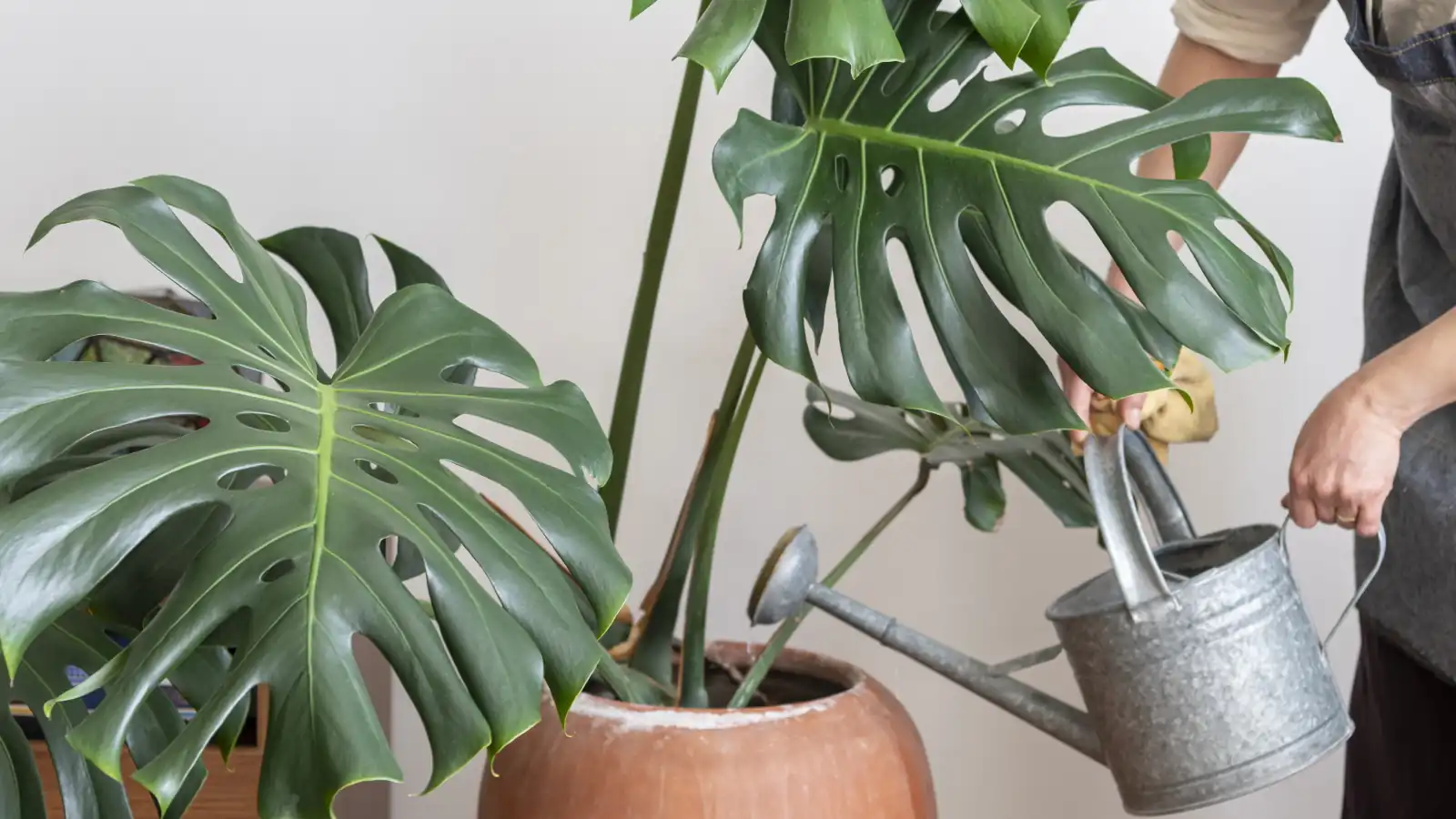
Why Fertilizer Affects Leaf Size
In the wild, Monstera deliciosa grows in the rich forest floor of Central America, where decaying organic matter constantly replenishes soil nutrients. In a pot indoors, that replenishment stops after the first few months — the initial fertilizer charge in your potting mix gets used up, and growth stalls. Each new leaf the plant produces has less raw material to work with, so it comes out smaller.
The three macronutrients in every fertilizer label (N-P-K) each play a specific role:
Nitrogen (N) drives leaf production and chlorophyll synthesis. It is the single biggest factor in whether new leaves come out large or small. When nitrogen is low, the plant redirects what it has toward survival, not growth.
Phosphorus (P) supports root development and cellular energy transfer. Less directly linked to leaf size, but without a healthy root system, the plant can’t absorb the nitrogen you’re providing.
Potassium (K) regulates water movement within cells, strengthens cell walls, and improves overall plant resilience against stress.
For leaf size, nitrogen is the variable that moves the needle most. But you need all three working together to see consistent results.
The Best NPK Ratio for Bigger Monstera Leaves
A 3-1-2 NPK ratio — or its proportional equivalents like 9-3-6 or 12-4-8 — is the collector consensus for Monstera leaf production. The nitrogen-heavy balance pushes leafy growth without over-loading the plant with phosphorus it doesn’t need mid-season. Growers chasing maximum leaf size consistently favour this ratio over balanced formulas.
If you can’t find a 3-1-2, a balanced 20-20-20 or 10-10-10 liquid fertilizer also works well, especially for beginners. It won’t push leaf size as aggressively, but it is far better than nothing and is easy to find at any garden centre.
| Fertilizer Type | NPK Ratio | Best For | How to Apply |
|---|---|---|---|
| Liquid fertilizer (3-1-2) | e.g. 9-3-6, 12-4-8 | Maximizing leaf size | Half-strength, every 2 weeks in growing season |
| Balanced liquid | 20-20-20 or 10-10-10 | General health & simplicity | Half-strength, every 3–4 weeks |
| Slow-release granules | Varies by brand | Low-maintenance feeding | Sprinkle at soil surface, every 3–4 months |
| Worm castings | ~1-0-0 | Organic microbial boost | Top dress or mix into soil at repotting |
Always dilute liquid fertilizers to half the recommended label rate. Monstera roots are sensitive — concentrated fertilizer salts are one of the most common causes of brown-tipped leaves and slow root damage that builds up over weeks before you notice it.
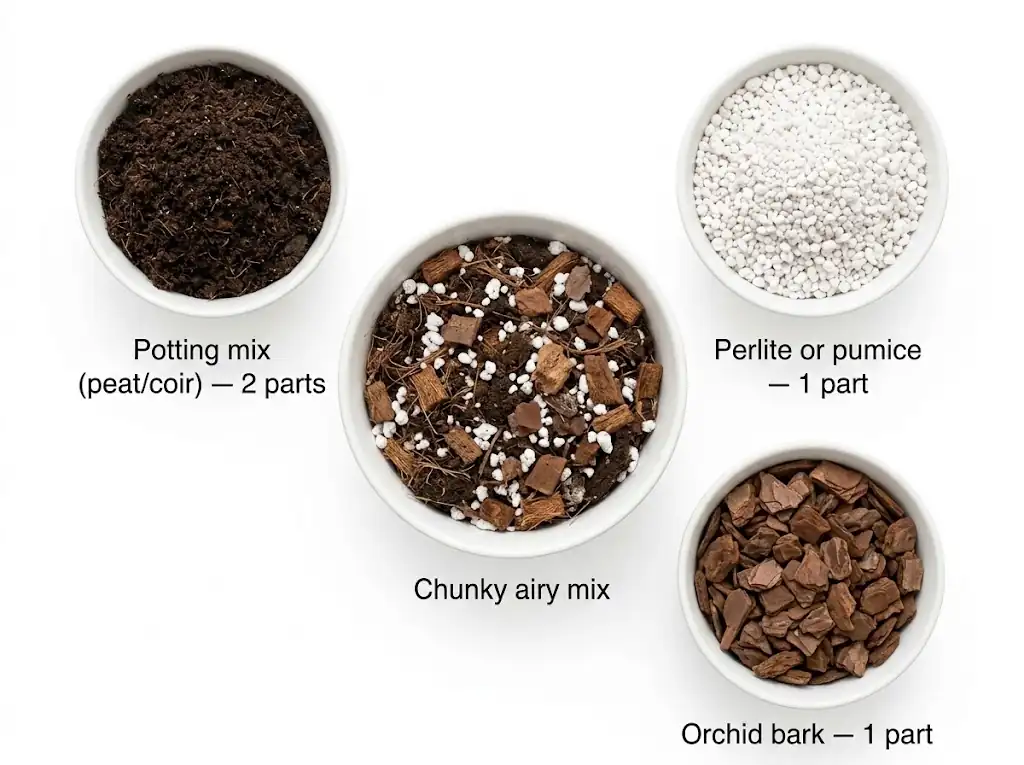
Good soil structure matters as much as what you feed. Roots need airflow and drainage to absorb nutrients effectively — compacted soil undermines even a solid fertilizer routine. See our guide to the best soil for Monstera.
Fertilizer Types Explained — and Which to Actually Buy
Not all fertilizers work the same way, and the format you choose affects both results and risk of damage. Here’s how the main types compare, with real products you can find online or at most garden centres.
Liquid Concentrate (Best for Leaf Size)
This is the go-to format for serious Monstera growers. You dilute it in water and apply it with each watering session. The advantage is precision — you control the exact dose every time, and the nutrients are immediately available to roots. The risk is over-application, which is why diluting to half-strength is non-negotiable.
Dyna-Gro Foliage Pro 9-3-6 is the most consistently recommended product across the plant collector community. The 9-3-6 NPK is the closest widely available product to the ideal 3-1-2 ratio, and it contains all 16 essential nutrients including calcium and magnesium — often missing from cheaper liquid fertilizers. How to use: ¼ teaspoon per gallon (3.8 L) of water for regular feeding, or ½ teaspoon per gallon at peak summer growth. Apply every 2–3 waterings.
Houseplant Resource Center Monstera Plant Food (5-2-3) is purpose-formulated for Monstera and similar aroids. It’s gentler than Dyna-Gro and harder to overapply, making it a good pick if you’ve had root burn issues in the past. How to use: 1 teaspoon per 2 cups (500 ml) of water, applied every 2 weeks during the growing season.
Miracle-Gro Tropical Houseplant Food (1-1-1) is the easiest to find at big-box stores. The NPK is very low, so it is extremely unlikely to cause burn — but it also won’t push aggressive leaf size gains. Best for beginners who want a simple, forgiving option. How to use: apply directly to moist soil — 1 pump per 946 ml of soil volume — every week during spring and summer.
Dry Water-Soluble Powder (Best Value)
Powder fertilizers have a long shelf life and are more economical per application than liquid concentrates. You mix them with water before each feeding session.
Jack’s Classic All Purpose 20-20-20 is a balanced formula widely used by houseplant enthusiasts. The 20-20-20 NPK is high concentration, so diluting to half or even quarter strength is important for Monstera. How to use: ¼ teaspoon per gallon of water at half the label strength. Apply every 2–3 weeks in the growing season.
Slow-Release Granules (Best for Convenience)
Granules are coated pellets that release nutrients gradually over 3–4 months with each watering. They are low-effort and low-risk for beginners, but give you less control over dosage and don’t let you adjust feeding based on the plant’s growth phase.
Osmocote Smart-Release Plant Food (14-14-14) is the most well-known brand in this category. How to use: sprinkle approximately ½ teaspoon at the soil surface (not pressed into roots), roughly 2–3 cm from the stem. Water in lightly. Reapply every 4 months.
Organic Options (Lowest Risk, Slowest Results)
Organic fertilizers feed soil biology rather than delivering nutrients directly. They work slowly and gently, and almost cannot be over-applied — but don’t expect the same dramatic leaf-size response as a nitrogen-forward liquid.
Espoma Organic Indoor Plant Food (2-2-2) and worm castings (top-dressed around the soil surface) are the most common organic approaches. Worm castings can be mixed into potting mix at repotting time for a slow-release organic base that you then supplement with liquid feeding during the growing season.
| Product | Type | NPK | Difficulty | Best For |
|---|---|---|---|---|
| Dyna-Gro Foliage Pro | Liquid concentrate | 9-3-6 | Intermediate | Maximum leaf size |
| HRC Monstera Plant Food | Liquid | 5-2-3 | Beginner | Monsteras specifically, low burn risk |
| Miracle-Gro Tropical | Liquid | 1-1-1 | Beginner | Set-and-forget simplicity |
| Jack’s Classic 20-20-20 | Dry powder | 20-20-20 | Intermediate | Value, long shelf life |
| Osmocote 14-14-14 | Slow-release granules | 14-14-14 | Beginner | Busy plant owners |
| Espoma Organic 2-2-2 | Organic liquid | 2-2-2 | Beginner | Organic-only growers |
| Worm castings | Organic top dress | ~1-0-0 | Beginner | Soil amendment at repotting |
When to Fertilize Your Monstera
Timing is straightforward once you understand the growth cycle:
Spring and summer (active growing season): fertilize every two weeks with a half-strength liquid fertilizer. This is when your Monstera is actively pushing new leaves — feeding is most effective during this window.
Fall: taper off. Feed once a month at most, and only if you’re still seeing active growth.
Winter: stop entirely. Monstera growth slows dramatically in lower light and cooler temperatures. Fertilizer applied to a dormant plant sits in the soil and accumulates as salt — causing root burn without any growth benefit to show for it.
Rule of thumb: If your Monstera isn’t pushing a new leaf, don’t fertilize. Nutrients are only useful when the plant is actively metabolizing them.
One timing mistake many growers make: fertilizing immediately after repotting. Fresh potting mix already contains a nutrient charge, and disturbed roots cannot handle the added salt load. Wait at least 4–6 weeks before resuming a feeding schedule after any repot. Our guide on when to repot Monstera deliciosa covers post-repot care in detail.
How to Apply Fertilizer Without Burning Roots
- Water thoroughly first. Moisten the soil with plain water and let it drain before adding any fertilizer. Never apply fertilizer into dry soil — the concentrated solution burns roots far more easily when there is no moisture buffer.
- Mix to half-strength. Dilute your liquid fertilizer to half the label rate in your watering can.
- Pour evenly over the soil until liquid runs out the drainage holes.
- Discard the runoff. Don’t let the plant sit in fertilizer water in a saucer.
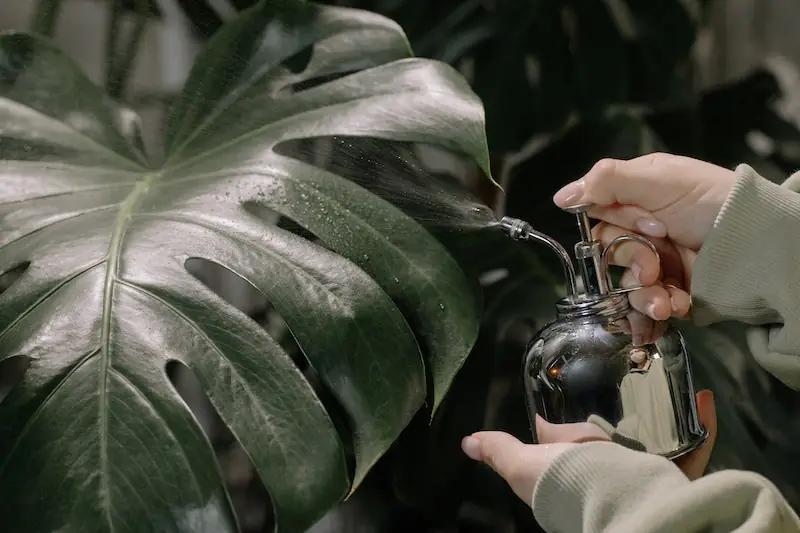
- Wipe leaves afterward if any fertilizer splashed on them — residue can cause spotting.
For slow-release granules: scatter a small amount at the soil surface, roughly 2–3 cm from the stem, and water them in. Don’t press them into the root zone.
The water quality you use matters here too. Hard tap water high in calcium and magnesium can interact with fertilizer and accelerate salt build-up in the soil. If you’re seeing white crusty deposits forming on your soil surface, switching to filtered or rain water can help — see our full guide on best water for Monstera.
Signs You’re Fertilizing Correctly — and Signs You’re Not
Healthy feeding looks like this:
- Each new leaf is the same size or larger than the previous one
- Leaves unfurl with clear fenestrations (splits and holes) at mature size
- Rich, deep green colour throughout — not pale or washed out
Signs of deficiency:
- New leaves emerge small and stay small (typically nitrogen)
- Pale yellow or light-green colour on older leaves (nitrogen)
- Purple tinting on the undersides of leaves (phosphorus)
- Stunted growth despite good light and regular watering
Signs of over-fertilization:
- Brown leaf tips or edges that appeared suddenly and spread
- White crust forming on the soil surface
- Wilting despite moist soil (salt damage to roots)
- Weak or scorched-looking new growth
| Symptom | Likely Cause | Fix |
|---|---|---|
| Yellowing older leaves | Nitrogen deficiency | Feed every 2 weeks, spring–summer |
| Small leaves, little or no fenestration | Low nutrients + low light | Fertilize + move to a brighter position |
| Brown tips across all leaves | Over-fertilization / salt build-up | Flush soil with plain water 3× in a row |
| Purple leaf undersides | Phosphorus deficiency | Switch to a balanced NPK |
| Mushy or brown new growth | Root burn from over-fertilization | Flush thoroughly, pause feeding 4–6 weeks |
Flushing is simple: water with plain (no fertilizer) water until it runs freely from the drainage holes, let it drain fully, and repeat two more times in the same session. This dissolves and removes accumulated salts. For persistent over-fertilization damage, Monstera Plant Resource’s reversal guide has a useful step-by-step.
What Else Drives Leaf Size (Fertilizer Is Only Part of It)
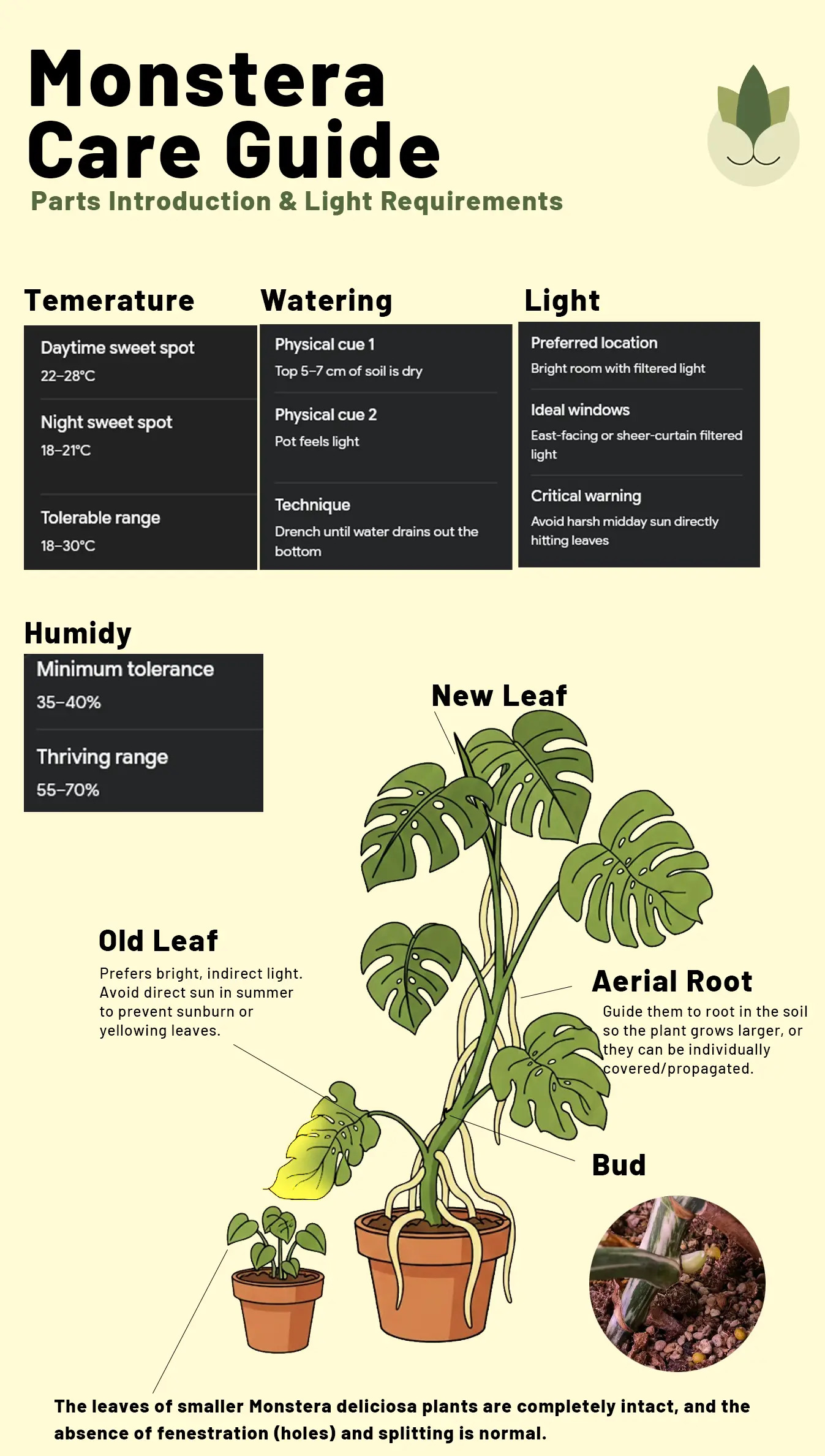
Fertilizer cannot compensate for poor light. If your Monstera is sitting in a dim corner, even a perfect NPK regime won’t produce big leaves — the plant simply won’t have enough energy to build them. Bright indirect light, ideally 2,000–5,000 lux, is the baseline for growth where fertilizer actually makes a visible difference. Check our Monstera light requirements guide to make sure you’re in the right range — and if you’re growing in a darker room, our Monstera grow light guide covers practical supplemental lighting setups.
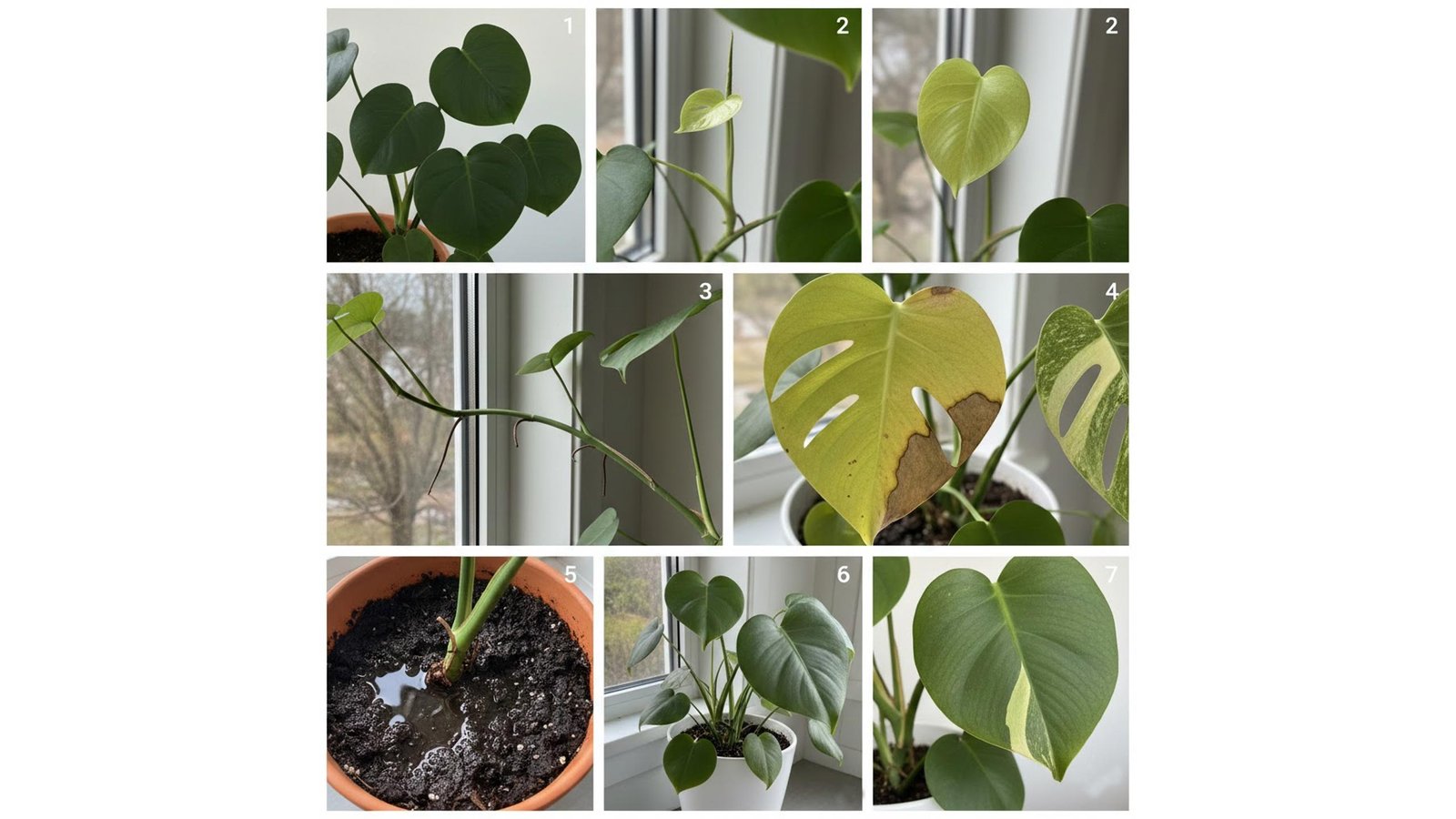
Small leaves with missing fenestration are often a light problem before they’re a fertilizer problem. Solve the light first.
Three other factors that combine with fertilizer to drive leaf size:
Soil aeration. Compacted or waterlogged soil blocks roots from absorbing nutrients even when they’re present. An airy aroid mix with bark, perlite, and chunky coco coir keeps the root zone oxygenated. Dense standard potting mix undermines even a solid fertilizer routine.
Pot size. A severely root-bound Monstera in a too-small pot cannot produce big leaves no matter how much you feed it. If you’re seeing roots circling the drainage holes or pushing up through the soil surface, prioritize repotting before ramping up fertilizer.
Moss poles. Monsteras with aerial roots anchored to a vertical support consistently produce larger leaves than those left to trail or sprawl. The climbing habit triggers a maturation response — the plant allocates energy toward bigger, more fenestrated leaves as it climbs. If you want maximum leaf impact, a moss pole is worth the investment alongside your fertilizer routine.
Key Takeaways
Use a 3-1-2 NPK liquid fertilizer at half strength every two weeks during spring and summer. A balanced 20-20-20 is an easy and effective alternative if 3-1-2 is hard to source.
Stop fertilizing in winter. Nutrients applied to a dormant plant accumulate as salt and cause root damage without delivering any growth.
Always water before you fertilize. Dry soil concentrates the solution and burns roots faster than almost anything else.
Small new leaves are usually a light problem first, not a fertilizer problem. Fix the light before adding more nutrients.
Flush the soil with plain water every one to two months to clear salt build-up, even if you’re diluting correctly and staying on schedule.
The full picture for bigger leaves combines good fertilizer with appropriate soil, a pot that isn’t too small, strong indirect light, and a moss pole if you’re serious about size.
If you’re new to Monstera care and want to cover all the fundamentals in one place, our complete Monstera care guide for beginners is the best starting point. And if you’re interested in other bold indoor plants alongside your Monstera, our roundup of houseplants with big leaves is worth a browse.
References
- Monstera Fertilizer Tips for Big, Healthy Leaves – Celebrated Nest
- Monstera Fertilizer Guide: How To, When To, What With and More – Little Flower Cottage
- Monstera Nutrients: Signs of Nutrient Excess, Deficiency & Solutions – Monsteraplant.net
- How to Fertilize Your Monstera Deliciosa to Keep It Thriving – Backyard Boss
- How to Reverse Overfertilization in Monsteras – Monstera Plant Resource
- Monstera deliciosa – Wikipedia