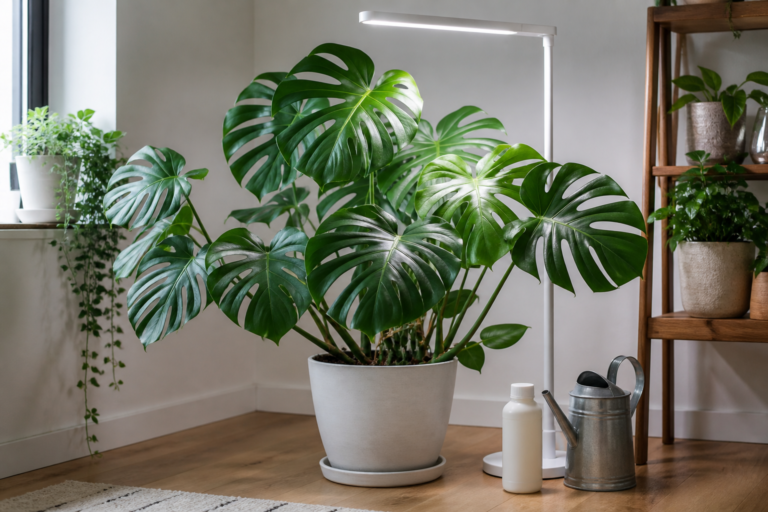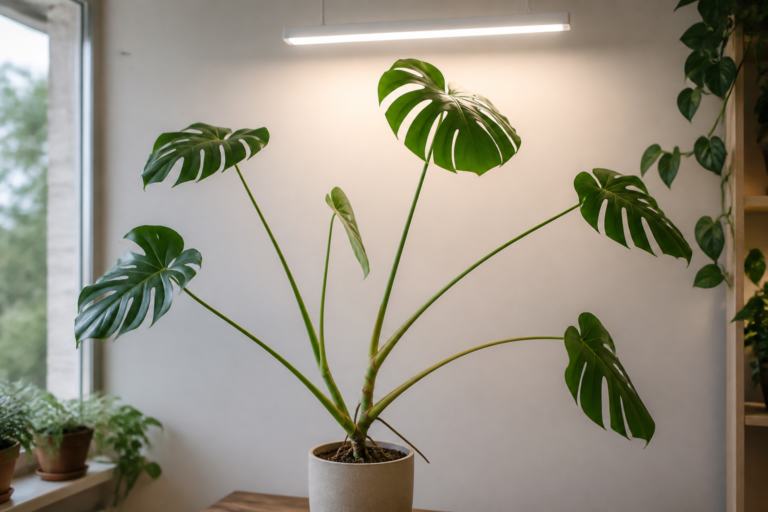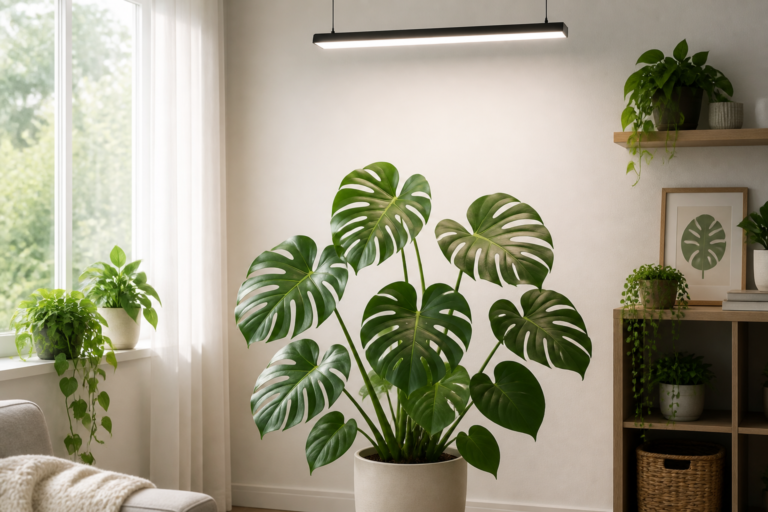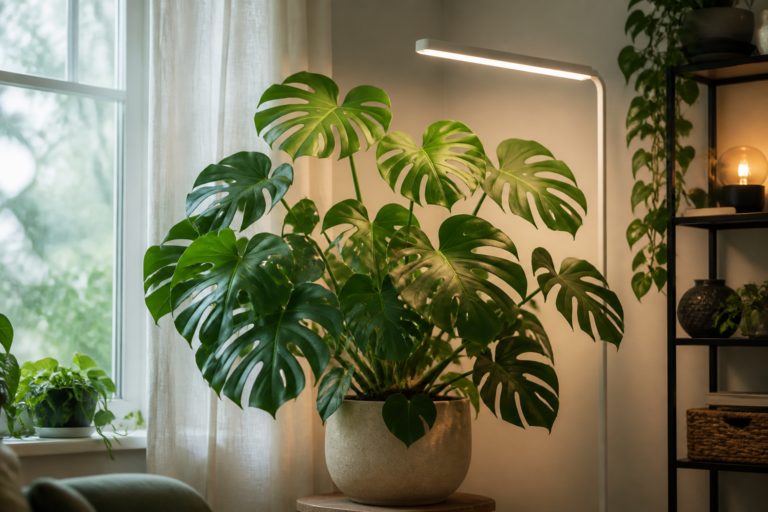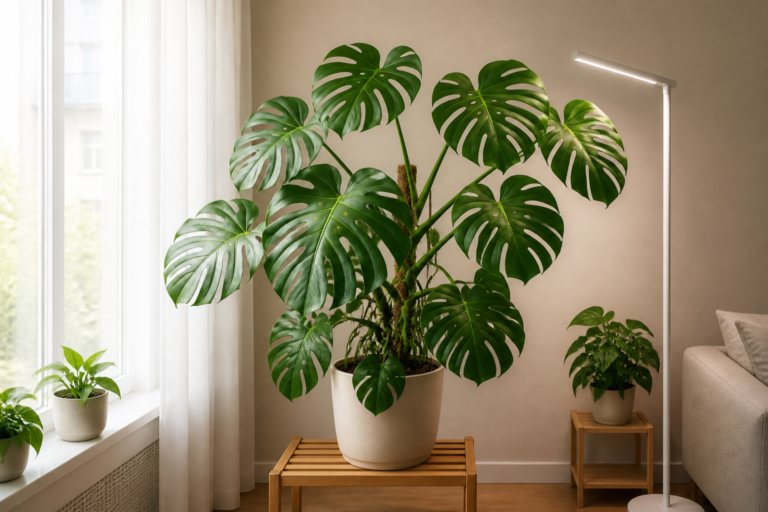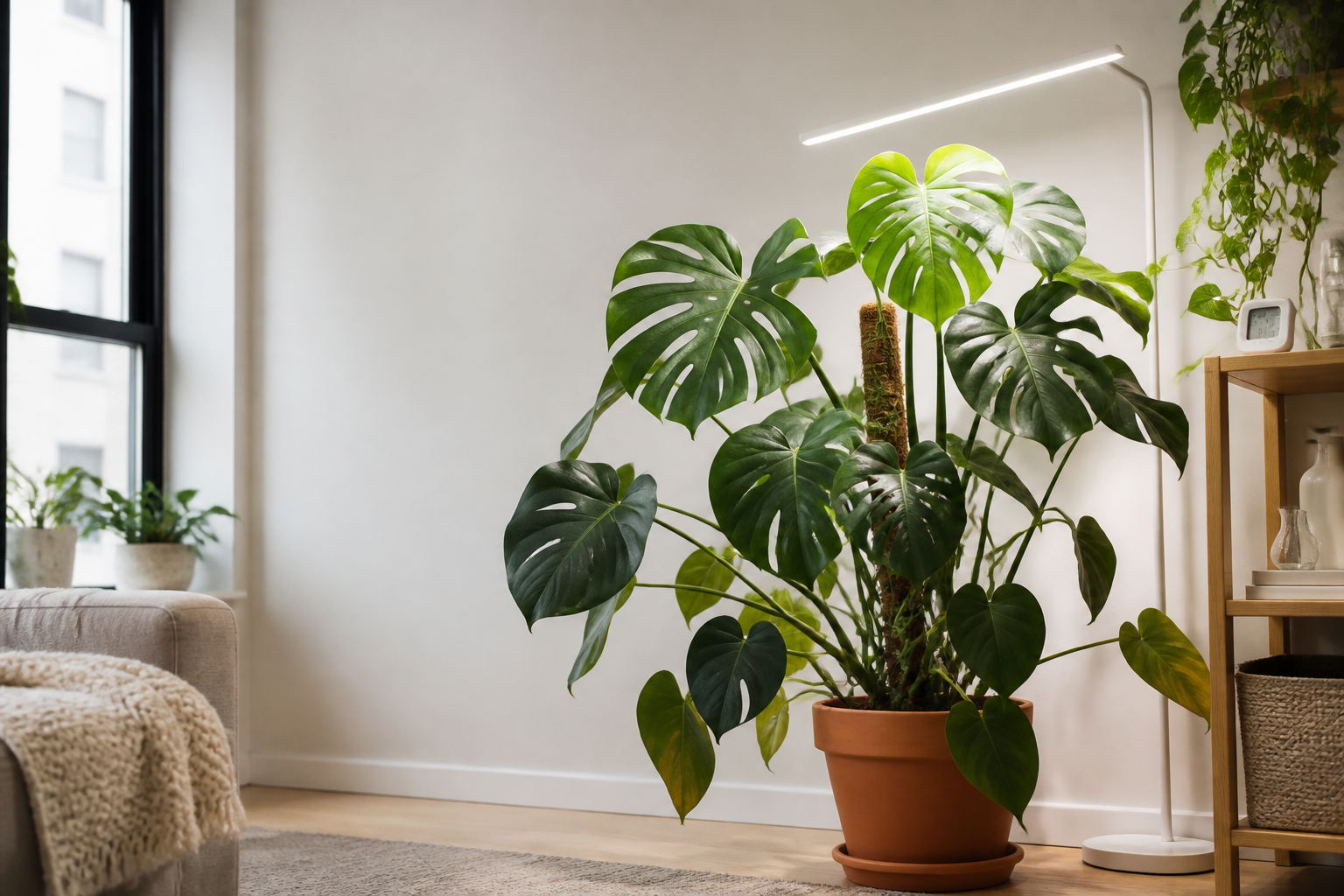
A Monstera may need a grow light when several signals point to too little usable light: new growth is stretched or smaller, stems lean toward one source, leaves look paler, and the pot stays wet longer than its normal rhythm. Check roots, watering, and plant maturity first; one symptom alone is not a verdict.
Your Monstera does not need a grow light merely because it is indoors, because winter arrived, or because a leaf lacks splits. A bright window may already be enough. The useful question is whether the leaves are receiving enough light for the plant's present goals and conditions—not whether the room looks bright to you.
Start by looking for a pattern over several weeks, then compare it with the room, the pot, and recent care changes. If the pattern still suggests a light gap, a grow light gives you a controllable way to supplement the plant rather than guessing. The broader Monstera grow light guide can then help you choose from a PPFD map, canopy coverage, distance, and a consistent daily schedule.
Table of Contents
- What are the clearest signs that a Monstera needs more light?
- Rule out look-alike problems before blaming the light
- Check the room before buying a grow light
- When is a grow light the sensible next step?
- How should you make the first adjustment?
- What changes should you expect after improving the light?
- Conclusion: use a grow light to solve an observed light gap
- Frequently Asked Questions
- References
What are the clearest signs that a Monstera needs more light?
The strongest case for supplemental light is a group of changes: longer spaces between nodes, a lean toward a window, slower or smaller new leaves, paler foliage, and slower drying after an otherwise unchanged watering routine. Low light commonly produces long, thin, stretched stems and wider node spacing because the plant is reaching toward its brightest source.1
For a climbing Monstera deliciosa, compare its newest growth with older growth from the same plant rather than comparing it with a large specimen online. Juvenile leaves naturally have fewer fenestrations, and a recently propagated, repotted, or stressed plant may pause before producing more ambitious foliage. A solid new leaf is useful context, but it is not proof that the plant needs a lamp.
| What you notice | Why light may be involved | What else to check first |
|---|---|---|
| Long, thin internodes or a pronounced lean | The plant may be directing growth toward its brightest side. | Rotate the pot only after noting the direction; check whether one side is shaded by furniture, a curtain, or another plant. |
| New leaves are smaller than recent leaves | Less light can limit the energy available for expansion. | Root crowding, a compact mix, a recent move, and immature growth can also affect size. |
| New growth is pale or the plant loses older shaded leaves | Insufficient light can reduce chlorophyll production and contribute to leaf drop.1 | Check roots, watering, pests, and whether yellowing begins in the lower or inner canopy. |
| The pot stays heavy much longer than before | With less light, growth and water use may slow. | Confirm the mix has not compacted and that drainage holes are open; do not compensate by watering on a calendar. |
| The leaf canopy has a darker side or weak lower leaves | The fixture or window may not cover the full plant. | Map where light actually falls across the leaves, not just near the pot. |
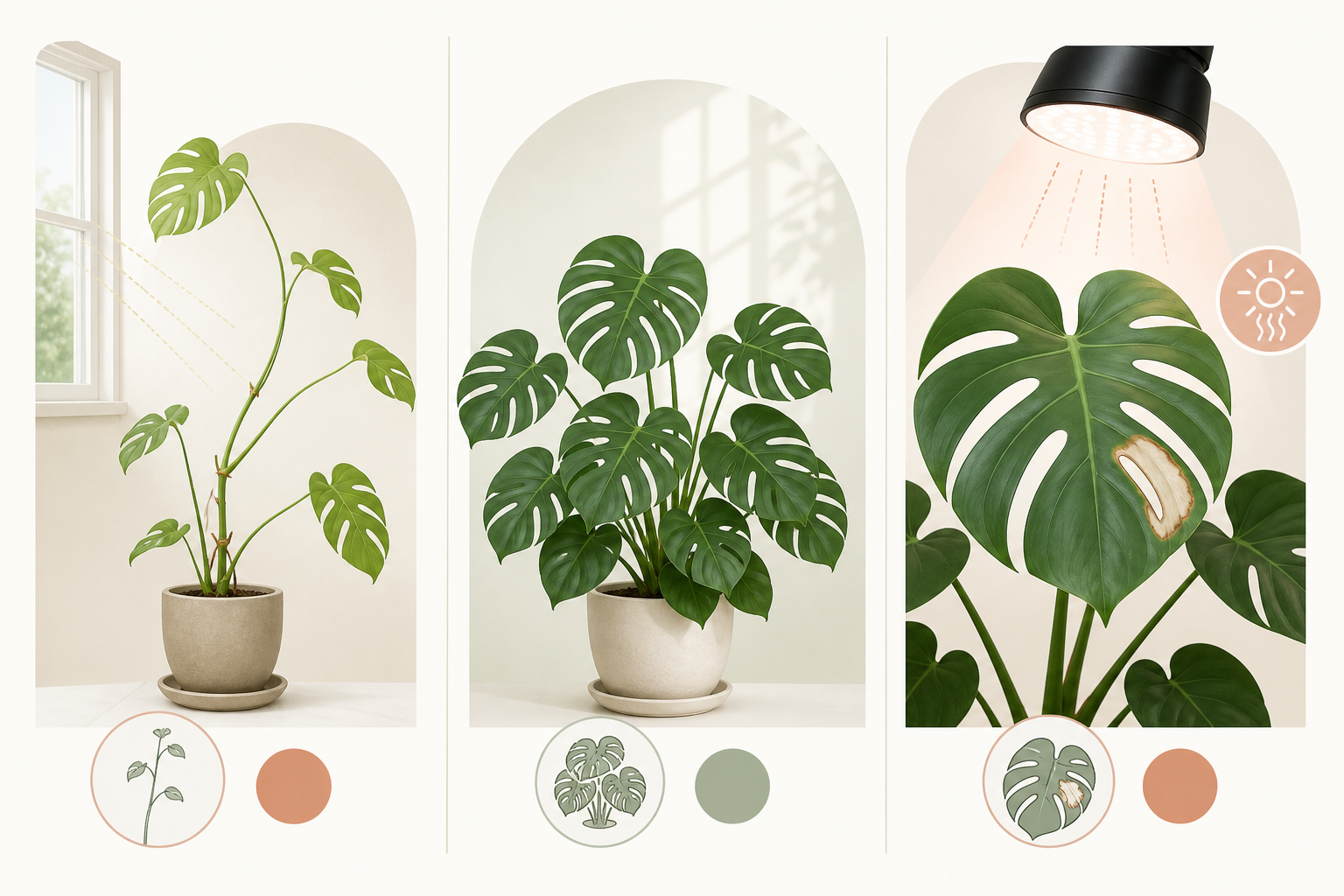
Compare the whole pattern—growth shape, colour, drying speed, and room conditions—before treating a grow light as the answer.
It also helps to check the opposite direction: excess light. Bleaching, scorch, or newly damaged tissue on the most exposed leaves calls for less intensity, more distance, or filtered sun—not a longer lighting period.2 The site's Monstera low-light and excess-light symptoms guide is useful when you need to separate a light shortage from a too-intense window or fixture.
Rule out look-alike problems before blaming the light
Low-light symptoms overlap with root-zone, nutrition, temperature, and watering problems, so inspect the plant before changing its lighting. University guidance cautions that poor root-zone aeration and nutrient or water deficits can resemble light-related symptoms.3
Begin with the pot. Lift it after watering and again before the next watering so you learn its usual weight change. Feel a little below the surface instead of judging only a dry crust. If the pot is staying saturated, smells sour, drains slowly, or has roots that are dark and soft rather than firm, correct the root-zone issue first. More light may eventually increase water use, but it cannot repair unhealthy roots by itself.
Then check the timing. Did the yellowing begin just after a repot, cold spell, pest treatment, move, or fertilizer change? Are only old leaves fading while the newest leaf looks normal? Those clues may tell a different story. Dust is worth removing too: it is a simple way to make the light already reaching the leaf surface more usable, while also making pests and damage easier to see.
Finally, check support and age. A young Monstera is expected to make smaller, unfenestrated leaves. A mature plant that sprawls without a stable vertical structure can also look less orderly even if the room is adequately bright. For watering, substrate, repotting, and a fuller diagnostic routine, use the complete indoor Monstera care guide alongside this light check.
Check the room before buying a grow light
You can often decide whether supplemental light is needed by observing the plant's exact position through a normal day. Window direction, obstructions, season, the distance from glass, and how far the foliage sits into the room matter more than whether the room feels sunny at noon.
Spend one clear or typical cloudy day noticing where soft, usable brightness reaches the leaf canopy. A Monstera beside a large bright window may have no need for a grow light; a Monstera three metres into the same room may receive dramatically less. Nearby buildings, deep balconies, blinds, trees, and a north-facing exposure can make that gap larger. In winter, the available daylight may also shorten or weaken without anything being wrong with the plant.
Use a simple, repeatable check rather than an app number that cannot be calibrated. At the leaf level, a soft but visible hand shadow suggests more useful ambient light than a barely perceptible one. Look at several leaves, especially the newest and the lower or farthest leaves. A big Monstera can outgrow the coverage it had when it was smaller.
Make a small observation note for two or three weeks: date, weather or season, window position, soil weight, new-leaf size, and which direction the stem leans. This protects you from reacting to one slow week. It also gives you a baseline if you later add a light and want to know whether the adjustment helped.
When is a grow light the sensible next step?
A grow light is a sensible next step when the room cannot provide consistent bright, indirect-equivalent light at the leaves and several low-light clues persist after root health and care conditions have been checked. It is especially practical for a deep apartment room, a shaded window, a winter setup, or a large canopy whose far side no longer receives enough light.
Choose the fixture from the area it must cover and the output it delivers at leaf level—not from wattage alone. A bulb may suit one compact plant, while a bar or panel can cover a wider canopy; each needs to be placed according to its own manufacturer instructions and published PPFD map. That map is more useful than a single centre-point claim because it shows how light changes across a real growing area.
You do not need to rush into a light if the plant is making firm, normally coloured new leaves, drying at its usual pace, and receiving ample natural brightness. Equally, do not expect a lamp to turn a juvenile leaf into a mature one on command. It is one part of a system that includes roots, temperature, watering, nutrition, and the plant's stage of growth.
If the plant is already climbing but lacks a stable direction, pairing the light assessment with climbing Monstera support can make the next growth cycle easier to read. A support does not replace light or guarantee larger leaves; it simply gives a climbing plant a steadier vertical structure while you observe its response.
How should you make the first adjustment?
Make one conservative change at a time: either improve the window position, or add a grow light at the fixture's recommended starting distance and a consistent timer. Changing distance, dimming, hours, watering, and fertilizer all at once makes it impossible to learn which change helped—or caused stress.
If you add a light, begin by following the fixture's electrical, mounting, and distance instructions. Measure from the emitting surface to the upper leaf canopy, then make sure the beam reaches more than the top centre leaf. For a large or uneven plant, move around the pot and check whether the lower and outer leaves are being missed. Keep cables, fixtures, and water safely separated, and use equipment rated for the room and mounting method.
A timer removes one variable. Extension guidance commonly uses roughly 12–14 total light hours for foliage houseplants and recommends monitoring plant growth before fine-tuning.1 That is a starting framework, not a fixed prescription for every home: natural daylight, fixture output, and seasonal conditions change the total the plant receives. Preserve a consistent dark period, and avoid leaving a light on around the clock.
Watch the response for fresh growth rather than expecting old leaves to repair. If the newest exposed leaf begins to bleach, scorch, or develop fresh dry patches, increase the distance, dim the fixture if possible, or shorten the period. If the plant continues to stretch toward a single source, check canopy coverage and position before simply increasing the number of hours. Iowa State's troubleshooting guidance similarly recommends matching the adjustment to the observed symptom and monitoring over the following weeks.2
What changes should you expect after improving the light?
The most meaningful improvements appear in new growth and in a steadier care rhythm, not as instant changes to existing leaves. Over several weeks or the next active growth cycle, you may see a more upright growth direction, firmer colour in new leaves, less exaggerated node spacing, and a return to a more predictable drying pace.
Progress is not always fast. A Monstera may be recovering from a repot, adapting to a new season, or allocating energy below the surface before it produces a new leaf. Variegated plants also have less green tissue available to collect light, so change intensity with extra care and read the pale sectors for stress. Never use a lamp's presence as a reason to water or fertilize more automatically; let the pot weight, root condition, new growth, and product instructions guide those decisions.
If the pattern does not change after several weeks, revisit the setup in order: Is the light reaching the actual canopy? Is the fixture at the recommended distance? Are roots and substrate healthy? Is the plant cold, pest-affected, or overdue for support? This measured sequence is much more reliable than repeatedly moving the lamp closer.
Conclusion: use a grow light to solve an observed light gap
Your Monstera probably needs a grow light when its room conditions and several plant signals agree that the canopy is underlit—not simply because it is growing slowly or has one imperfect leaf. Check light at leaf level, rule out roots and watering problems, make one measured change, and use new growth to judge the result.
If the room is genuinely dim, a properly positioned, timer-controlled grow light can make the light environment more consistent. If the room is already bright and the plant's new growth is healthy, keep observing before buying another piece of equipment. That small pause usually leads to better care decisions.
Frequently Asked Questions
Does a Monstera need a grow light in winter?
Not automatically. Add supplemental light when winter reduces the usable light at the leaves and you see a continuing group of low-light signals, such as stretching, smaller new growth, and a slower drying rhythm. A bright window may still be sufficient; assess the plant's position, not the season alone.
Can a Monstera be too close to a grow light?
Yes. A fixture that is too close or too intense can bleach or scorch the most exposed foliage. Follow the fixture's distance guidance, begin conservatively, and adjust one lever at a time. Fresh damage on upper leaves is a reason to increase distance or reduce intensity, not to wait for the next watering.
Are smaller Monstera leaves always caused by low light?
No. Light can contribute, but leaf size is also influenced by plant age, root health, support, recent stress, cultivar, and the growing season. Compare several new leaves over time and inspect the roots and potting mix before treating a grow light as the solution.
Should I water my Monstera more after adding a grow light?
Do not increase water on a schedule. Better light can change how quickly a plant uses water, but drying speed also depends on the pot, substrate, temperature, humidity, and root condition. Check pot weight and the root zone, then adjust only when the plant's actual drying pattern changes.
References
[1] University of Minnesota Extension. “Lighting for indoor plants and starting seeds.” 2026.
[2] Iowa State University Extension and Outreach. “How to Determine How Much Supplemental Light to Provide for Indoor Plants.” 2026.
[3] UC Statewide Integrated Pest Management Program. “High and Low Light.” 2026.