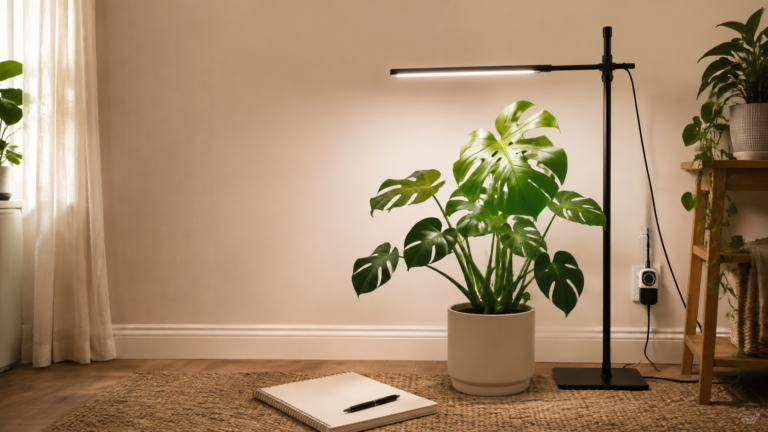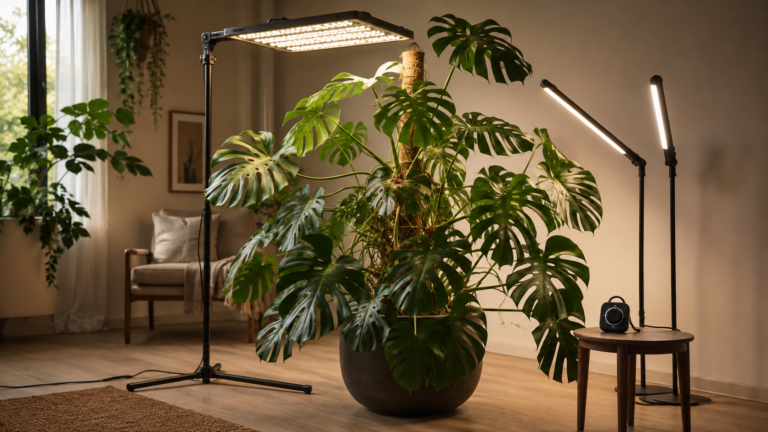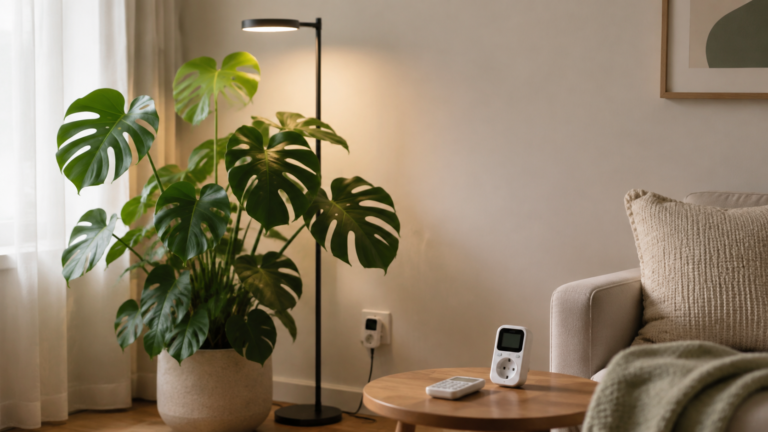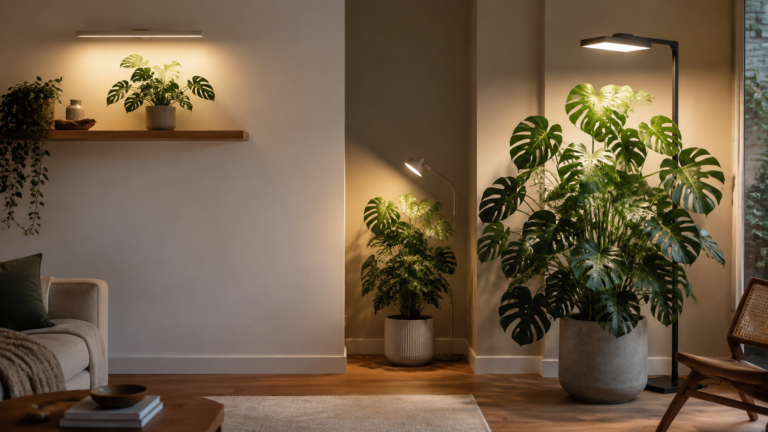
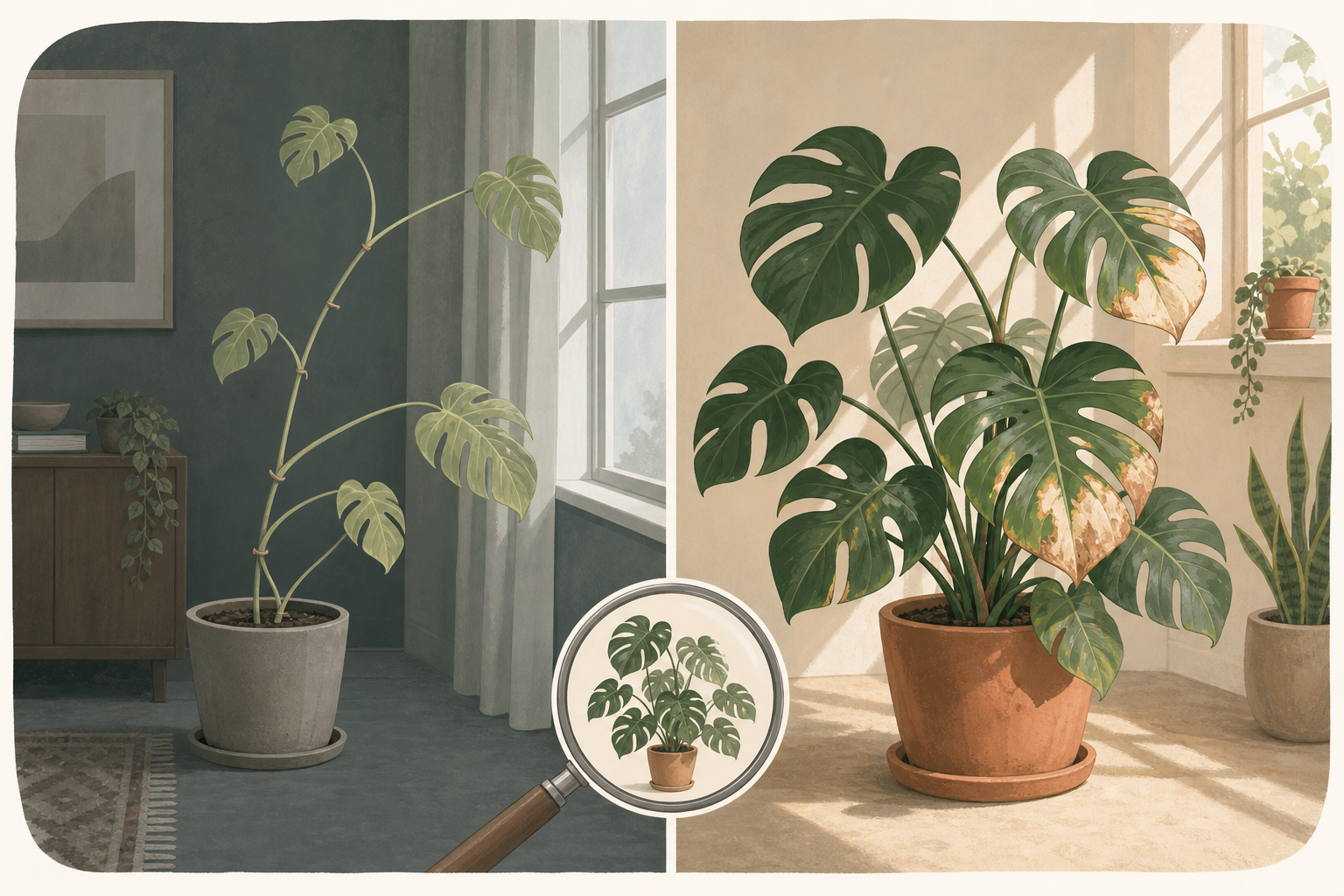
Monstera light requirements are enough even, usable light for steady new growth—not one fixed window direction or number of hours. Gradual whole-plant stretching points more strongly to low light; fresh pale or crispy injury on the exposed side points more strongly to excess light. Check the pattern, the light path, and recent changes before moving the plant.
Low light and too much light can both coincide with yellowing, leaf drop, slow growth, or a plant that looks thirsty. That overlap is why “more light” is not a safe automatic fix. A Monstera in a dim corner may need more usable light; a Monstera with fresh pale patches after a move into direct afternoon sun needs relief, not a stronger lamp.
This guide separates those two patterns, shows the look-alikes worth checking, and helps you make one measured adjustment at a time. The goal is not maximum brightness. It is a stable setup in which the next leaf gives you useful feedback.
Table of Contents
- What are Monstera light requirements indoors?
- Use a three-step diagnosis before moving your Monstera
- Why yellowing and brown edges do not settle the diagnosis
- Check the room and root zone before changing the light
- Fix a low-light Monstera without creating a high-light problem
- Fix excess-light stress without overcorrecting
- Track new growth and separate light from structural leaning
- Conclusion: aim for a stable middle, not maximum brightness
- Frequently Asked Questions
- References
What are Monstera light requirements indoors?
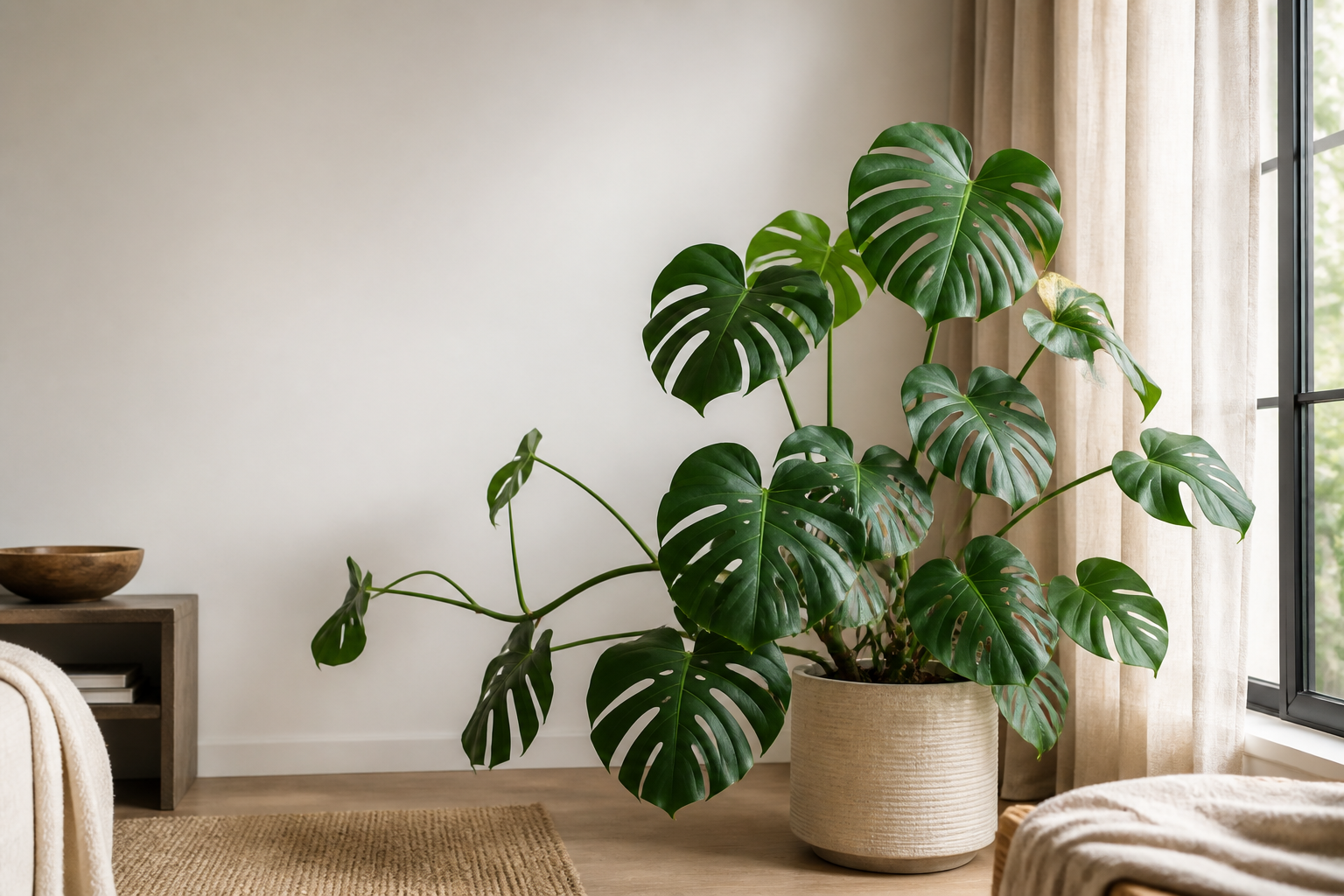
Indoors, a Monstera needs enough light to support its active leaves without exposing an unacclimated canopy to a harsh, concentrated beam. The practical test is not whether a room looks bright to you. It is whether new growth stays reasonably sturdy, the plant uses water predictably, and the exposed leaves avoid fresh bleaching or scorch.
Monstera deliciosa grows best under filtered or light shade outdoors, while intense sun can scorch foliage. 1 Indoor rooms vary too much for one universal placement rule: a window can be gentle in winter, intense in summer, blocked by trees, or made harsher by reflective surfaces. Treat “bright indirect light” as a starting condition to observe, not a diagnosis to repeat.
Use a three-step diagnosis before moving your Monstera
The fastest reliable diagnosis combines where the symptom appears, how the newest growth is built, and what changed in the room. One yellow leaf alone is not enough evidence.
- Map the damage. Pale, tan, or papery patches concentrated on window-facing or lamp-facing leaves are more consistent with excess exposure. Whole-plant changes are more consistent with a light shortage or a root-zone problem.
- Compare the newest two or three internodes. Longer, thinner growth, wider gaps between nodes, and a consistent lean toward one source point toward low usable light. A single solid leaf does not prove the case; plant age, recent propagation, and support also affect leaf form.
- Check the timeline. Low-light patterns usually build over weeks or a dim season. High-light injury often follows an abrupt move, a curtain change, a seasonal shift in direct sun, or a leaf growing closer to a lamp.
| What you notice | More consistent with low light | More consistent with too much light | Check before deciding |
|---|---|---|---|
| Stem shape | Long, thin, widely spaced internodes; a lean toward one light source | Usually not the main sign | Compare the newest two or three internodes with older growth. |
| Leaf color | Whole new leaves may look less green or the plant may gradually look sparse | Pale or bleached areas concentrate on the exposed face | Note whether color change began after a move or seasonal sun shift. |
| Brown tissue | Not a primary low-light clue; may follow a wet root problem | Crisp tan or brown patches on sun-facing leaves | Look for a matching sunbeam or lamp footprint. |
| Potting mix | Often stays wet longer as growth and water use slow | May dry unusually fast in a hot, bright spot | Check moisture at root depth, not only the surface. |
| Timing | Builds gradually over weeks or through a dim season | Can appear after a sudden bright exposure; damage may be localized | Write down recent changes in location, curtains, lamp height, or weather. |
A documented grower case: the move can be the problem
One community grower described propagating a leggy Monstera from a dark location, then placing new plants straight into a west-facing sunny position. Within days, the directly placed plants appeared sunburned, while cuttings kept in a less sunny location looked better. 4 This is one grower's report, not a universal trial or a schedule to copy. Its value is the sequence: a plant can show signs of low light and still be damaged by an abrupt jump in exposure.
Why yellowing and brown edges do not settle the diagnosis
Yellowing and brown edges are signals to investigate, not labels for a light problem. A plant short of light may grow slowly and use water more slowly, but high light, hot glass, root stress, water deficit, nutrient issues, pests, and normal aging can create overlapping symptoms. 2 3
Ask these questions before rebuilding the lighting setup:
- Where is the symptom? A lower, older leaf fading slowly is different from a fresh exposed leaf with a pale patch.
- What changed first? A bare west window, a new lamp, changed curtains, or a long cloudy spell gives the symptom context.
- What is the root zone doing? Constantly wet mix, a sour smell, compact substrate, or weak roots can imitate a low-light pattern because the plant cannot use water normally.
In real rooms, the revealing detail is often not a leaf color but the mismatch between the symptom and the exposure. If only the window-facing side is damaged while shaded leaves stay green, investigate light first. If yellowing is widespread and the pot remains heavy for a long time, investigate roots and watering before intensifying the light.
Check the room and root zone before changing the light
Watch the plant's actual light path on a clear day, then check its root zone at depth. Those two observations prevent the most common overcorrection: moving a stressed plant without knowing what is stressing it.
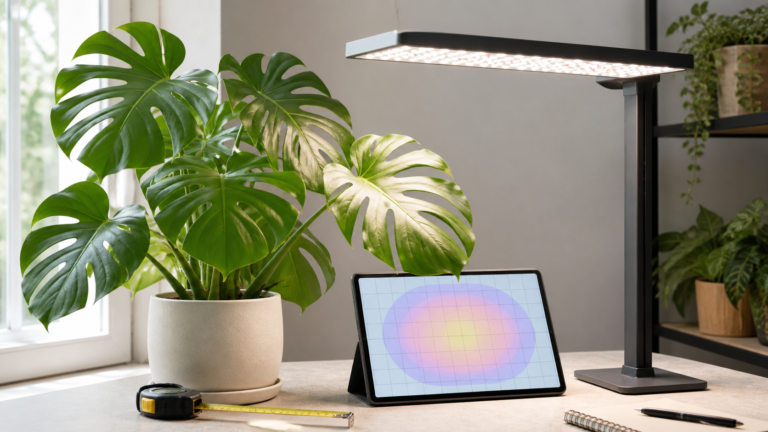
Stand where the leaves are and note when direct rays touch them. Record whether the path reaches one face of the canopy or the whole plant. If a grow light is involved, note its published hanging range, beam footprint, and whether the closest leaf has grown nearer since you installed it.
Then check the pot. In lower light, houseplants commonly grow more slowly and use less water, so an old watering rhythm can become excessive. 1 Feel below the surface rather than watering by calendar. If the mix stays heavy and wet, inspect drainage, pot size, and root health before increasing light. The airy Monstera soil mix guide can help you assess whether the substrate supports a dependable wet-to-dry cycle.
Finally, inspect both sides of several leaves for pests and inspect new growth before it unfurls. Root-zone aeration deficits, nutrient deficiency, and water deficit can resemble high- or low-light problems. 3 Use the complete indoor Monstera care guide when the light diagnosis still does not explain the full picture.
Fix a low-light Monstera without creating a high-light problem
Make the smallest useful light change, then let the next growth show whether it helped. A move closer to a bright window or a carefully set grow light is safer than shifting a dim-grown plant straight into a long, unfiltered midday beam.
Try a new position within the same room first. A sheer curtain can preserve brightness while reducing the strongest direct sun. If the room cannot provide enough usable light, set up a Monstera grow light from the fixture's coverage map, canopy distance, and a consistent daily period—not from wattage alone. Begin conservatively, keep the beam over the leaves rather than just the pot, and change one lever at a time. Iowa State Extension likewise recommends observing plant response rather than expecting one universal supplemental-light setting. 2
As light improves, do not automatically water more often. The plant may eventually use water faster, but the next decision should still come from the mix at root depth. Existing stretched stems will not shorten; success looks like sturdier new internodes, a more even lean, and healthier leaves that form after the change.
Fix excess-light stress without overcorrecting
Remove the damaging exposure while keeping the plant in a bright, usable environment. Moving it into a dark corner solves the immediate burn risk by creating a new low-light problem.
Move the plant farther from the glass, shift it out of the direct beam, or diffuse the sun with a sheer curtain. For a grow light, raise the fixture, lower its output if it has a dimmer, or correct a narrow hot spot so the nearest leaf is not receiving a disproportionate share of the light. Change distance, intensity, or timer—one at a time—so you can tell what helped.
Keep watering based on the mix, not on the appearance of the damaged leaf, and avoid a burst of fertilizer or a drastic repot while you are reading the plant's response. Existing bleached or crispy tissue will usually remain marked. Judge recovery by the absence of new pale patches and by later leaves emerging intact.
Track new growth and separate light from structural leaning
Use dated photos of the whole plant, the newest node, and the window or lamp position to turn a vague hunch into an observable comparison. Revisit the same views after the next leaf develops, then make another small adjustment only if a trend is clear.
For a corrected low-light setup, look for less extreme leaning, sturdier new internodes, and steadier new growth. For a corrected high-light setup, existing damage remains, but new leaves should avoid fresh bleaching or crisp areas. This is the same measured-observation approach recommended for supplemental indoor light. 2
Do not diagnose every lean as low light. If recent internodes are healthy but a large plant angles because one heavy stem lacks stability, that is a structure question after the light question has been checked. A climbing Monstera support can provide vertical stability for a climbing plant; it does not replace usable light or make a juvenile plant mature on demand.
Investigate beyond light if you see widespread yellowing with persistently wet mix, soft dark spots, pests, sudden collapse, or no new growth during an otherwise active period. Light is a powerful variable, but it does not explain every imperfect Monstera leaf.
Conclusion: aim for a stable middle, not maximum brightness
Low light usually shows up as a gradual whole-plant growth pattern. Too much light usually leaves a more localized exposure pattern, especially after a sudden change. Check new growth, the path of the light, the pot's drying behavior, and recent changes before acting. Then make one measured adjustment and judge it from future growth.
Frequently Asked Questions
Can a Monstera recover from too much light?
Yes. Existing bleached or crispy areas usually remain damaged, but the plant can resume healthy growth after the harsh exposure is removed and routine care stays stable. The next leaf is the clearest evidence that the new position is working.
Do pale Monstera leaves always mean too much light?
No. Pale foliage can reflect too little light, excess light, watering problems, nutrient issues, or root stress. Compare the color change with stem shape, exposure pattern, the recent timeline, and the potting mix before deciding.
Can brown edges be too much light or underwatering?
Either is possible. Crisp brown tissue that follows the path of direct sun or a strong lamp supports an exposure diagnosis. Dry mix, edge crisping across the plant, or a long gap between watering may point toward water stress instead. Check both the leaf pattern and the root-zone moisture.
Does a Monstera need a grow light in a low-light room?
It may. First confirm a whole-plant low-light pattern and rule out a wet, unhealthy root zone. If the room cannot provide enough usable light, add a fixture with coverage across the canopy and adjust it gradually from the plant's response.
Can I use a grow light for a Monstera that has sunburn?
Yes, but not as an immediate intensification. First remove the harsh direct exposure. If natural light is then inadequate, use an evenly positioned fixture conservatively and observe the next growth before increasing the setup.
Why is my Monstera leaning toward the window?
Leaning can mean the plant is orienting toward its strongest available light. Confirm that the newest internodes are also longer and thinner before concluding it needs more light; a heavy, unsupported plant can lean for structural reasons too.
References
- University of Minnesota Extension: Lighting for indoor plants and starting seeds — General guidance on indoor-light responses and observable signs of insufficient or excessive light.
- Iowa State University Extension and Outreach: How to Determine How Much Supplemental Light to Provide for Indoor Plants — How fixture output, distance, and plant response guide supplemental-light adjustments.
- UC Statewide Integrated Pest Management Program: High and Low Light — Why root-zone, water, and nutrient problems can resemble light-related symptoms.
- r/Monstera: What have I done — A documented grower report illustrating why a sudden change from low light to direct sun can complicate diagnosis; this is individual experience, not controlled evidence.