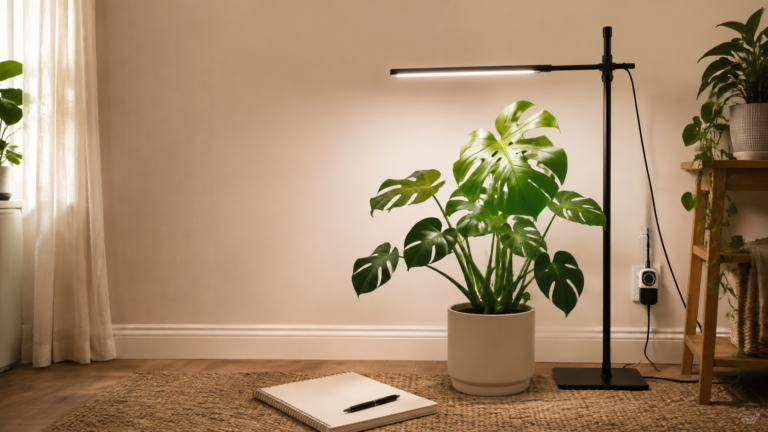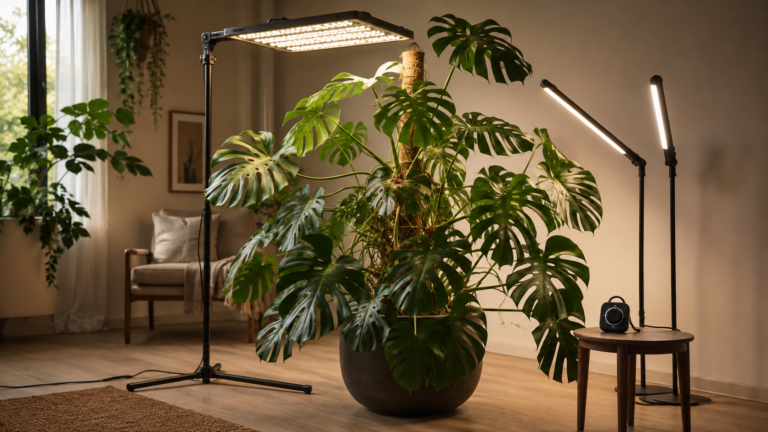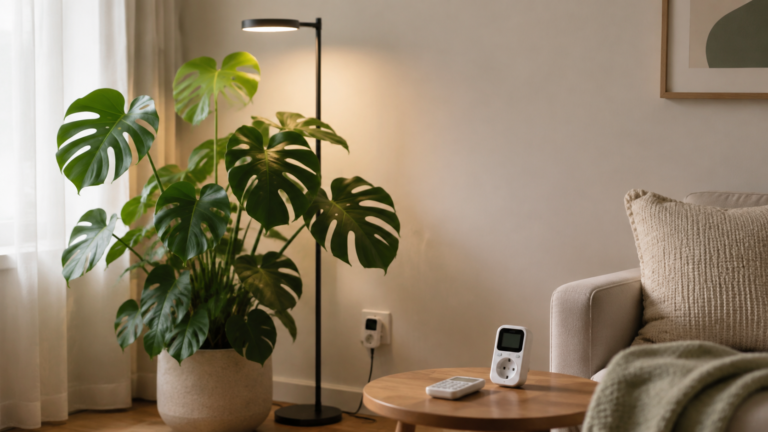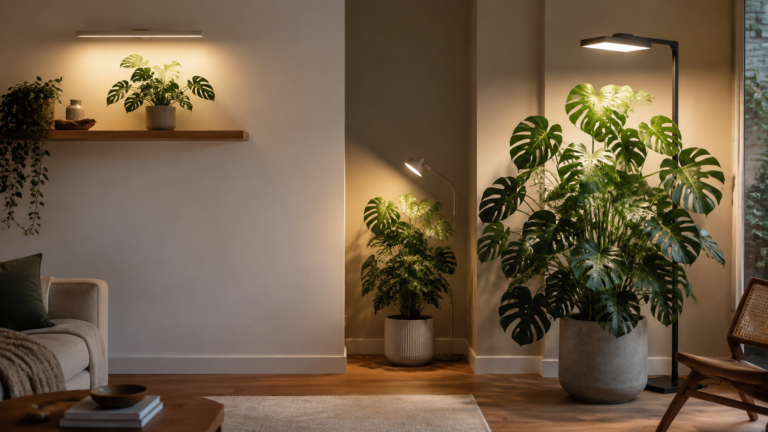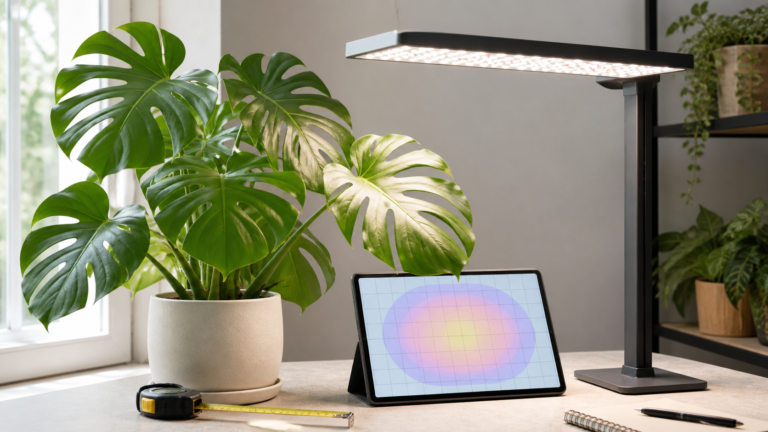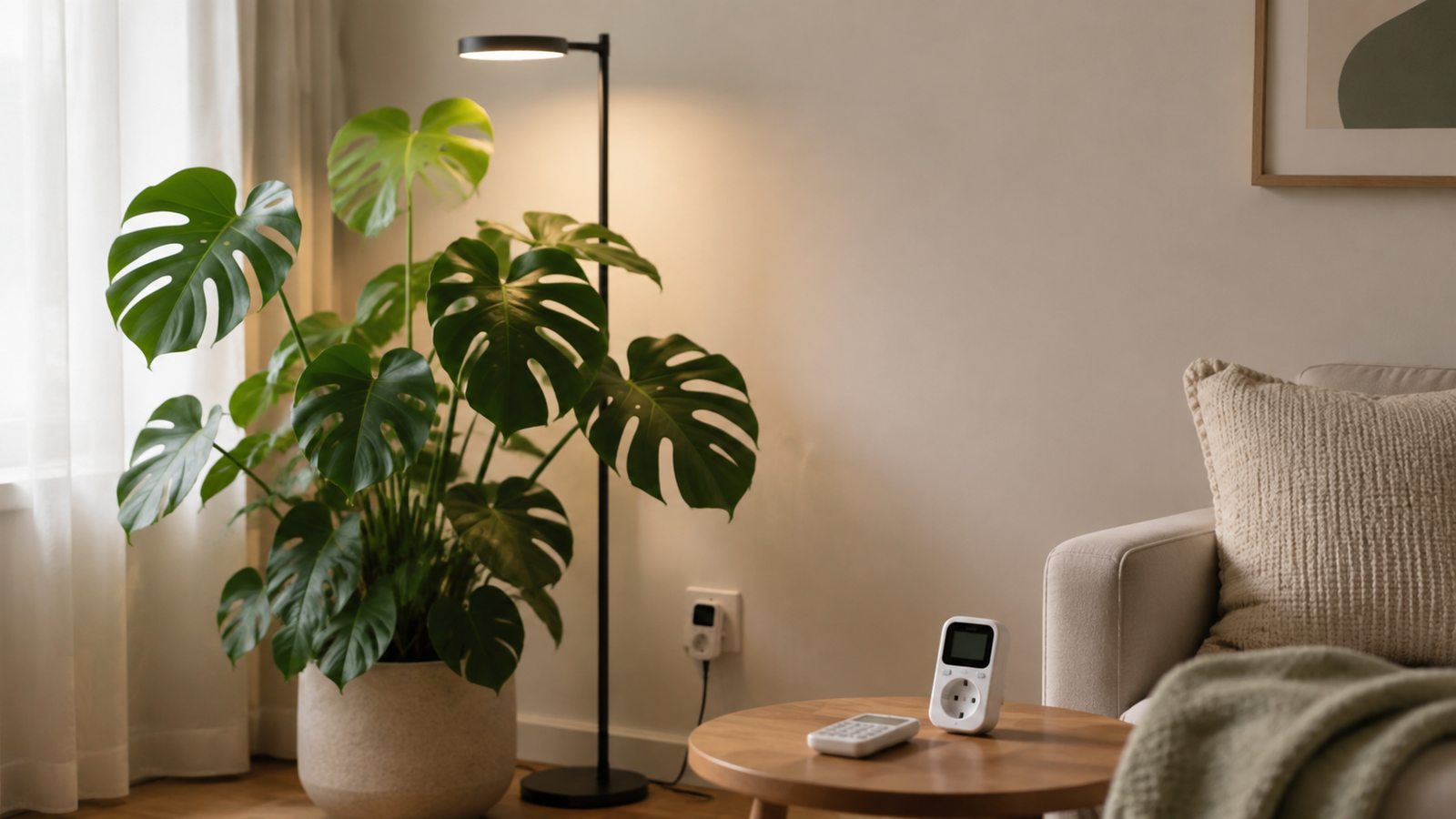
Running a Monstera grow light usually costs less than most household appliances, but the exact bill depends on the fixture's real watt draw, hours per day, and your all-in electricity rate. Convert watts to kilowatts, multiply by monthly hours, and multiply again by the rate on your utility bill.
Table of Contents
- What actually determines a Monstera grow-light's cost?
- How do you calculate monthly and annual cost?
- What do realistic wattage examples cost?
- How does a 12-hour versus 16-hour schedule change the bill?
- Does dimming or distance lower electricity use?
- What about timers, drivers, and standby draw?
- How do shelf, corner, and floor setups compare financially?
- How can plant response prevent overspending?
- Can brighter light change watering and fertilizer costs?
- What should you check before comparing fixtures?
- Conclusion: pay for useful coverage, not impressive wattage
- Frequently Asked Questions
- References
What actually determines a Monstera grow-light's cost?
The cost is driven by energy consumed over time, not by the fixture's advertised wattage alone. The important inputs are actual wall draw, daily operating hours, days in the billing period, and the all-in price per kilowatt-hour (kWh).
The U.S. Energy Information Administration distinguishes watts as power at a moment and watt-hours or kilowatt-hours as energy used over time.1 That distinction matters because a 30-watt lamp used for 14 hours can consume more electricity than a 60-watt lamp used for six hours. A timer, dimmer, and seasonal schedule can change the bill without changing the fixture.
Your real-world rate may include energy, delivery, taxes, and time-of-use pricing. Use the total variable rate from your bill when you want a household-budget estimate. If your utility uses tiers, calculate each block separately or use the marginal rate that applies to the extra kWh. Avoid substituting a national average for the number on your own bill.
Also check whether the label shows input watts or LED output. A driver can draw a little more than the diode rating, while a dimmed fixture may draw less. The most reliable number is a plug-in energy meter reading while the light is operating at the setting you intend to use.
How do you calculate monthly and annual cost?
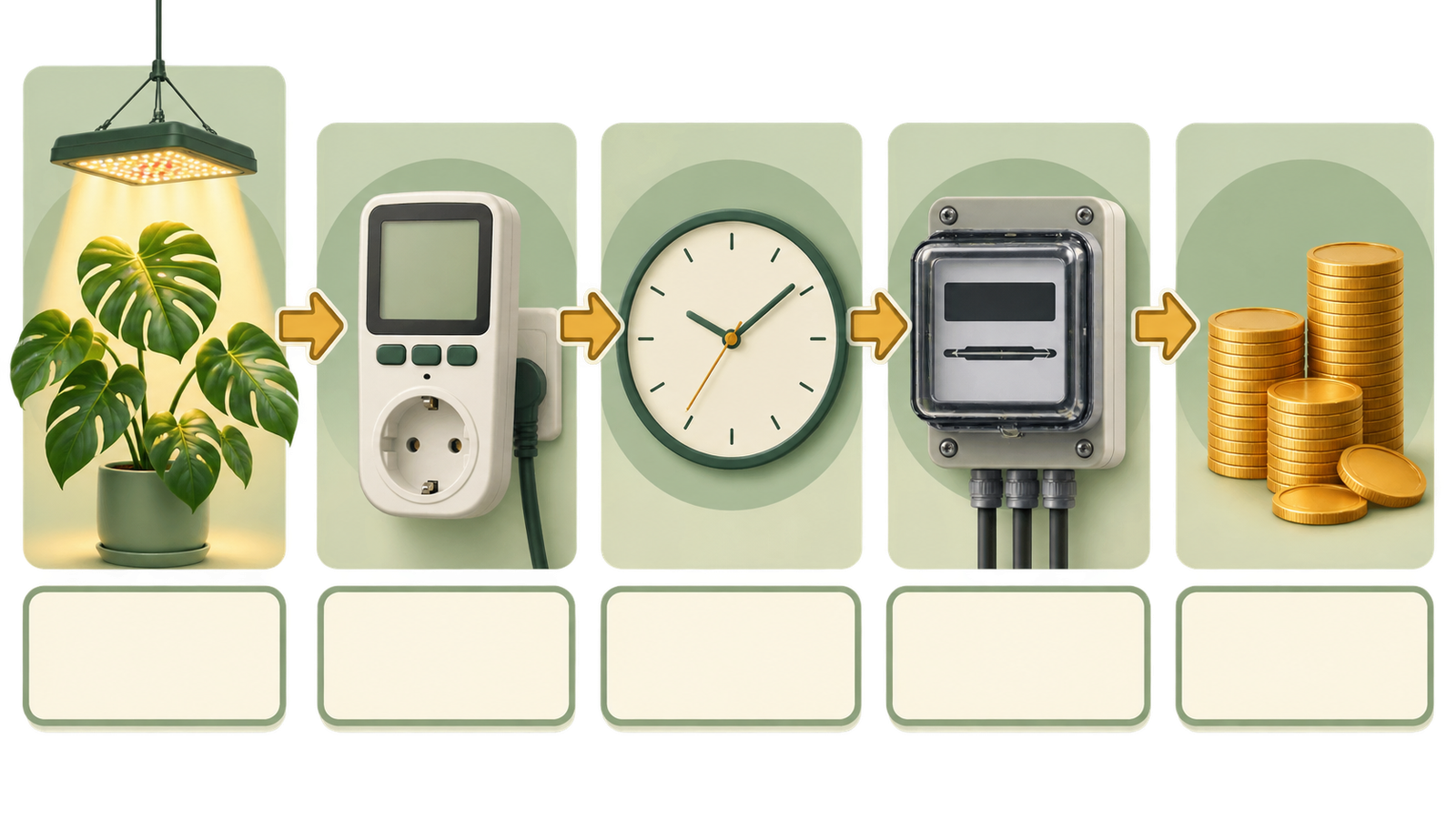
Use one formula and keep the units consistent: monthly cost = (watts ÷ 1,000) × hours per day × days per month × electricity rate per kWh. For an annual estimate, replace days per month with 365, or multiply a 30-day estimate by 12 for a quick budget.
For example, a 40-watt fixture running 12 hours daily for a 30-day month uses:
“text (40 ÷ 1,000) × 12 × 30 = 14.4 kWh per month “
At an illustrative rate of $0.15/kWh, that is $2.16 per month. At $0.30/kWh, it is $4.32 per month. Those rates are examples for the calculation, not a claim about what your utility charges.
For a year at the same schedule, the fixture uses 175.2 kWh. The annual energy cost would be $26.28 at $0.15/kWh or $52.56 at $0.30/kWh. If you use a seasonal schedule, calculate each season's hours and rate, then add the subtotals rather than assuming one schedule runs all year.
Write the calculation next to the fixture's model and dimmer setting. That small record helps you compare a cheaper-looking lamp that needs 16 hours with a higher-output lamp that can cover the canopy in 10 or 12 hours. The lower wattage is not automatically the lower-cost or better plant choice if it leaves key leaves under-lit.
What do realistic wattage examples cost?
The following examples show the scale of a single Monstera light at 12 hours per day and 30 days per month. They use illustrative rates of $0.15/kWh and $0.30/kWh so you can substitute your own rate.
| Actual draw | Monthly energy at 12 h/day | Cost at $0.15/kWh | Cost at $0.30/kWh | Typical use case |
|---|---|---|---|---|
| 20 W | 7.2 kWh | $1.08 | $2.16 | Small shelf plant or daylight fill |
| 40 W | 14.4 kWh | $2.16 | $4.32 | Medium canopy with a bar or bulb |
| 60 W | 21.6 kWh | $3.24 | $6.48 | Wider corner or compact floor plant |
| 100 W | 36.0 kWh | $5.40 | $10.80 | Broad panel for a larger canopy |
These are energy-only examples. A timer, smart plug, or meter may add a small purchase cost, and a driver can add a little standby draw. More importantly, a fixture that does not cover the full canopy may lead you to buy a second light, making the total system cost higher than the first lamp's wattage suggests.
Two 40-watt fixtures running together cost approximately twice one 40-watt fixture at the same hours. If the second source is used only for a dark season or a shaded edge, calculate that fixture's seasonal hours separately. A side fill used four hours daily has a different budget from a second lamp left on for the full photoperiod.
How does a 12-hour versus 16-hour schedule change the bill?
Longer hours increase cost in direct proportion, provided watt draw and the rate stay the same. A 40-watt light running 16 hours uses one-third more energy than the same light at 12 hours.
| Actual draw | 12 h/day monthly kWh | 16 h/day monthly kWh | Increase in energy |
|---|---|---|---|
| 20 W | 7.2 | 9.6 | 33% |
| 40 W | 14.4 | 19.2 | 33% |
| 60 W | 21.6 | 28.8 | 33% |
| 100 W | 36.0 | 48.0 | 33% |
For the 40-watt example, 16 hours costs $2.88 at $0.15/kWh or $5.76 at $0.30/kWh. Extending hours is therefore easy to price, but it is not always the best fix for weak growth. Iowa State Extension describes timers and a daily light period for supplemental lighting, while also advising growers to monitor plants and avoid excessive exposure.2 A Monstera still needs a dark interval; an all-night schedule can add cost and stress without improving the measured canopy.
Use the shortest schedule that supports steady new growth at the intensity your fixture can deliver safely. If a 12-hour day leaves the edge leaves dim, first check height, aim, and coverage. A better-aligned fixture can sometimes solve the problem at the same hours.
Does dimming or distance lower electricity use?
Dimming can lower power draw on many LED fixtures, but the reduction is model-specific and should be measured rather than assumed. Moving a light farther away usually broadens the footprint but does not necessarily reduce the fixture's watt draw; it changes how much light reaches each leaf.
If a lamp has a 25%, 50%, and 100% setting, use a wall meter to record actual watts at each setting. Multiply each reading by the same hours and rate. Do not treat a dimmer percentage as a guaranteed percentage of electricity savings because drivers can have different efficiencies and minimum loads.
Distance is a plant-coverage decision first. Follow the manufacturer's distance and coverage map, then look for even centre-to-edge response. A lamp that is farther away but runs longer may cost more than a closer, dimmed lamp that covers the same canopy. Conversely, a very close lamp may create a bright hotspot, forcing you to raise it and add hours later.
The parent Monstera grow-light guide explains how to read a published PPFD map and adjust for canopy height. Use that map before comparing electricity costs: paying for photons that miss the leaves is wasted energy.
What about timers, drivers, and standby draw?
Most of the cost comes from the lamp while it is on, but accessories can create small additional loads. A timer or smart plug may draw a tiny amount continuously, and a driver can consume power when the light is off if it has an indicator or remote-control circuit.
To include those loads, measure the complete setup at the wall: lamp, driver, timer, and any controller. Record the “on” wattage and the “off but plugged in” wattage. Then calculate:
“text total monthly kWh = (on watts × on hours + standby watts × standby hours) ÷ 1,000 “
For a simple plant shelf, standby energy is usually much smaller than the lamp's operating energy, but a multi-fixture room can make it visible on a meter. Unplug unused drivers during long travel or off-seasons if the manufacturer allows it and the setup can be safely restarted.
Keep the timer's daytime block consistent and preserve darkness overnight. A timer that resets after a power interruption can unexpectedly run the lamp continuously, so check its memory after outages. The goal is predictable plant light and a predictable bill.
How do shelf, corner, and floor setups compare financially?
Placement affects cost through coverage efficiency: the cheapest fixture is the one that supplies useful light to the important canopy without needing unnecessary hours or a second lamp.
| Placement | Cost-friendly starting format | Why it can be efficient | What can raise the bill |
|---|---|---|---|
| Shelf | Slim LED bar | Short distance and shallow canopy can allow modest wattage | Bar misses a deep or tall plant, leading to longer hours or a second lamp |
| Corner | Adjustable bulb or arm | Directional fill can target a dark side instead of lighting the whole room | One-sided growth prompts extra hours, or two lamps are needed for balance |
| Floor plant | Broad panel or coordinated bars | One broad field can cover a tall, wide canopy | High mounting wastes intensity, while a second fixture adds operating hours |
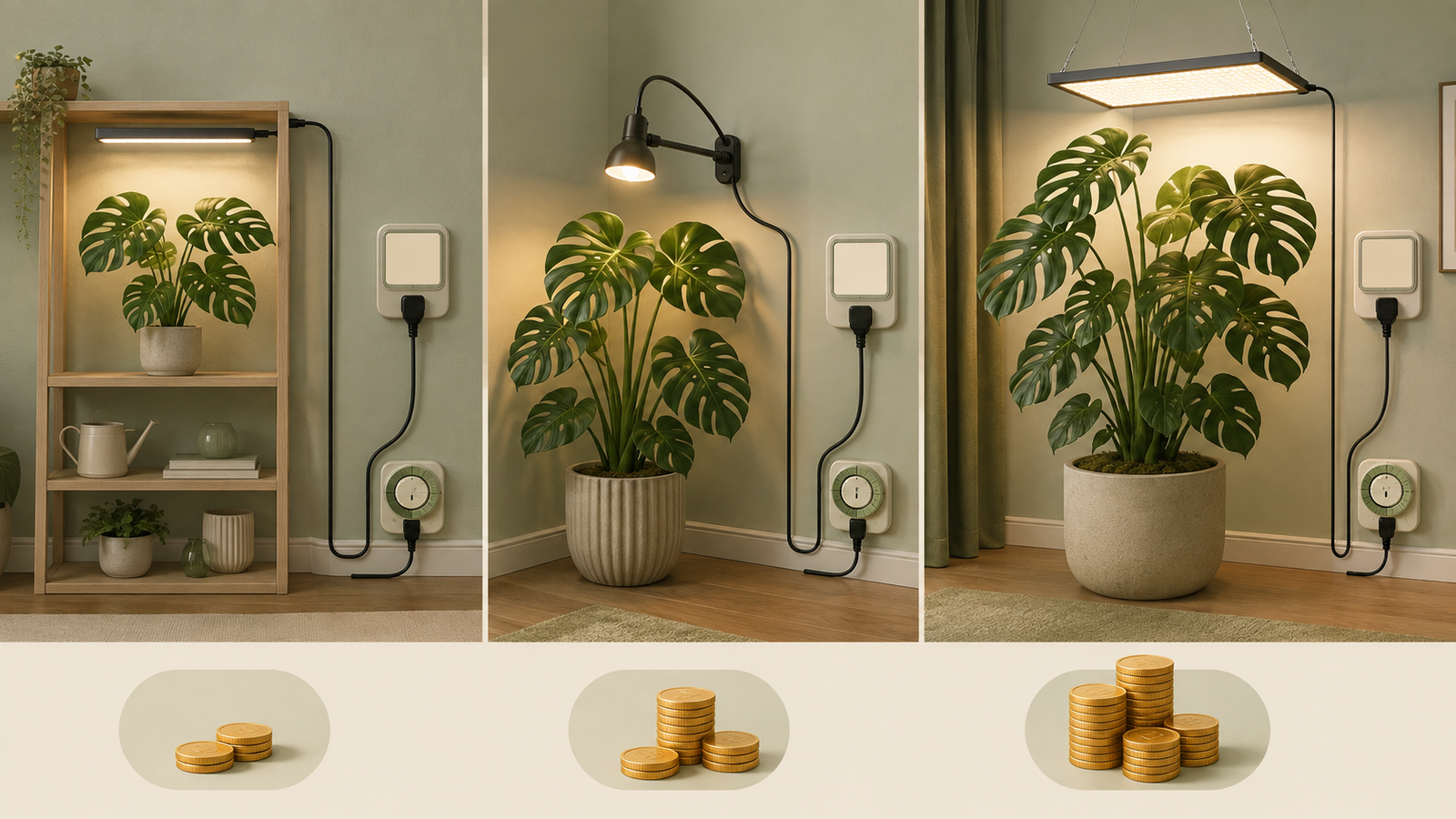
Compare total system cost, not just the label on one fixture. Include the lamp, stand or mount, timer, replacement parts, and the electricity used at the schedule that actually works. A broad panel that runs 10 hours may be less expensive over a year than two small bulbs that need 16 hours and still leave the rear leaves dim.
How can plant response prevent overspending?
Use plant signals to decide whether more electricity is buying useful growth. Before changing the schedule, photograph the same leaves and note the growth point, petiole angle, leaf colour, edge texture, and dry-down time. Compare the centre and outer canopy, not only the leaf closest to the lamp.
The Monstera light requirements guide helps separate stretching or uneven growth from heat, pests, root problems, or abrupt environmental changes. If only one side stretches, repositioning may solve the issue more cheaply than adding wattage. If the centre develops pale or crisp patches, more hours are not a safe response.
Run one controlled change for two weeks: adjust aim, height, dimmer, or hours—but not all four together. Keep watering and room conditions as consistent as practical. A stable climbing stem also makes the comparison fair; the modular moss pole for climbing Monstera can keep a moving growth point inside the measured footprint. It cannot guarantee larger leaves, but it can make light placement repeatable.
If the plant is healthy and producing steady new growth, a higher bill may not improve it. If the leaves remain chronically stretched despite good root health and stable temperature, calculate the cost of a targeted side fill before buying a much stronger lamp for the whole room.
Can brighter light change watering and fertilizer costs?
Brighter or longer light can increase leaf temperature and water use, so the indirect cost may appear as faster dry-down rather than a larger electric bill. Check the root-zone moisture, pot weight, drainage, and airflow before changing watering. Do not water on a fixed schedule simply because the lamp runs every day.
Use the complete indoor Monstera care guide to cross-check substrate, roots, humidity, temperature, and fertilizer timing. A plant that dries faster may need a smaller interval, but the correct response depends on pot size, mix, room temperature, and root health. Extra fertilizer is not a substitute for even light and can add salt stress.
When calculating the full budget, separate electricity from consumables. A timer, meter, support, potting mix, and fertilizer are purchase or maintenance costs; they do not belong in the kWh calculation. Keeping the categories separate makes it easier to see whether a fixture is expensive to operate or simply expensive to install.
What should you check before comparing fixtures?
Check actual coverage, input watts, dimming behaviour, and your utility rate before deciding that a fixture is “cheap” or “expensive.” Product wattage without a beam map cannot tell you whether a Monstera's lower or outer leaves receive useful light.
Use this checklist:
- Find the fixture's input wattage and model-specific coverage chart.
- Measure real wall draw at the intended dimmer setting with a plug-in meter when possible.
- Record the daily hours and whether daylight contributes part of the total.
- Use the all-in marginal kWh rate from your utility bill, including time-of-use differences.
- Calculate a 30-day and 365-day estimate, then repeat for winter or cloudy-season hours.
- Check clearance, heat, glare, cord routing, and timer memory before leaving the system unattended.
- Compare centre and edge leaves for at least two weeks before adding a second fixture.
If the light is for a rare variegated Monstera or a newly moved plant, keep changes gradual and document the response. A cost calculation is only useful when the underlying setup is safe and repeatable.
Conclusion: pay for useful coverage, not impressive wattage
A Monstera grow light's running cost is straightforward: watts divided by 1,000, multiplied by daily hours, days, and your local kWh rate. Illustrative 20–100 watt fixtures used for 12 hours often land in the low single-digit to roughly ten-dollar monthly range at $0.15–$0.30/kWh, but your wall draw, tariff, and schedule decide the real number.
Start with the manufacturer's coverage map, use the shortest effective photoperiod, measure dimmed draw when possible, and inspect the whole canopy. A well-aimed, moderate fixture can be more economical than a powerful lamp that misses the leaves. Budget for stable coverage and healthy plant signals—not brightness for its own sake.
Frequently Asked Questions
How much does a 20-watt Monstera grow light cost per month?
At 12 hours per day for 30 days, a 20-watt light uses 7.2 kWh. That equals $1.08 at $0.15/kWh or $2.16 at $0.30/kWh. Substitute your actual all-in rate for a useful estimate.
Is it expensive to leave a Monstera grow light on all day?
Cost rises in direct proportion to hours. A 40-watt light running 16 hours uses 19.2 kWh per 30-day month, compared with 14.4 kWh at 12 hours. The plant still needs a dark interval, so all-day operation is rarely the first fix for weak growth.
Does a higher-wattage grow light always cost more to run?
Usually, if both fixtures run for the same hours, the higher actual draw costs more. But coverage and dimming matter: a better-aligned fixture may need fewer hours or no second lamp. Compare useful canopy coverage and measured watts, not wattage alone.
Does a timer reduce the electricity rate?
A timer does not change your utility's rate. It reduces wasted hours by switching the lamp on only during the planned photoperiod. Include any timer standby draw if you want a highly precise whole-system estimate.
Should I use the label wattage or measure the wall draw?
Use the label for a first estimate, then measure at the wall when possible. Input watts can differ from the LED output rating, and dimming or driver efficiency can change actual consumption.
Can a grow light cost more indirectly by changing watering?
Brighter light can speed dry-down, which may change how often you check or water the pot. That is a care-routine effect, not a fixed extra cost. Check moisture, drainage, and root health before changing the interval or fertilizer rate.
References
- U.S. Energy Information Administration: Measuring Electricity — Definitions of watts, watt-hours, and kilowatt-hours used for the cost formula. 2026.
- Iowa State University Extension and Outreach: How to Set Up Supplemental Lights for Indoor Plants — Supplemental-light distance, timers, photoperiod guidance, and monitoring over time. 2026.
- University of Connecticut Home & Garden Education Center: Monstera deliciosa — Mature leaf size, climbing habit, and indoor light acclimation context. 2020.
- University of Minnesota Extension: Lighting for Indoor Plants and Starting Seeds — Relative light categories for houseplants, including medium-light Monstera. 2026.
- North Carolina Cooperative Extension: Monstera deliciosa (Ceriman, Cutleaf Philodendron, Hurricane Plant) — Moderate-light guidance and caution with harsh direct sun. 2026.