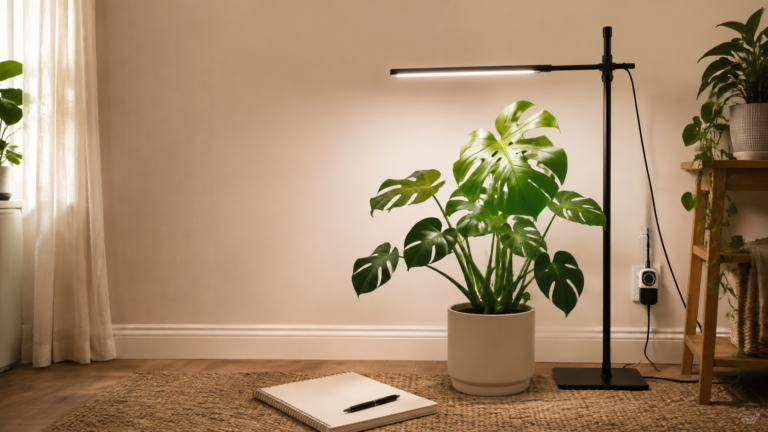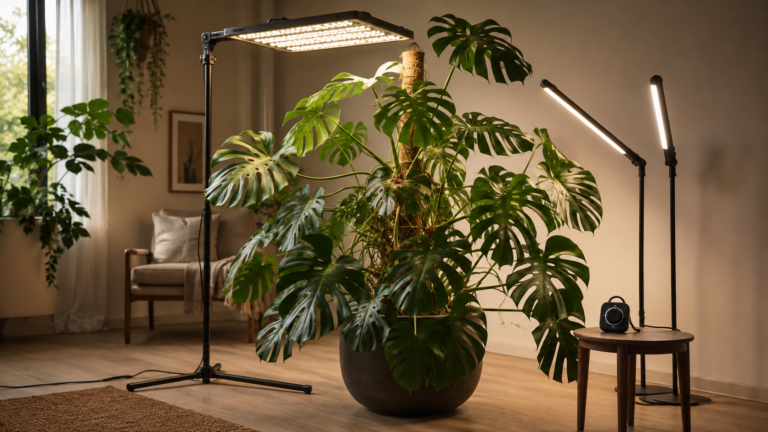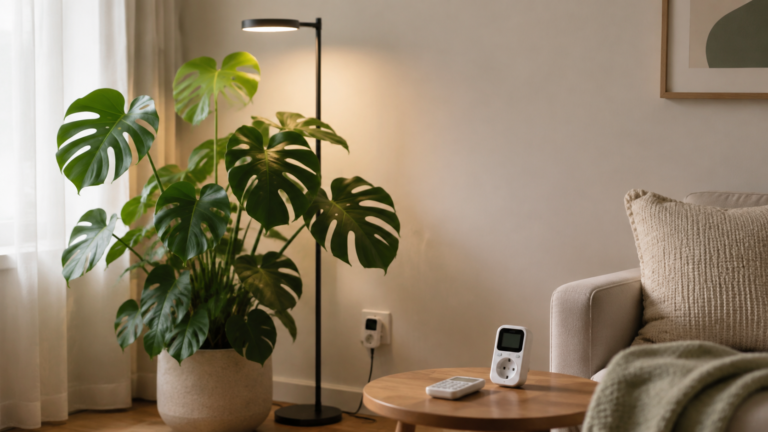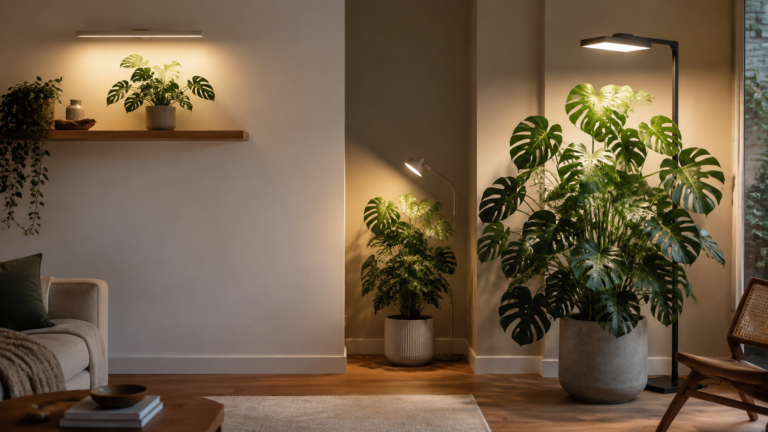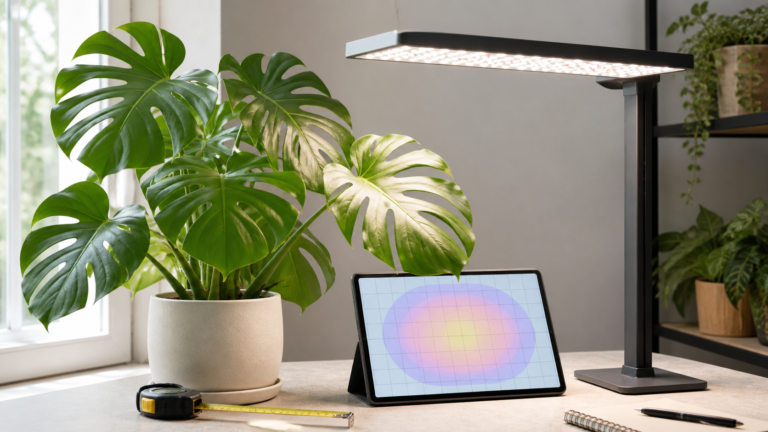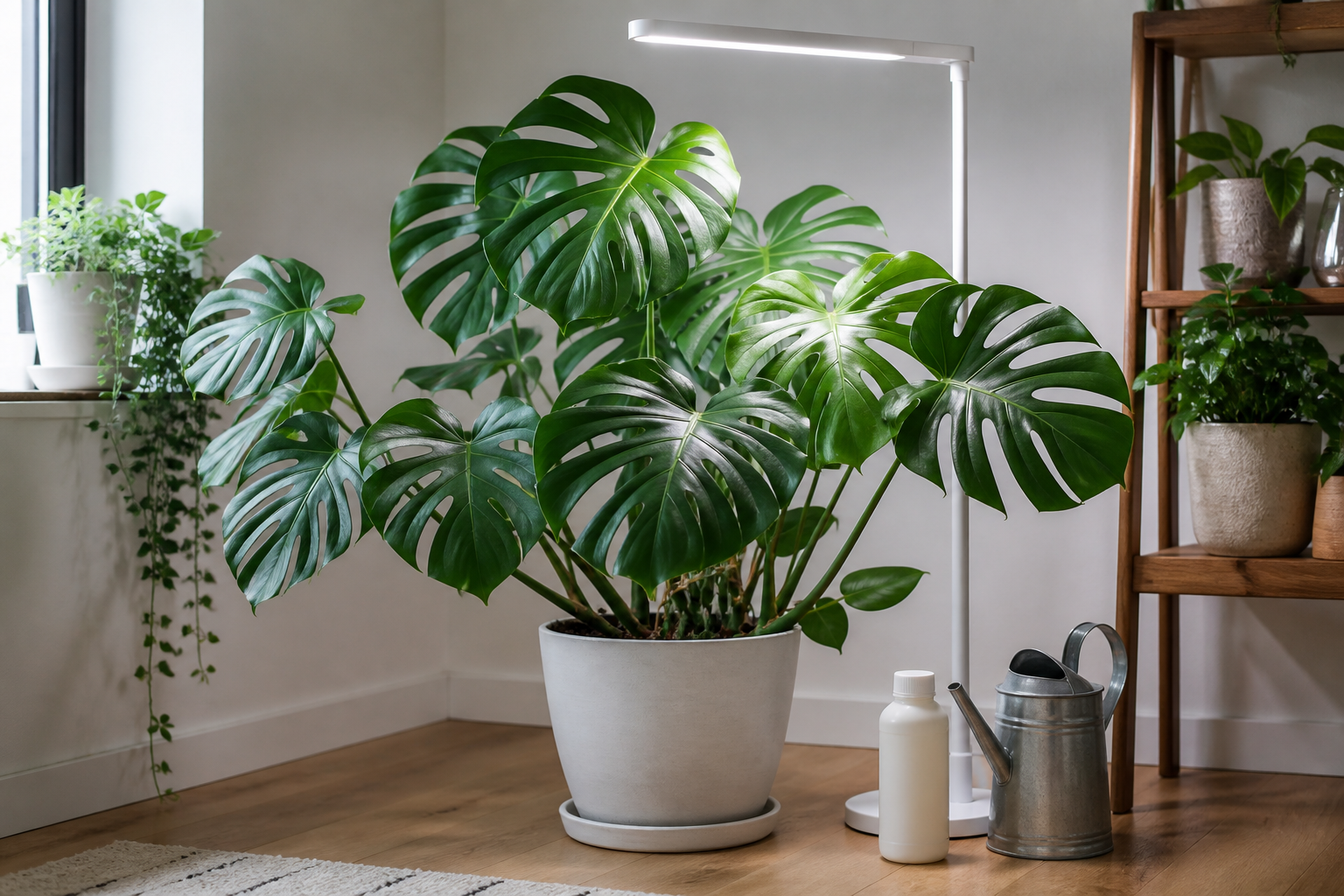
When you add a grow light, do not automatically water or fertilize your Monstera on a new calendar. More usable light can increase photosynthesis, active growth, and drying speed, but the change depends on intensity, heat, humidity, substrate, pot size, and plant stage. Watch the root zone and new growth before adjusting either input.
Turning on a lamp changes the environment around the leaves, not a fixed care formula. A small LED over a dim corner may barely change water use, while a well-positioned fixture that reaches the whole canopy can help a Monstera push new leaves and use moisture faster. The safest response is to measure what changed, then adjust one routine at a time.
Table of Contents
- Why grow lights change Monstera water and nutrient demand
- What changes first: drying speed or fertilizer demand
- How to water a Monstera under a grow light
- A practical watering adjustment after adding light
- When a grow light changes fertilizing needs
- How to fertilize without turning light into salt stress
- When more light should not mean more water or fertilizer
- A four-week observation plan for a new grow-light setup
- Watering and feeding differences by pot and substrate
- Troubleshooting common grow-light care patterns
- Conclusion: let the root zone set the pace
- Frequently Asked Questions
- References
Why grow lights change Monstera water and nutrient demand
A grow light can change water and fertilizer demand only when it delivers enough usable light to increase active photosynthesis and growth. The lamp does not “dry the soil” by itself; leaf temperature, air movement, humidity, substrate structure, container design, and plant size determine how quickly the root zone loses water.
Light is one part of an indoor system that also includes soil, container, temperature, humidity, water, and fertilizer 1. More light may give the plant more energy to build leaves, but a dim fixture, narrow beam, or shaded lower canopy may produce little change. The first question is therefore not “How often should I water now?” but “Did the leaves actually receive more usable light?”
Use the Monstera grow-light guide to review fixture distance, coverage, and the daily light window before changing the root-zone routine. If only the top leaf is illuminated, extending the timer can add hours without solving the uneven footprint.
What changes first: drying speed or fertilizer demand
Drying speed usually gives you a useful early signal; fertilizer demand should follow confirmed active growth, not the light switch. A Monstera can sit under a lamp for weeks without needing extra fertilizer if the roots are stressed, the plant is cool, or no new growth is developing.
| Observation after adding light | What it may mean | First response |
|---|---|---|
| The pot becomes light sooner and a new leaf is expanding | Water use and growth have increased | Recheck the soil trigger more often; do not water by the old weekday |
| The pot remains heavy and wet, but the lamp is bright | Roots, substrate, temperature, or drainage may be limiting | Inspect the root zone and airflow before extending light or feeding |
| New leaves are appearing, but the pot dries at the same pace | Growth may be small, humidity may be high, or the light change is modest | Keep observing; do not increase fertilizer only because a lamp is on |
| Brown tips or a white crust appear after more feeding | Salt concentration or dry-root feeding may be stressing roots | Pause fertilizer, water thoroughly with plain water, and let excess drain |
University of Minnesota guidance notes that higher-light areas can be warmer and dry plants faster, so the soil should be checked more frequently rather than watered on a preset schedule 2. That is a change in observation frequency, not permission to keep the medium constantly wet.
How to water a Monstera under a grow light
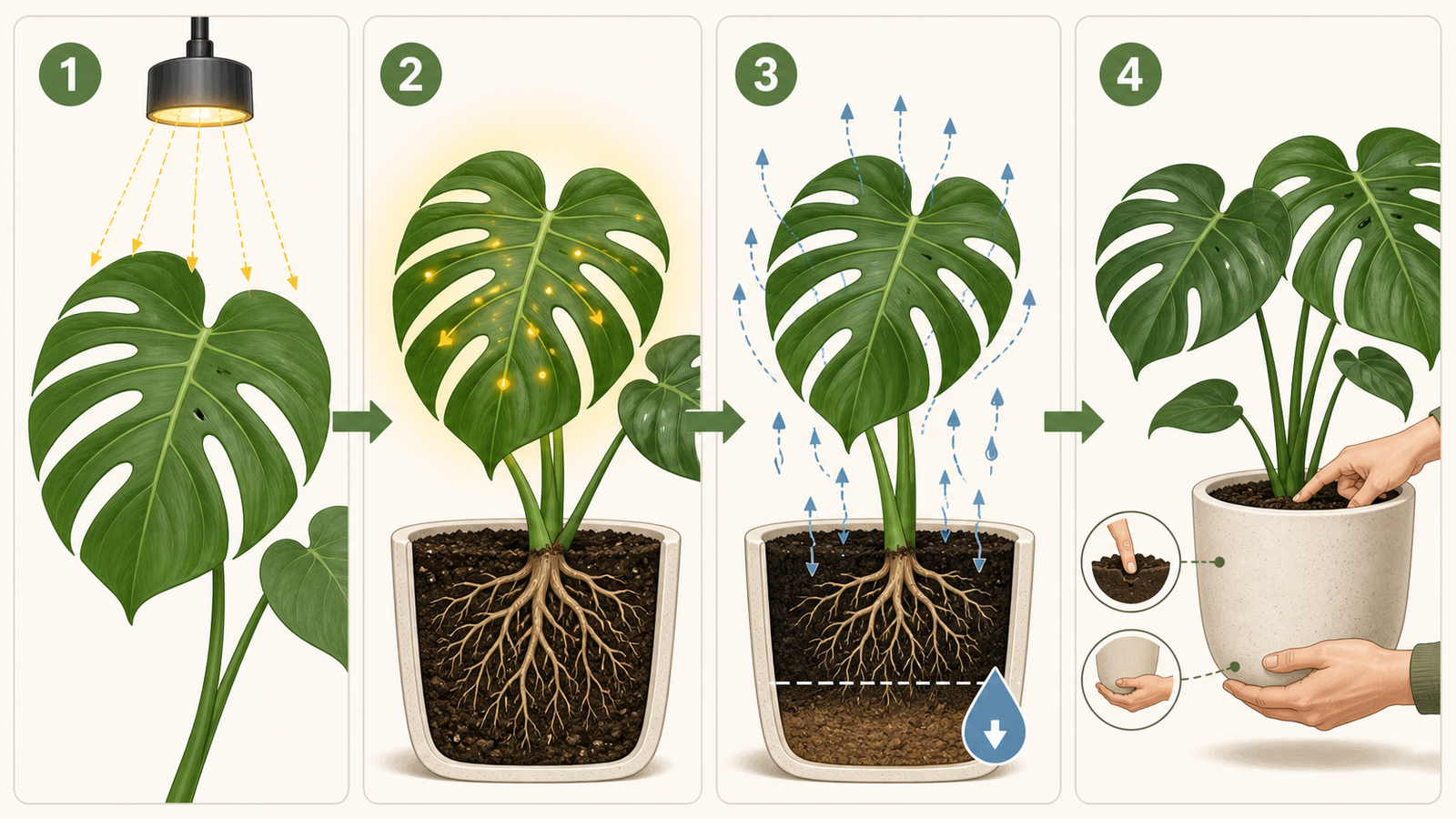
Water a Monstera under a grow light when the root-zone signals say it is ready, then water thoroughly and allow drainage. Light hours alone cannot tell you when the pot needs water because the same fixture behaves differently in a chunky aroid mix, a moisture-retentive peat mix, a self-watering reservoir, or a cool humid room.
Check several signals together:
- Feel the mix. Push a finger about an inch into the surface, or use a moisture tool in more than one location. If the mix still feels wet, wait and check again rather than following a lamp timer. Iowa State Extension specifically recommends checking the soil instead of watering every Saturday 1.
- Lift the pot. A lighter container is a useful trend, especially when the pot is opaque and the center stays wetter than the top. Compare the weight after a full drain with the weight just before watering.
- Look at the plant. A slightly dull leaf or soft petiole can support the diagnosis, but limp leaves can also come from root damage, heat, cold, or pests. Do not use wilt as your only trigger for a valuable plant.
- Check the drainage event. When watering is due, wet the complete root ball until water exits the drainage holes. Empty the saucer or cachepot so the pot does not sit in runoff 1.
- Record the interval. Write down the date of watering, the date the mix becomes dry at the chosen depth, the light hours, and any room-temperature or humidity change. After two or three cycles, you will have a better baseline than a generic “weekly” rule.
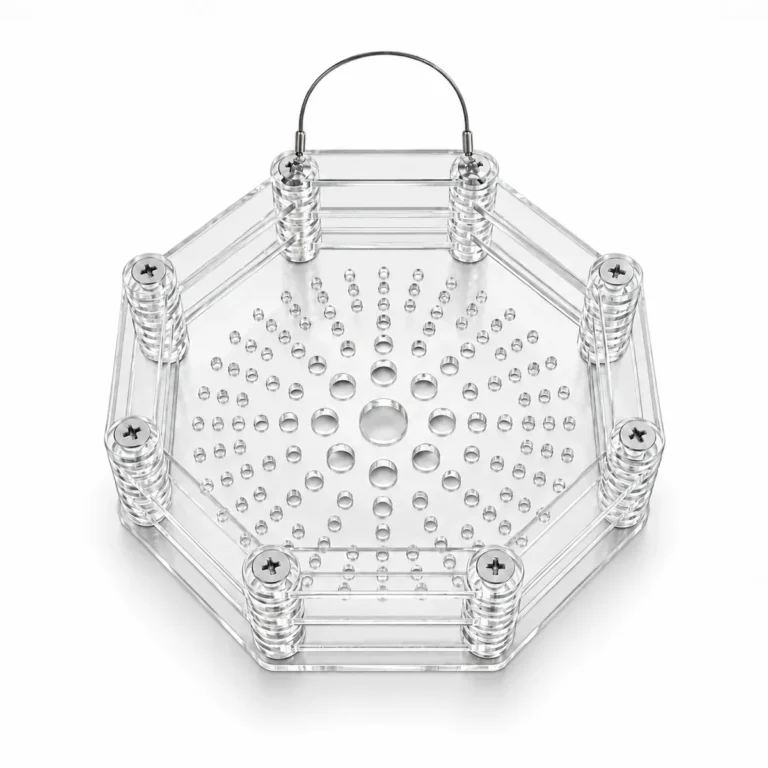
If you cannot read the root zone because the container is opaque or the pot is hidden inside a cover, a transparent root-control planter may make moisture and root observations easier. It is an observation aid, not a guarantee against overwatering; drainage and the actual substrate still matter.
A practical watering adjustment after adding light
Make a small watering adjustment only after the new light has run consistently long enough for the root zone and the newest growth to show a pattern. A useful home test is to preserve the old watering trigger, check the pot more often, and change only the interval when the mix repeatedly reaches the same dry point sooner.
Try this sequence:
- Photograph the plant, note the pot weight, and write down the current drying interval before moving the fixture.
- Set the light using its manufacturer distance and coverage guidance. A general indoor-light reference may suggest a 12–14 hour window, but the total should include usable window light and must retain a dark period 2 3.
- Keep the watering volume and substrate unchanged for the first cycle. Check the soil at the same depth each day or every other day.
- If the mix reaches your usual dry point earlier for two consecutive cycles, water at that signal. Do not add a second weekly watering just because the light runs longer.
- If the pot dries extremely fast, inspect temperature, airflow, pot size, and root binding. A hot fixture or a root-bound plant can change drying speed for reasons that are not simply “the Monstera needs more water.”
For example, suppose a plant in a ventilated bark-and-perlite mix previously reached its dry-point check on day 10. After a bar light is positioned over the full canopy, it reaches the same check on day 7, and a new leaf is expanding without heat damage. Keep the same thorough watering method, but begin checking around day 6–7 instead of watering on day 10 by habit. That is a measured adjustment; it is not a universal seven-day schedule.
When a grow light changes fertilizing needs
A grow light can make fertilizing more useful when it supports sustained new growth, but it does not make fertilizer safe for a dormant or damaged root system. Fertilizer supplies mineral nutrients; light supplies energy. Both are needed for growth, yet adding nutrients cannot compensate for roots that lack oxygen or a canopy that still receives weak light.
Use visible activity as the gate:
- A new leaf is actively expanding or another growth point is clearly moving.
- Roots are firm and the substrate drains rather than staying sour or waterlogged.
- The plant is not freshly repotted, severely pest-damaged, chilled, or recovering from drought.
- The light reaches enough of the canopy to support the new growth instead of producing one bright leaf and a shaded plant.
University of Maryland Extension advises fertilizing indoor plants during active growth and reducing or stopping fertilizer during winter when reduced light and temperature slow growth; excessive fertilizer can cause salt buildup and weak, leggy growth 4. University of Minnesota similarly notes that brighter-growing plants may need more frequent feeding late in spring, while low-light plants need less 2.
For Monstera deliciosa and related indoor aroids, treat fertilizer instructions on the label as the upper boundary, not a challenge to exceed. A half-strength, balanced houseplant fertilizer during confirmed active growth is a conservative starting point for many home growers, but the product label, water quality, substrate, and plant response still control the final choice. The Monstera fertilizer guide can help you compare liquid and slow-release formats after you have established that the light and root zone are working together.
How to fertilize without turning light into salt stress
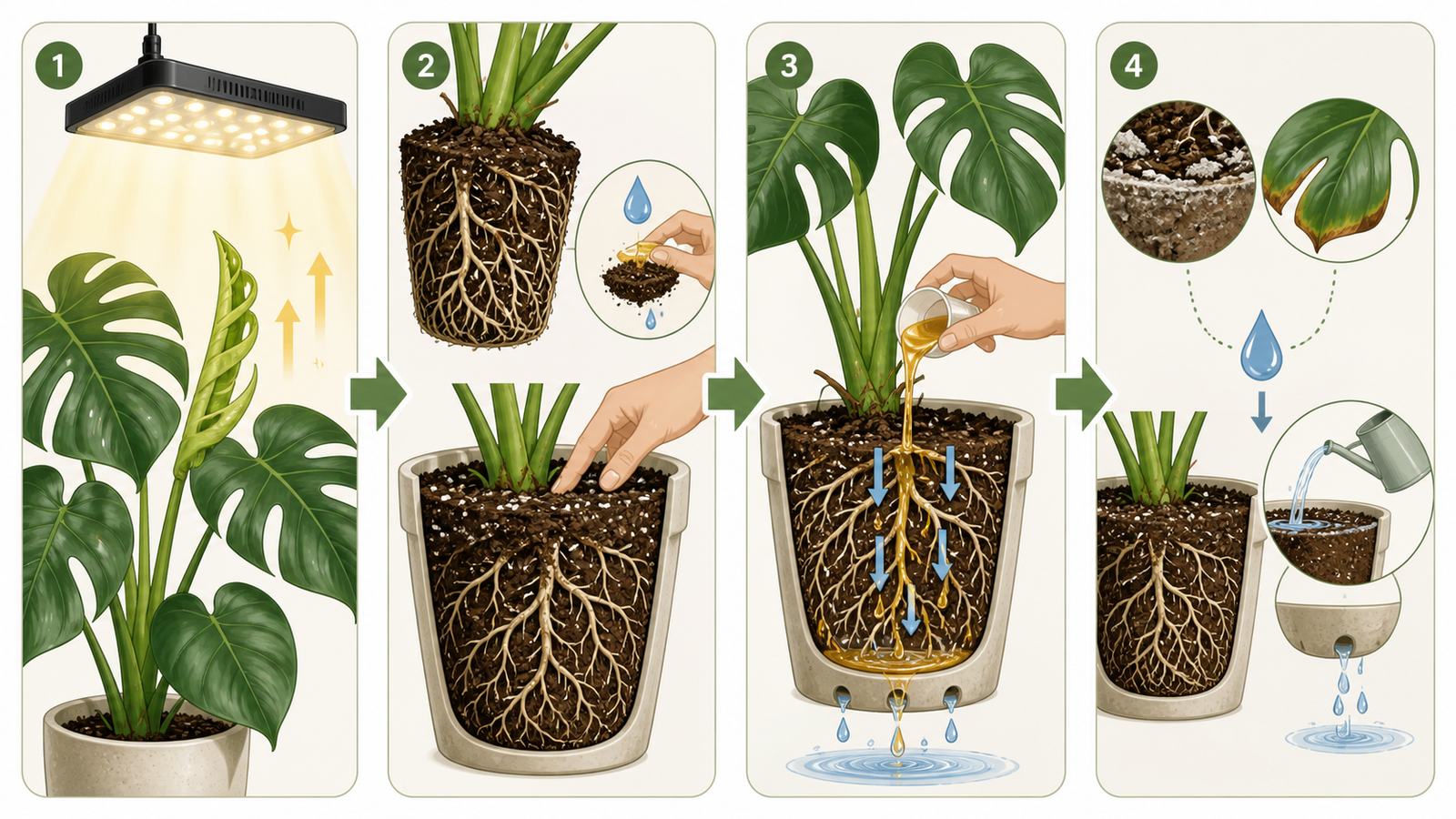
Apply fertilizer to a Monstera only when the soil is already lightly moist, use the label dilution, and let the solution drain freely. Never use extra fertilizer to “match” a grow-light schedule. The plant cannot store a weekly care promise, and unused salts can remain in the container after water evaporates.
Use this safer method:
- Check the root zone first. If the mix is bone dry, water with plain water and let it drain before feeding on another day or after the root ball has rehydrated.
- Choose one fertilizer format. Do not stack liquid feed, slow-release pellets, compost tea, and micronutrient supplements without knowing the combined dose.
- Dilute exactly as the label directs; beginning at half strength is a cautious option for many indoor plants, not a substitute for reading the label.
- Apply evenly to the substrate, not to dry aerial roots or leaves. Let runoff leave the pot.
- Empty the saucer and watch the next two or three leaves. Brown margins, a white crust, or sudden root decline are reasons to pause and flush with plain water, not to add a corrective nutrient.
The UF/IFAS Monstera guidance also describes Monstera fertilizer needs as relatively modest and warns that lawn irrigation timers can overwater roots in outdoor settings 5. Indoors, the same principle applies: more inputs are not automatically better when water, air, and drainage are out of balance.
When more light should not mean more water or fertilizer
Do not increase both watering and feeding when the pot is staying wet, the room is cool, or the plant is not making new growth. Supplemental light can expose a different problem rather than solve it.
Pause and diagnose if:
- The mix stays wet for much longer. Check compacted media, a pot that is too large, blocked drainage, low temperature, and root damage. Low light and weak roots can reduce water use even while the lamp is running.
- Leaves scorch or bleach. The fixture may be too close, too intense, or heating the canopy. Reduce intensity or increase distance before increasing water to compensate.
- Only the top leaf improves. Coverage may be narrow. A side or broader fixture may help more than a longer timer, especially on a tall Monstera 3.
- The plant was repotted recently. Fresh mix often contains nutrients, and disturbed roots need oxygen and time. Delay routine feeding until active growth and normal drainage return.
- The plant is a juvenile, variegated, or recently propagated specimen. Its growth rate and leaf size may differ from a mature green Monstera. Do not use the feeding rhythm of another cultivar as a prescription.
- Pests or root rot are present. Treat the cause and stabilize the plant first. Fertilizer can worsen salt stress without repairing damaged roots.
If you are unsure whether the symptom is light-related, compare the Monstera light requirements guide before changing water or nutrients. A yellow leaf, small leaf, or slow-drying pot can have several causes.
A four-week observation plan for a new grow-light setup
A simple month-long log lets you separate a true light response from a coincidental change in weather or care. Iowa State Extension recommends starting with a general setup, monitoring growth for several weeks, and adjusting based on the plant response 3.
| Week | Keep steady | Record | Decision gate |
|---|---|---|---|
| 0: baseline | Existing water and fertilizer routine | Pot weight, dry-point depth, light hours, room temperature, newest leaf | Do not change inputs yet |
| 1: light only | Fixture position and timer | Soil moisture, leaf temperature by touch, canopy coverage, any scorch | Move or dim the fixture if heat or bleaching appears |
| 2: water signal | Same fertilizer dose, if the plant was already actively growing | Days to the same dry point, drainage speed, leaf firmness | Adjust the next watering trigger only if the pattern repeats |
| 3: growth check | Same light and watering trigger | New leaf expansion, root-zone smell, salt crust, pest signs | Feed only if growth is active and roots drain well |
| 4: one change | Change one lever at a time | Before/after photos and the next dry-down interval | Keep, reverse, or refine the single adjustment |
The goal is not to create a perfect spreadsheet. It is to avoid changing light hours, watering volume, fertilizer strength, potting mix, and humidity all in the same weekend. One controlled change gives you a better answer about what your Monstera actually needed.
Watering and feeding differences by pot and substrate
The same grow light can produce very different care decisions in different containers. Treat these as starting questions, not fixed schedules.
| Setup | Why the response differs | What to monitor |
|---|---|---|
| Chunky bark, perlite, and coco mix in a draining pot | Air space is high and water may leave quickly; the outer mix can feel dry while the center remains moist | Pot weight, center moisture, drainage time, and root firmness |
| Peat-heavy or fine mix | Water is retained longer and can become hydrophobic when too dry | Dry-point depth, pot weight, sour smell, and whether water runs around the root ball |
| Self-watering reservoir | The reservoir can keep the lower root zone wet even when the surface looks dry | Reservoir level, root color, oxygen at the lower zone, and growth response |
| Recently repotted Monstera | Fresh media may contain nutrients and disturbed roots may not use water normally | New root growth, drainage, leaf firmness, and time since repotting |
| Juvenile cutting or propagation plant | Small roots and leaves use less water and tolerate less fertilizer salt | Root development, container scale, humidity, and gentle light acclimation |
For broader substrate, temperature, humidity, and drainage decisions, use the complete indoor Monstera care guide rather than treating the grow light as the only variable.
Troubleshooting common grow-light care patterns
| Pattern | Most useful question | Low-risk next step |
|---|---|---|
| The lamp is on 14 hours, but the pot is still wet on day 14 | Is the canopy actually receiving usable light, and are the roots oxygenated? | Check coverage, temperature, drainage, and roots before adding water |
| The new leaf is larger, but the soil dries two days sooner | Did active growth and transpiration increase? | Keep the same thorough watering method and check the dry point sooner |
| White crust appears after adding fertilizer | Are salts accumulating because the dose is too strong or runoff is trapped? | Pause feeding, flush with plain water, and empty the saucer |
| Lower leaves yellow while the top leaf looks bright | Is the lower canopy shaded or is the root zone staying wet? | Check the full canopy and root zone; do not assume nutrient deficiency |
| Leaves curl after moving the lamp closer | Is heat or intensity stressing the leaf surface? | Increase distance or reduce output, then reassess before watering more |
| Growth is still slow after a brighter setup | Are roots, temperature, pests, support, or plant stage limiting growth? | Inspect the whole care system and wait for new-growth evidence |
Conclusion: let the root zone set the pace
Grow lights change Monstera watering and fertilizing indirectly: usable light can support photosynthesis, active growth, and faster water use, but only the root-zone signals tell you when to water and only healthy new growth justifies feeding. Start with fixture coverage and a repeatable light window, then log drying time, pot weight, leaf response, and drainage before changing a routine.
If you want to revisit the lighting decision, return to the Monstera grow-light guide. Make one modest adjustment, keep a dark period, and let the next few leaves—not an old calendar—show whether the plant is using more water and nutrients.
Frequently Asked Questions
Will a grow light make my Monstera need water every day?
No. A grow light may increase water use, but daily watering depends on intensity, heat, humidity, substrate, pot size, root health, and plant size. Check the mix and pot weight at a consistent depth instead of copying a daily schedule.
Should I fertilize every time I water under a grow light?
Not automatically. Feed only during active growth and follow the fertilizer label. A balanced, diluted feed may be appropriate for some actively growing Monsteras, while a stressed, recently repotted, cool, or slow-growing plant may need no additional fertilizer.
How long after adding a grow light should I change my watering routine?
Give the setup enough time to show a repeatable pattern—often two or three watering cycles—while checking the soil more frequently. Change the trigger only when the same dry point arrives earlier more than once.
Can extra fertilizer fix small Monstera leaves under a grow light?
Only if nutrients are actually limiting growth. Small leaves can also indicate weak or uneven light, juvenile growth, unsupported climbing, root stress, or a cultivar difference. Confirm light and roots before increasing fertilizer.
What if the soil dries faster but the leaves develop brown tips?
Check heat, fixture distance, humidity, water quality, and fertilizer concentration. Brown tips can reflect salt or heat stress rather than simple thirst. Correct the likely stressor and watch new growth before increasing fertilizer.
Is a self-watering pot safer under a grow light?
Not by itself. A reservoir can stabilize moisture for some setups, but it can also keep the lower root zone too wet if the substrate and roots are not adapted. Monitor the reservoir, root color, oxygen, and new growth together.
References
- Iowa State University Extension and Outreach: How to Care for Houseplants — How light, substrate, temperature, humidity, container, plant size, and season change watering; thorough drainage and observable soil checks.
- University of Minnesota Extension: Lighting for Indoor Plants and Starting Seeds — Medium- and high-light drying behavior, Monstera’s indoor light category, light intensity, and a 12–14 hour foliage-houseplant reference.
- Iowa State University Extension and Outreach: How to Set Up Supplemental Lights for Indoor Plants — Monitoring over several weeks, distance and coverage, adjustments, side light, timers, and the need for a dark period.
- University of Maryland Extension: Fertilizer for Indoor Plants — Reduced feeding in winter or low growth, diluted liquid fertilizer, and salt buildup from excess fertilizer.
- University of Florida IFAS Extension: Monstera Growing in the Florida Home Landscape — Monstera’s modest fertilizer requirements, active-growth timing, watering in dry periods, and root-rot risk from excessive irrigation.