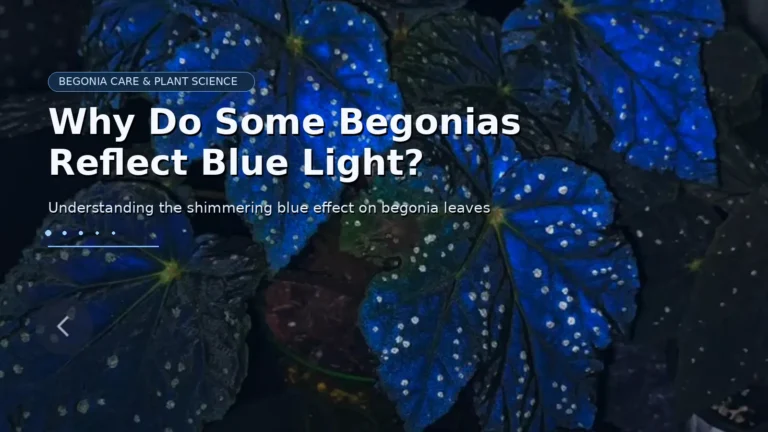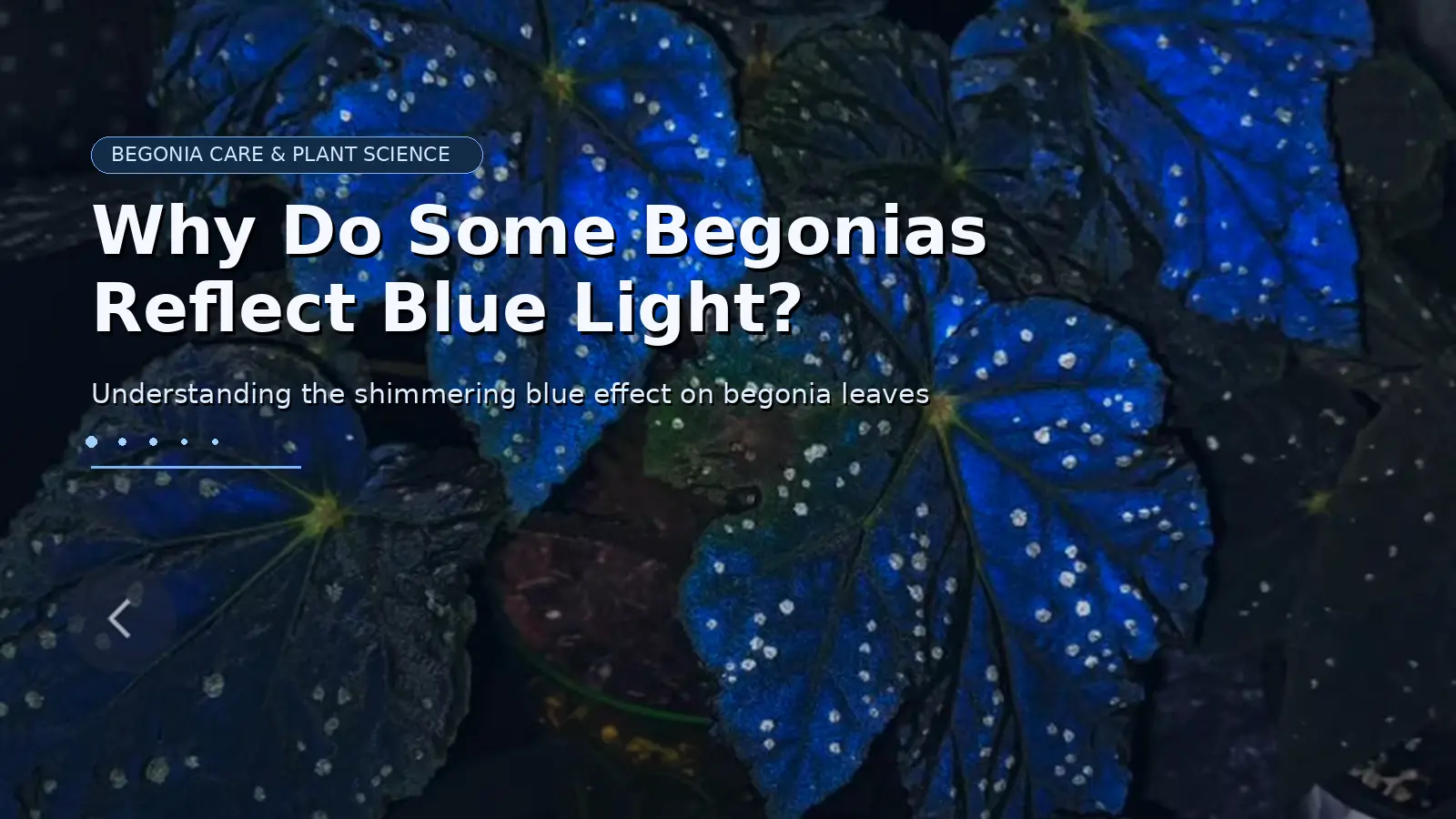
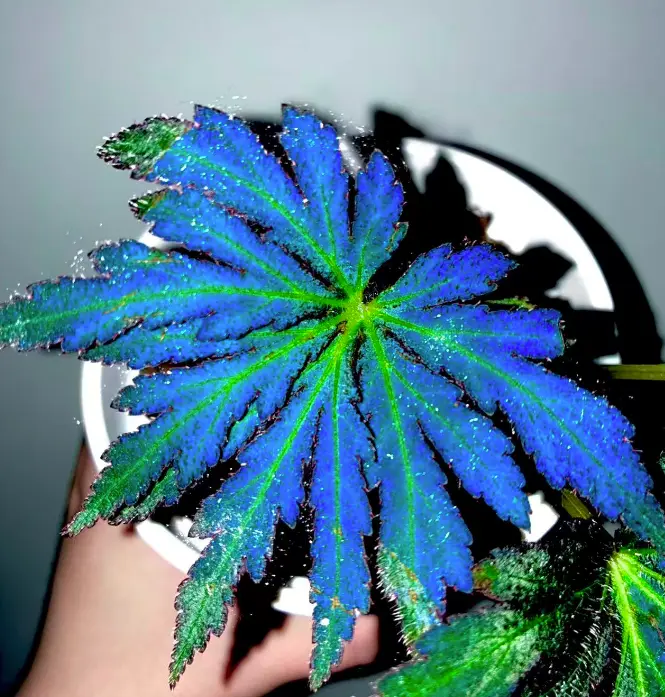
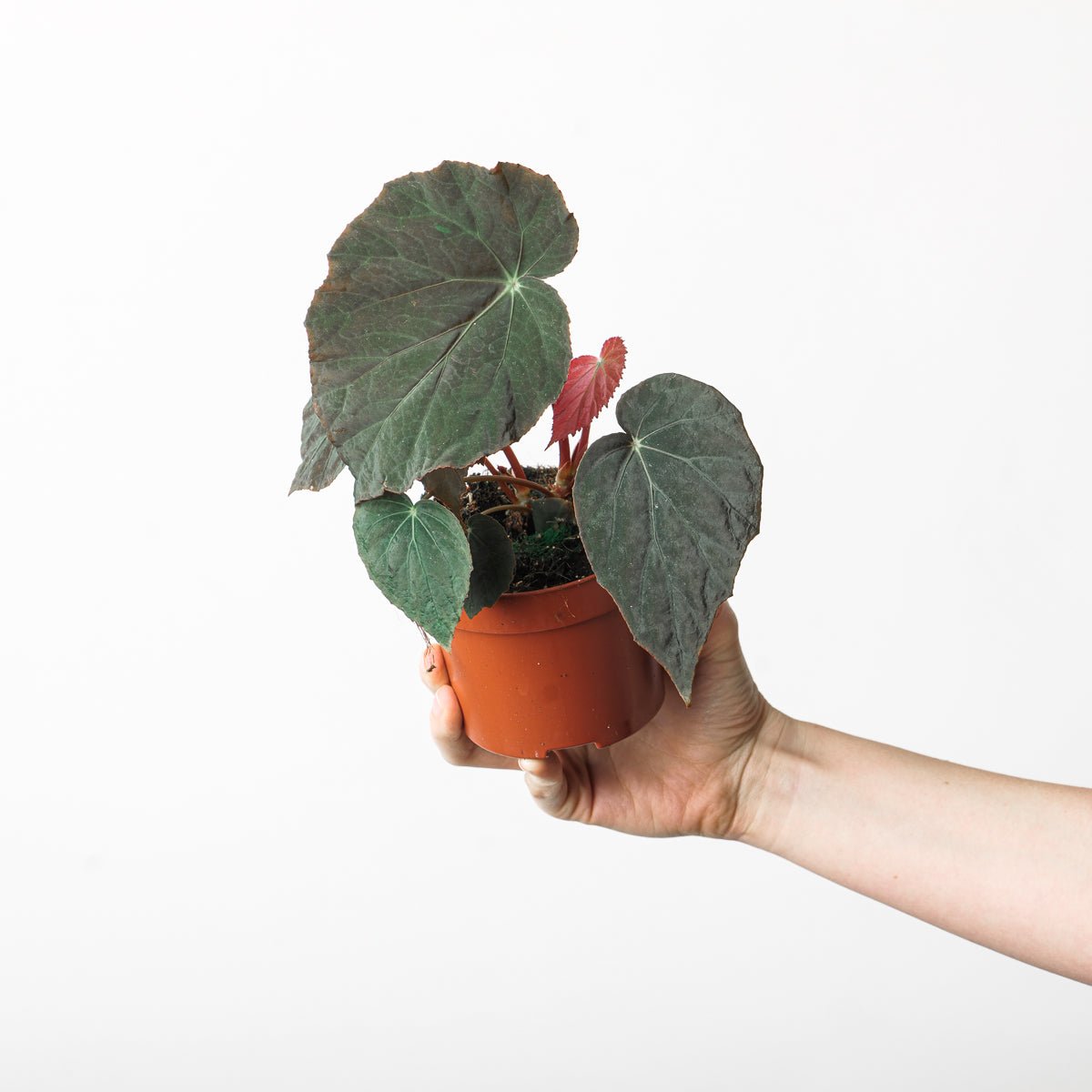
Tilt a Begonia pavonina leaf into the light at just the right angle and it flips from ordinary deep green to a vivid, oily metallic blue — the kind of color you’d expect on a beetle’s shell or a peacock’s tail, not a houseplant. That blue isn’t a pigment. There’s no blue dye in the leaf at all. Crush it, and you get green juice. The color comes from the way the leaf is built at the nanometer scale, and it’s tied directly to how the plant survives on a dim rainforest floor.
Table of Contents
Here’s what’s actually happening inside those leaves, why it evolved, and what it means if you want to grow one.
Structural color, not pigment
Most leaf color is pigment color. Chlorophyll absorbs red and blue light and reflects green, so leaves look green. Pigments work by chemistry — specific molecules absorbing specific wavelengths.
The blue of a peacock begonia works by physics instead. It’s structural color: color produced by microscopic structures that interfere with light waves rather than by any colored substance. The same effect makes soap bubbles swirl with rainbows, gives morpho butterflies their electric blue, and puts the shimmer on an oil slick. In every case there’s no blue pigment — just layered structures spaced at roughly the wavelength of visible light, bouncing certain colors back at you while letting others through.
Structural color is why the blue moves as you move. Shift your viewing angle and the shimmer shifts with it — a dead giveaway that you’re looking at physics, not pigment.
That angle-dependence is the tell. A pigment looks the same color from every direction. The peacock begonia’s blue appears, intensifies, and vanishes as the angle between the light, the leaf, and your eye changes. Photographers chasing the effect line their camera up almost exactly with the light source, because the blue you see is light being reflected straight back toward you.
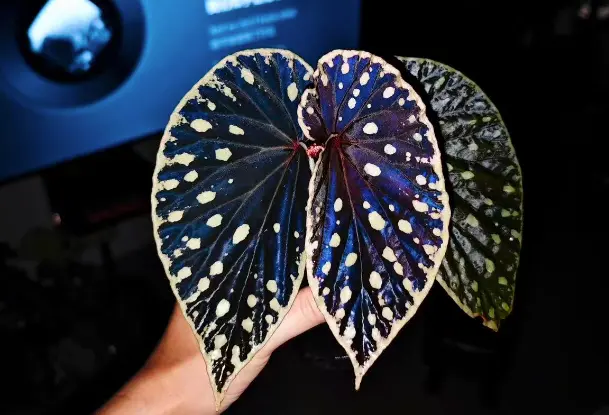
If some begonias are varieties that reflect blue light, but it’s not very obvious, you can try taking them to a dark room, turning on your phone’s flash to take a picture of them. You’ll then see more clearly how they reflect blue light, which is completely different from how they look normally.
Meet the iridoplast
The structures responsible sit inside specialized cells in the upper leaf surface. In a normal plant cell, chloroplasts — the green organelles where photosynthesis happens — have their internal membranes (called thylakoids) stacked somewhat loosely and irregularly. In Begonia pavonina and a handful of other deep-shade plants, some chloroplasts are different enough to get their own name: iridoplasts.
Inside an iridoplast, the thylakoid membranes are arranged into an extraordinarily regular, repeating stack — uniform layers only a few hundred nanometers thick, about one-thousandth the width of a human hair. This periodic, crystal-like lattice is what physicists call a photonic crystal. When light hits these evenly spaced layers, the blue wavelengths reflected from each layer line up in phase and reinforce each other, while other wavelengths cancel out. The result is that the iridoplast throws back blue light — the same multilayer-interference principle behind the colors of a CD or a butterfly wing.
This was worked out by researchers at the University of Bristol and published in Nature Plants in 2016. They imaged the chloroplasts directly and confirmed the spacing of the layers matched the blue wavelengths the leaves reflect. It was the first time a self-assembled photonic crystal had been found doing a job inside a living chloroplast.
So why would a plant want blue leaves?
Reflecting away perfectly good blue light seems like a strange move for a plant living in near-darkness — and that’s the clue to what’s really going on. The iridescence is essentially a side effect. The blue you see is the small fraction of light the structure rejects; the interesting part is what it does with the light it keeps.
Begonia pavonina grows on the floor of montane rainforests in Peninsular Malaysia, under a dense canopy that filters out most of the usable spectrum. The light reaching it is dim and skewed toward green wavelengths, because the leaves overhead have already absorbed the red and blue. A plant down there has to wring every drop of energy out of weak, green-heavy light.
The Bristol team found that the photonic structure helps on two fronts. First, it tunes the chloroplast to absorb more strongly in the green-to-red range that actually reaches the forest floor, capturing wavelengths a normal chloroplast handles poorly. Second — and this is the elegant part — the layered crystal slows light down as it passes through, a phenomenon called “slow light.” Light lingering longer inside the photosynthetic machinery has more chances to be absorbed. In the lab, this raised the quantum yield (photosynthetic efficiency under low light) by roughly 5 to 10 percent compared with ordinary chloroplasts.
For a plant scraping by in deep shade, a 5–10% efficiency gain is a real survival advantage. The blue shimmer collectors prize is the visible by-product of a leaf engineered to photosynthesize in the dark.
Other hypotheses worth knowing
Improved low-light photosynthesis is the best-supported explanation, but botanists have floated others that may also play a part:
- Camouflage. The blue-green sheen may help the leaf blend into the dappled, shifting light of the understory, making it harder for insects to find.
- Photoprotection. Reflecting away surplus wavelengths could protect the shade-adapted machinery on the rare occasions a sunfleck breaks through.
These aren’t mutually exclusive, and the efficiency story remains the headline finding.
Not every Begonia does it — and not every “blue” leaf is the same
Iridescence is scattered across the genus rather than universal. In one survey of Begonias with specialized epidermal chloroplasts, only a minority — roughly nine of twenty-two examined — actually showed visible blue-to-blue-green iridescence. Researchers have also described related structures (lamelloplasts and so-called minichloroplasts) that look different under the microscope and have lower photosynthetic efficiency than ordinary mesophyll chloroplasts. In other words, “blue Begonia” covers several distinct cellular strategies, not one.
This structural trick isn’t unique to Begonias, either. Similar photonic chloroplasts have turned up in unrelated shade-dwellers like the spikemoss Selaginella and certain filmy ferns — a case of convergent evolution, with different lineages independently inventing the same nanoscale solution to the same dim-light problem. Velvet-leaved aroids such as Anthurium crystallinum get their sheen a different way again, through dome-shaped surface cells rather than photonic chloroplasts — proof that “shimmery leaf” is a destination plants reach by many roads.

A note for collectors: the “blue form” is probably a hybrid
If you’ve bought a “blue form” Begonia pavonina in North America and found it surprisingly easy and vigorous, there’s a good chance it isn’t the pure species. The plant widely sold under that name is very likely the hybrid Begonia grandis × pavonina — the same cross the Bristol researchers used in their study because it shows pavonina-style iridescence while inheriting the tougher, faster growth of B. grandis. Tell-tale signs versus true pavonina include smoother (less hairy) petioles, more jagged leaf edges, an upright branching habit rather than a low creeping rhizome, and blue that you have to “find the angle” for rather than the relentless metallic green-blue of the wild species.
None of this makes the plant less worth growing — hybrid vigor is exactly why it thrives as a houseplant. But it’s worth knowing what you actually have before you pay a “rare species” price.
How to actually see (and grow) the blue
The iridescence only shows under the right conditions, and so does the plant’s health. Both come down to mimicking that cool, humid, shaded understory.
| Factor | Target | Notes |
|---|---|---|
| Light | Low to moderate, filtered | Bright direct sun washes out the blue and scorches leaves. Deep shade brings the iridescence out — but give it some indirect light to keep it growing. |
| Humidity | 60–80%+ | A terrarium, cabinet, or humidified setup is ideal. Avoid misting the leaves directly — it invites powdery mildew. |
| Temperature | 20–27°C day, cooler nights | A high-elevation plant. It benefits from an ~8°C nighttime drop; keep nights above ~12–15°C. |
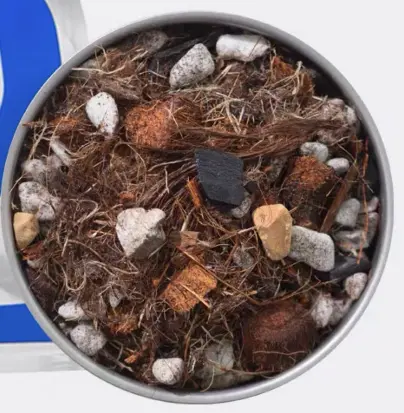
| Substrate | Loose, moisture-retentive, airy | Peat or coir with chunky perlite and bark; a little sphagnum mosshelps balance moisture. Slightly acidic. |
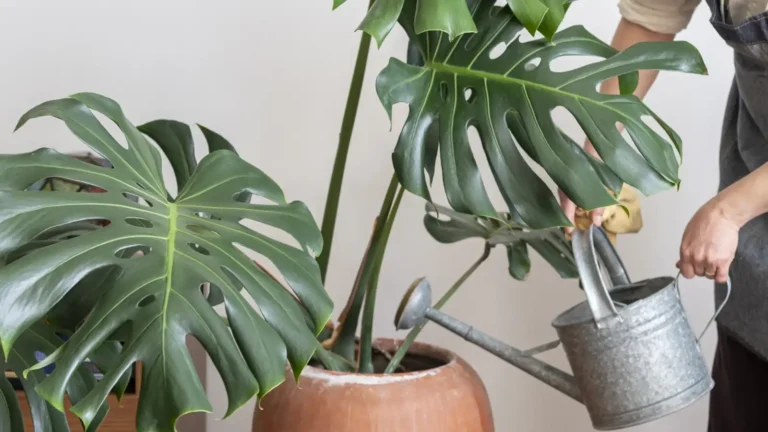
| Water | Keep evenly moist | Shallow-rooted — don’t let it dry out hard, but keep the mix oxygenated and never waterlogged. |
How to make your Begonia “show” the blue
This is the part that trips people up. They buy a peacock begonia, sit it on a shelf, glance down at it, and see a plain green leaf — then assume they got a dud. The blue is real; you’re just not standing where it lives. Because this is structural color, the blue only appears along a narrow band of angles where the light, the leaf, and your eye line up. Move out of that band and it’s gone. Here’s how to find it on purpose.
The one rule that matters
You see the blue when your eye is close to the path the light takes to reach the leaf — when you are looking with the light, not across it or against it.
The reflection comes almost straight back toward the source. So the trick is to put your eye (or camera) near the light, and aim both at the leaf together.
Step by step
- Dim the room. The effect is far easier to see when there’s one clear light source rather than flat, even daylight washing the leaf from all directions. Evening, or a room with the overheads off, is perfect.
- Pick a single, fairly directional light. A phone flashlight, a small LED torch, a single lamp, or a bright window all work. A point source gives a crisper flash than soft, diffuse light.
- Get the light next to your head. Hold the flashlight right beside your temple, or stand so a window is just over your shoulder — the light should be traveling roughly the same direction your gaze is.
- Aim both at the leaf and watch the surface. Look straight down the beam at the upper leaf surface. As you slowly tilt the leaf (or move your head a few centimeters), you’ll hit the angle where it suddenly flares electric blue.
- Hunt the angle. If it doesn’t pop immediately, rock the pot slightly or shift your viewpoint by small amounts. The “sweet spot” is narrow — patience of a few seconds usually finds it.
A phone is the easiest setup of all: turn on the camera flash (or torch) so the light sits right next to the lens, point it at the leaf, and tilt until the screen lights up blue. Cameras often catch the flash more vividly than the naked eye.
Why isn’t mine showing any blue at all?
If you’ve tried the above and still get nothing, the cause is usually one of these:
- Too much light, long term. Plants kept in bright light produce less iridescence — the blue fades when the leaf doesn’t need its low-light machinery. Move it somewhere shadier for a few weeks and let new leaves come in.
- New or stressed growth. Iridescence is strongest on healthy, mature leaves. A freshly unfurled leaf, or a plant that’s been struggling, may show little.
- You’re lit from the wrong side. Light hitting the leaf face-on from where you aren’t standing won’t bounce back to your eye. Re-read the one rule above — get the light beside your head.
- It may simply be a weak-iridescence plant. Not every Begonia, and not every individual, flashes strongly. Some of the “blue form” hybrids are subtler than the metallic-green wild species.
Encouraging more blue over time
You can’t paint the color on, but you can grow leaves that have more of it. Keep the plant in lower, shadier light (without starving it — it still needs some indirect light to grow), maintain steady high humidity, and let it settle and mature. Leaves that develop under dim conditions build the photonic structure most fully, so the iridescence tends to get better as a well-grown plant ages in shade — not worse.
Where to start
If the science has you wanting one, treat it as a shade-loving, humidity-hungry terrarium plant rather than a windowsill begonia, and start with the readily available “blue form” (hybrid) before chasing the temperamental true species. Pair it with other low-light tropicals that enjoy the same humid, shaded conditions — many of the plants in our beginner tropical jungle guide will happily share a cabinet with it. And if you love the look but not the fuss, the peacock begonia’s unmistakable leaf has even made its way onto home accessories — no terrarium required.
The takeaway: that hypnotic blue isn’t decoration the plant grew for our benefit. It’s the visible signature of a leaf that turned its own chloroplasts into nanoscale mirrors so it could keep photosynthesizing where almost no light gets through. Beautiful, and quietly brilliant engineering.
References
- Photonic multilayer structure of Begonia chloroplasts enhances photosynthetic efficiency — Nature Plants (2016)
- Same study, PubMed listing
- Lamelloplasts and minichloroplasts in Begoniaceae: iridescence and photosynthetic functioning — Journal of Plant Research (2018)
- Peacock Begonia (Begonia pavonina) — Gardens by the Bay, What’s Blooming
- Begonia pavonina Care & Culture — Here But Not (grower notes on the hybrid question)
- Begonia pavonina — GrowTropicals