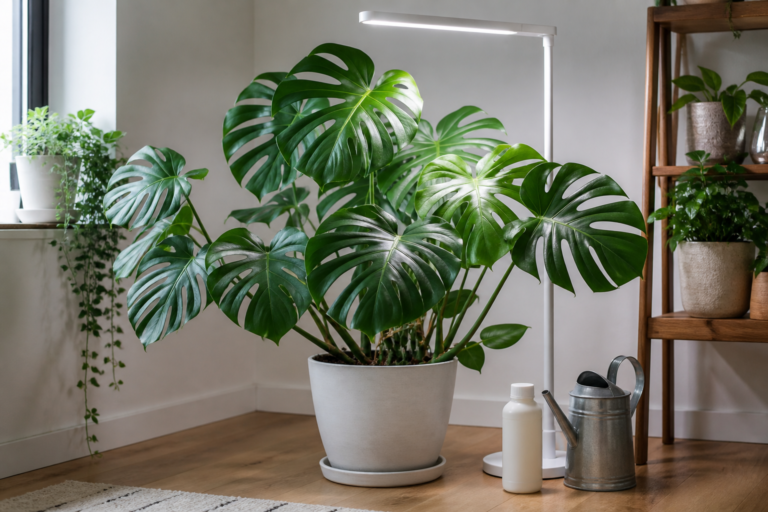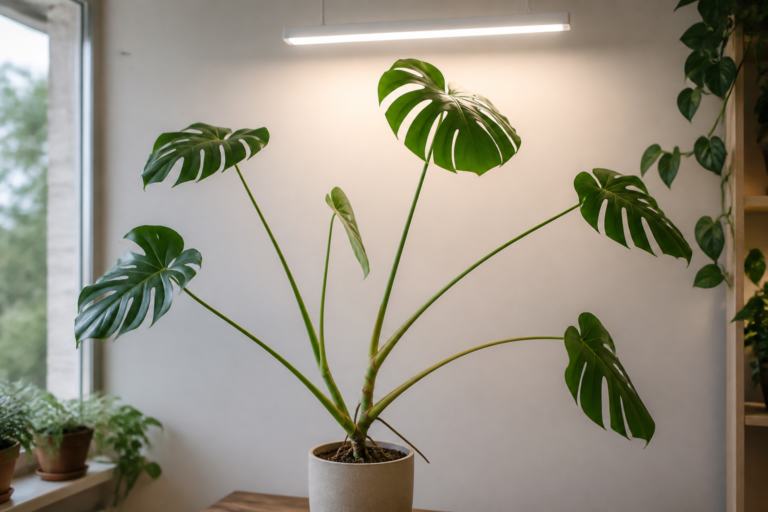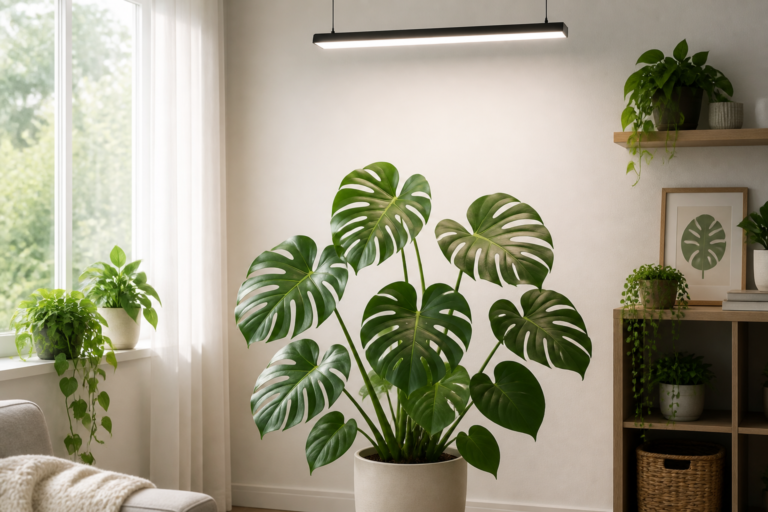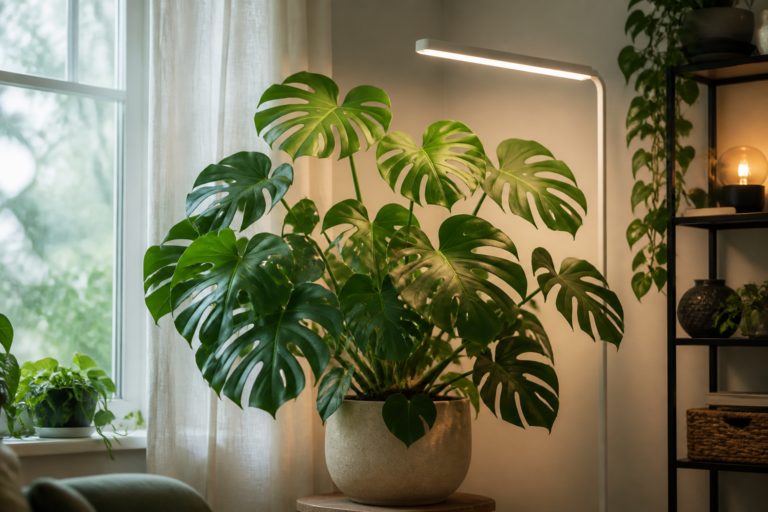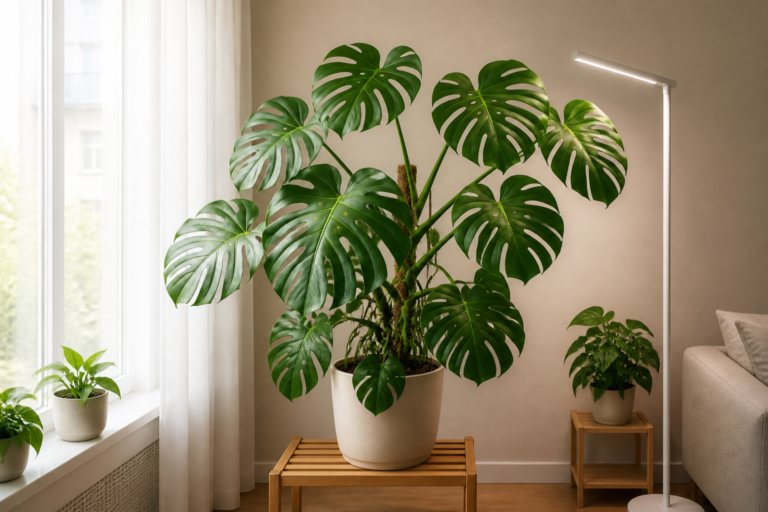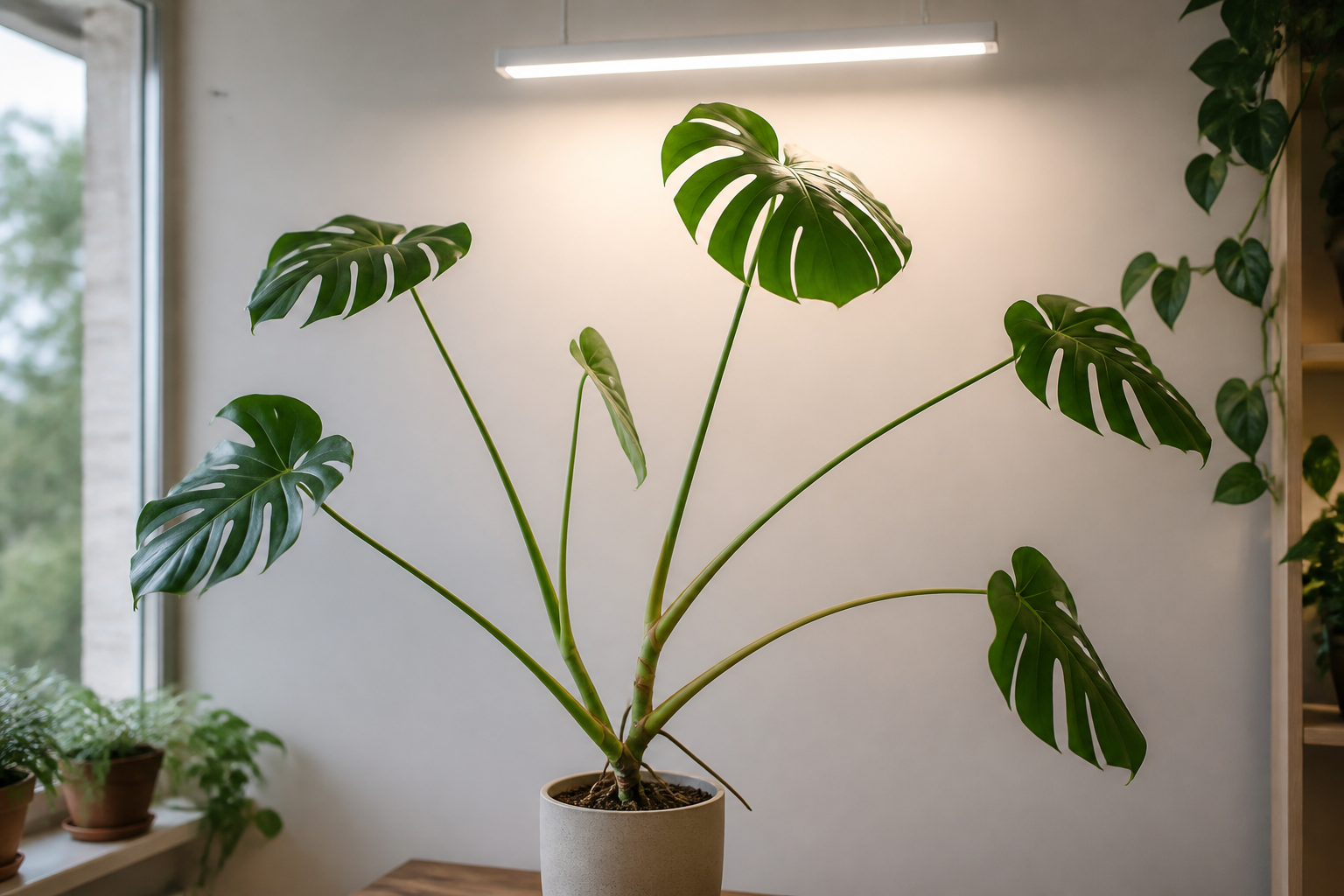
Your Monstera can stay leggy under a grow light when the leaves still receive too little usable intensity, the beam covers only the center, the timer is compensating for weak light, or the plant is reaching from one direction. Check leaf-level coverage, distance, duration, orientation, roots, and support before buying a stronger lamp.
Turning on a grow light is not the same as delivering enough useful light to every leaf. A Monstera may continue producing long internodes and thin, leaning growth when a small bulb lights only the top leaf, sits too far away, or competes with a brighter window from the side.
This guide separates those causes so you can make one measured change at a time. For the broader fixture and canopy setup, start with the Monstera grow-light guide.
Table of Contents
- Why a Monstera can stay leggy under a grow light
- First, confirm what leggy growth looks like
- Check intensity at the leaves, not the lamp label
- Check coverage: bright center, dim edges
- Check timing before adding more hours
- Check direction and plant orientation
- Rule out support, roots, water, temperature, and plant stage
- What to change first: a low-risk troubleshooting sequence
- Can pruning make a leggy Monstera look fuller
- Conclusion: measure the canopy, then change one lever
- Frequently Asked Questions
- References
Why a Monstera can stay leggy under a grow light
A grow light can be on while the plant still receives insufficient intensity, uneven coverage, or an unhelpful direction of light. Low usable light encourages longer spaces between nodes and reaching growth, while a lamp that is too narrow or one-sided can leave part of the canopy in a weak-light zone 1 2.
The first distinction is between old shape and new response. Existing internodes do not shorten when you improve the light. Judge the setup by the next leaves, the spacing on new stem growth, the firmness of new petioles, and whether the plant continues leaning toward a window or lamp.
There is also a practical attribution problem. A Monstera may look leggy after a move because it is a juvenile plant, has recently been repotted, lacks a climbing support, or is recovering from weak roots. A grow light should be tested as one part of the environment, not treated as the only explanation.
First, confirm what leggy growth looks like
Leggy growth usually combines long internodes, thin or widely spaced petioles, a stem that leans toward a light source, and new leaves that remain smaller than the plant's established potential. University of Minnesota Extension describes long, thin stems and extended spaces between nodes as classic signs of insufficient light 1.
Use a group of observations rather than one leaf. The table below helps you decide whether the grow light deserves attention first.
| What you notice | More consistent with insufficient usable light | Other possibility to check |
|---|---|---|
| New stem has long spaces between nodes | Light is weak at the active growth point or the plant is reaching toward a window | Juvenile growth, cultivar habit, or a recent move |
| Leaves lean in one direction | The brightest source is off to the side or the lamp does not cover the whole plant | Normal phototropism, pot rotation, or poor support |
| Upper leaf looks acceptable but lower leaves stay small or pale | The beam is concentrated at the top and fades across the canopy | Root stress, pests, or natural aging of older leaves |
| Lamp runs for many hours but growth remains stretched | Duration is compensating for low intensity or poor coverage | Lamp spectrum, temperature, root health, or a dormant season |
| Stem is long but leaves are firm and healthy | The plant may need support and time to mature as much as it needs more light | Species or cultivar growth form |
Photograph the whole plant from the same angle before changing anything. Include the lamp, the top leaf, the brightest window, the pot, and the support if one is present. A repeatable image makes the next new leaf easier to compare.
Check intensity at the leaves, not the lamp label
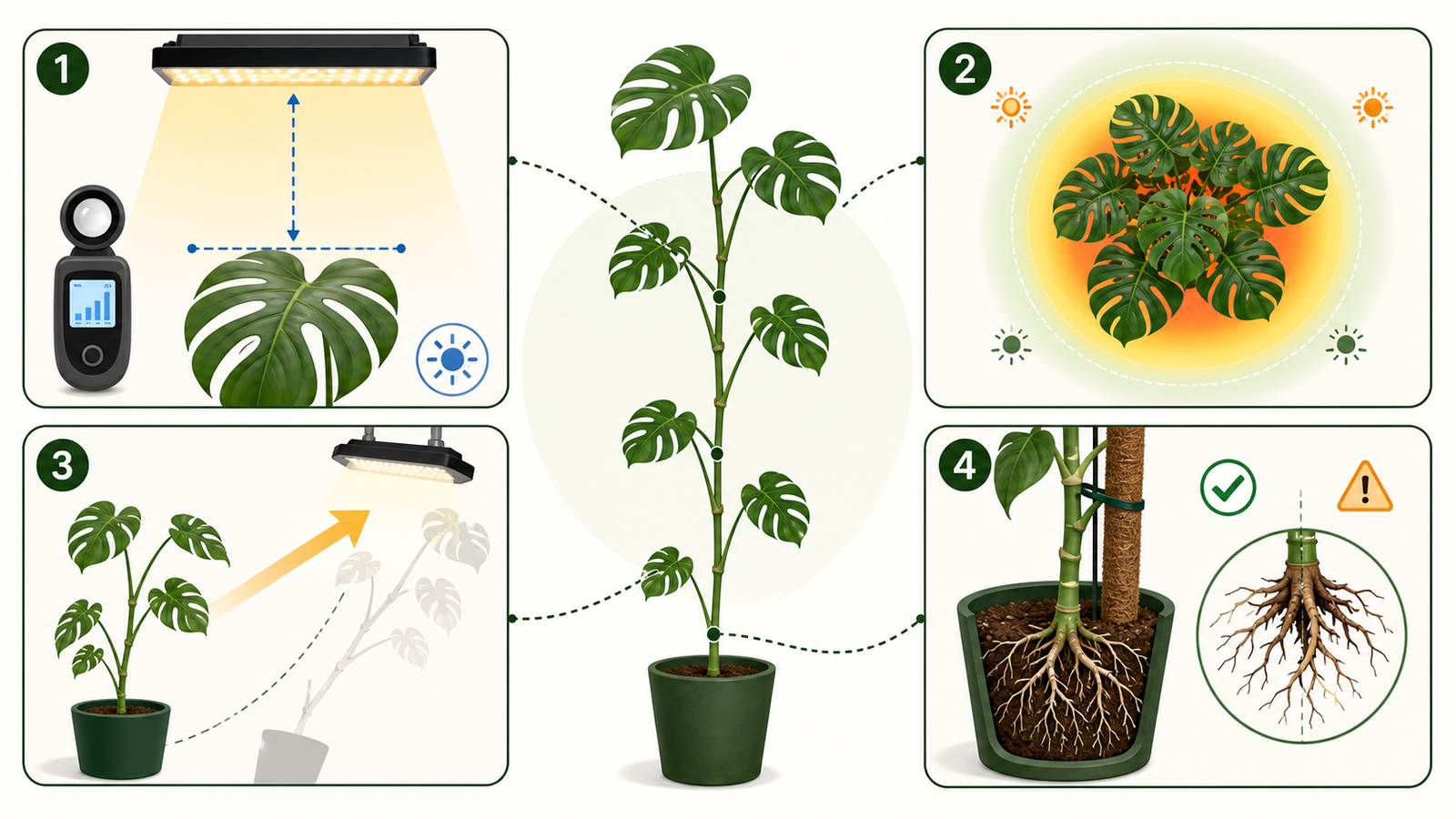
The useful question is how much plant-usable light reaches the leaf surface, not how many watts the fixture consumes. Iowa State Extension explains that PPFD is a more useful measure of light intensity at the plant than wattage or lumens alone, and that distance and angle change what reaches each leaf 2.
Start with the fixture's own output chart or PPFD map if it provides one. Compare the map's hanging height with the top, center, and edge of your Monstera canopy. A peak value in the center is not enough if the growing point or lower leaves sit outside the useful footprint.
If you have a quantum or PAR meter, take readings with the sensor parallel to the leaf surface. Measure at least three positions and record the fixture height, dimmer setting, and timer window. If you use a phone app, treat it as a relative comparison tool rather than a calibrated prescription; phone cameras and spectrum affect accuracy.
Do not respond to a leggy plant by immediately buying the strongest lamp available. A high-output fixture can create a hot spot or bleaching before it improves the shaded leaves. The safer test is to make the smallest change that raises leaf-level intensity across the active canopy, then hold the rest of the routine steady.
Check coverage: bright center, dim edges
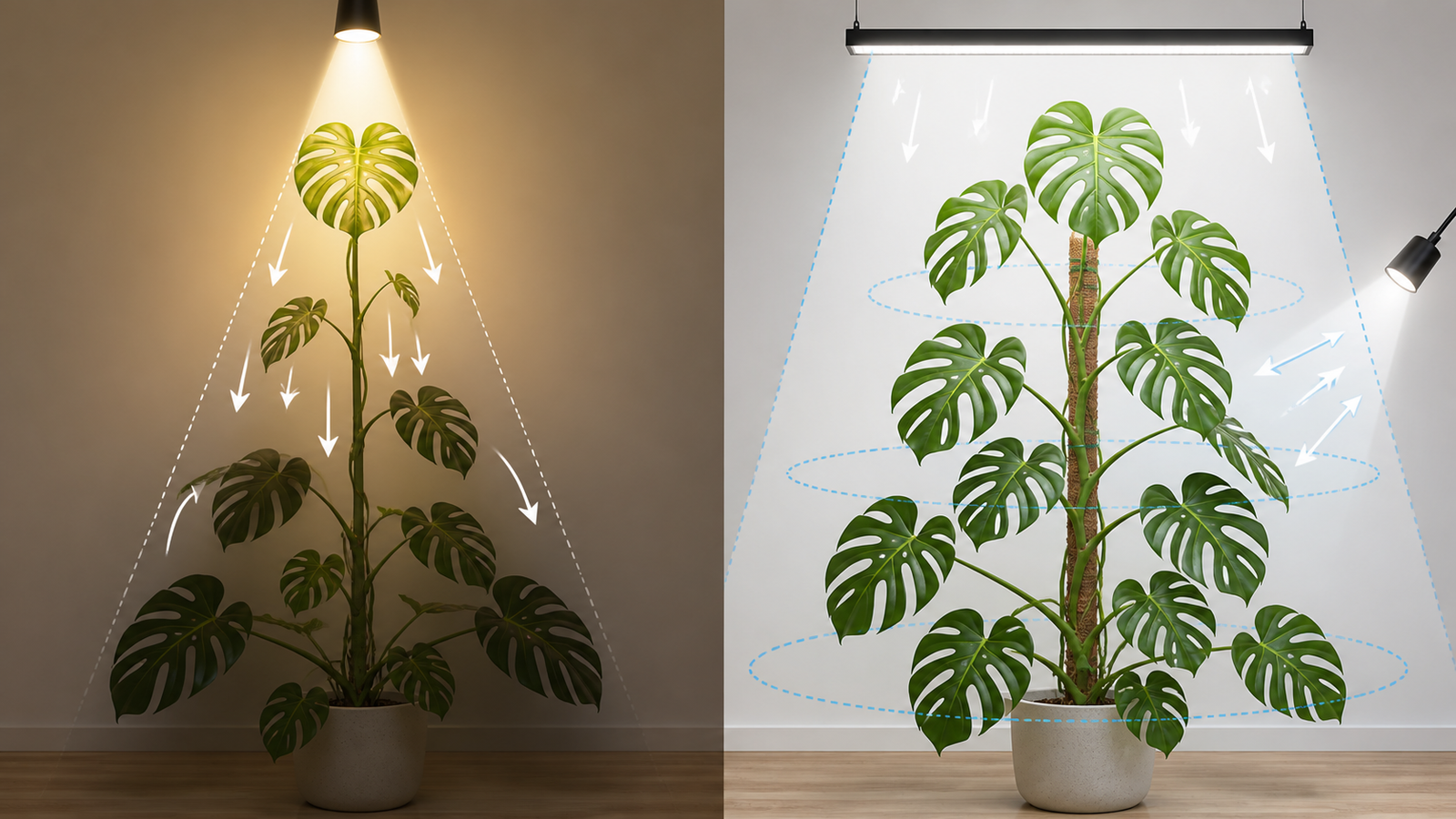
A narrow beam can make the top-center leaf look bright while the lower and outer leaves remain light-starved. Moving that fixture closer may increase intensity in the middle but shrink the area it covers, so “closer” is not automatically the same as “better” 2.
Map the canopy as a three-dimensional shape. Note which leaf is highest, which leaf is furthest from the lamp, and where the newest growth point sits. If the plant is tall, a broad bar, a second lower-output fixture, or a carefully positioned side light may provide more even coverage than a single bright bulb above the top leaf.
Reflective walls can spread light into darker parts of the plant, but reflected light is less intense and reflective materials can become warm. Keep fabric, water, and electrical connections away from a hot fixture. The goal is an even, repeatable footprint rather than a dramatic bright circle in one photograph.
Check timing before adding more hours
Longer runtime can increase a plant's daily light dose, but it cannot fully repair a weak beam or a shaded canopy. Extension guidance commonly starts foliage houseplants around 12–14 total light hours and recommends a consistent dark period, with a general home limit of no more than 16 hours when natural and artificial light are combined 1 2 4.
Count window light and grow-light hours together. A Monstera near a bright window may need supplemental light only in a cloudy afternoon or winter morning. A plant in a dark room may rely on the fixture for most of its daily light. A timer keeps the pattern repeatable and prevents accidental all-night exposure.
If the plant is stretching with cool, undamaged leaves, first check intensity and coverage before extending the timer. If the light map already covers the canopy but the total daily window is short, add a modest amount of runtime and observe new growth. Change one variable at a time so you know what actually helped.
Check direction and plant orientation
Monstera leaves and petioles can orient toward the strongest nearby source. A ceiling fixture may illuminate the top while a side window continues pulling the stem sideways, especially when the lamp is dim or positioned too high.
Look at the direction of the newest petiole rather than judging only the older leaves. If the newest growth points toward the window, move or angle the light to make the combined sources less unequal. If the newest growth points upward but the lower canopy stays dark, improve coverage rather than simply increasing the overhead intensity.
You can turn the pot slightly over a consistent interval if the space allows, but avoid daily chasing. Frequent rotations and lamp changes make the plant's response difficult to read. Keep a stable orientation long enough to see whether the next leaf develops with shorter spacing and a stronger petiole.
Rule out support, roots, water, temperature, and plant stage
Light is only one part of Monstera architecture. Monsteras are climbing plants, so a long stem may sprawl when it has no stable direction even after the light is adequate. A support for a climbing Monstera can help the stem grow upward, but it cannot replace adequate light or healthy roots.
Check the root zone if growth is weak, the pot stays wet, leaves yellow broadly, or the plant recently suffered a repot. Low light can reduce water use, while compact substrate, poor drainage, cold conditions, or root damage can also slow new growth. Do not extend the light period to solve a pot that remains wet.
Plant stage matters as well. A juvenile Monstera may naturally have smaller, less divided leaves and a different spacing pattern than a mature climbing specimen. Variegated cultivars can grow more slowly, and a recently propagated cutting may need to establish roots before it produces compact new growth. Use the Monstera light requirements and symptoms guide to compare low-light clues with excess-light and environmental look-alikes, then use the complete indoor Monstera care guide for the root, water, temperature, and support checks.
What to change first: a low-risk troubleshooting sequence
Use a short sequence that protects the plant from simultaneous changes. Iowa State Extension recommends monitoring growth over several weeks and adjusting intensity, coverage, or fixture placement when growth remains unacceptable 3.
- Record the baseline. Photograph the whole plant and newest leaf. Note fixture height from the nearest leaf, dimmer setting, timer window, window exposure, and support.
- Check the map. Confirm that the manufacturer range or PPFD chart covers the active growth point, not only the brightest leaf.
- Measure three positions. Compare top, center, and edge leaves. If the edge is much darker, solve coverage before increasing hours.
- Change one light lever. Move the fixture modestly, adjust the dimmer, widen the footprint, or add carefully placed side light. Do not change all four.
- Hold the timer steady. Keep a consistent dark period while the plant experiences the new intensity or coverage.
- Wait for new evidence. Review the next growth point and the pattern across several leaves. Existing long internodes will remain; the useful test is whether new growth is less stretched.
- Recheck non-light causes. If the next growth remains weak, inspect roots, substrate, pests, temperature, plant stage, and support before escalating the lamp.
| Pattern after the adjustment | What it suggests | Next useful move |
|---|---|---|
| New leaf is firmer and spacing is shorter | Intensity or coverage was part of the problem | Keep the routine steady and document the setting |
| Top leaf improves but lower leaves remain weak | Coverage is still narrow or too directional | Raise or widen the source, or add gentle side coverage |
| No new improvement and the pot stays wet | Light may not be the limiting factor | Inspect roots, drainage, substrate, and temperature |
| Plant grows toward the window despite the lamp | Combined light is still strongly one-sided | Re-angle the lamp or change the plant's position gradually |
| Leaves bleach, crisp, or heat up after the change | The correction was too intense or too close | Reverse the last change and check the fixture's safe range |
Can pruning make a leggy Monstera look fuller
Pruning can change the plant's outline, but it cannot make old internodes compact or correct an underpowered light. If the stem is healthy, a clean cut just above a node can create material for propagation or a shorter, more manageable plant; University of Minnesota Extension includes trimming leggy stems above a leaf node as part of seasonal houseplant care 5.
Treat pruning as a second-stage design decision after the light diagnosis. Use a clean tool, keep enough healthy foliage for recovery, and do not remove several leaves immediately after a repot, pest treatment, or major light change. A support can guide the remaining stem, while improved coverage gives future leaves a better chance to develop evenly.
If you propagate a cutting, give the new section the same stable, moderate light and avoid assuming that a brighter lamp will force instant maturity. The cutting's roots, node, cultivar, and support all influence how quickly it produces stronger growth.
Conclusion: measure the canopy, then change one lever
A Monstera can remain leggy under a grow light because the light is too weak at the leaves, too narrow for the canopy, too one-sided, or being used as a substitute for support and root-zone care. Start with the fixture map, inspect top-center-edge coverage, count the full daily light pattern, and watch the next new leaf instead of expecting old internodes to disappear.
Make one measured adjustment, keep a consistent dark period, and record what changes. If you need to review the full fixture decision, return to the Monstera grow-light guide before increasing output again.
Frequently Asked Questions
Why is my Monstera still leggy under a grow light?
The fixture may not deliver enough usable intensity at the leaves, may cover only the center of the canopy, or may be competing with a brighter side window. Check distance, PPFD or the manufacturer map, coverage, timer, orientation, roots, and support before changing the lamp.
Can more hours fix a leggy Monstera?
Sometimes a modestly longer daily window helps when intensity and coverage are already adequate. More hours will not fully fix a weak or narrow beam, and the plant still needs a consistent dark period. Improve leaf-level intensity or coverage first when stretching continues.
Is my grow light too far away if the Monstera is stretching?
It may be, but stretching can also come from a narrow footprint, one-sided window light, juvenile growth, or a support problem. Compare the top, center, and edge leaves with the fixture's published range before moving it closer. A closer lamp can create a hot spot and reduce coverage.
Should I rotate a Monstera under a grow light?
A gradual, consistent turn can reduce one-sided growth when the room's light is directional. Do not rotate and move the lamp every day. Keep the setup stable long enough to compare the next leaf, and use a better-angled or side light when the canopy is tall.
Should I cut off leggy Monstera stems?
Not automatically. First correct light, coverage, roots, and support. If the stem is healthy and the plant is established, pruning above a node can reshape it or provide a cutting, but it will not undo existing long internodes or replace a suitable growing environment.
References
- University of Minnesota Extension: Lighting for indoor plants and starting seeds — Leggy stems, long spaces between nodes, light intensity, distance, and general foliage-plant light duration.
- Iowa State University Extension and Outreach: Important Considerations for Providing Supplemental Light to Indoor Plants — PPFD, distance, angle, coverage, duration, DLI, and why watts alone do not describe plant-usable light.
- Iowa State University Extension and Outreach: How to Set Up Supplemental Lights for Indoor Plants — Monitoring growth, adjusting intensity, moving fixtures, using side light, and maintaining a timer.
- University of Maryland Extension: Lighting for Indoor Plants — Spindly growth under low light, spectrum considerations, and the need for a dark period.
- University of Minnesota Extension: Spring houseplant care — Practical seasonal pruning guidance for leggy houseplants.