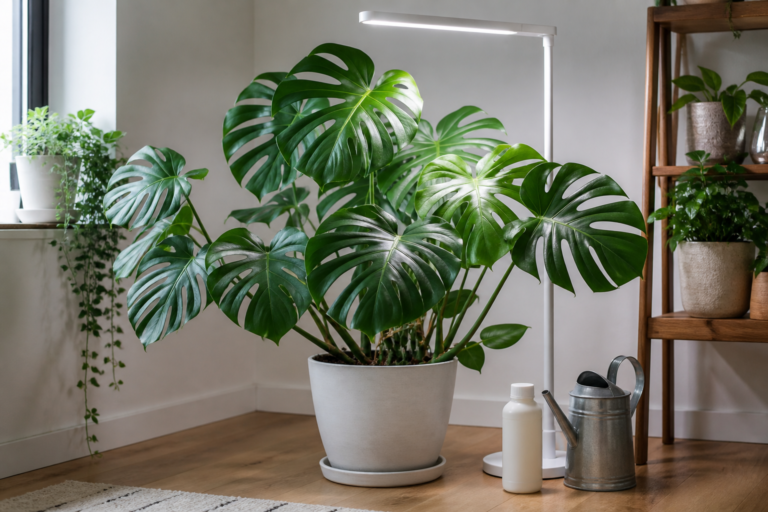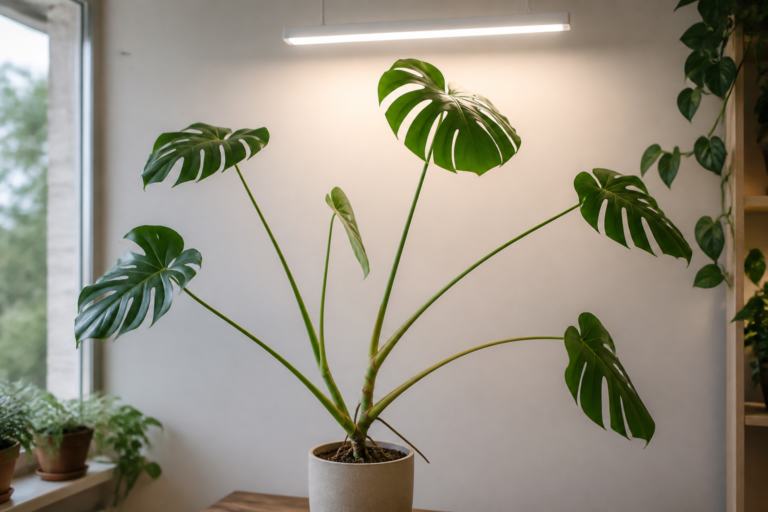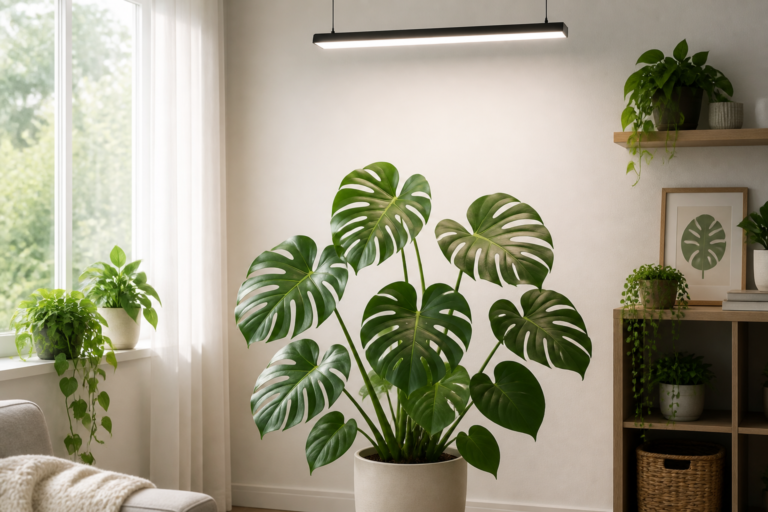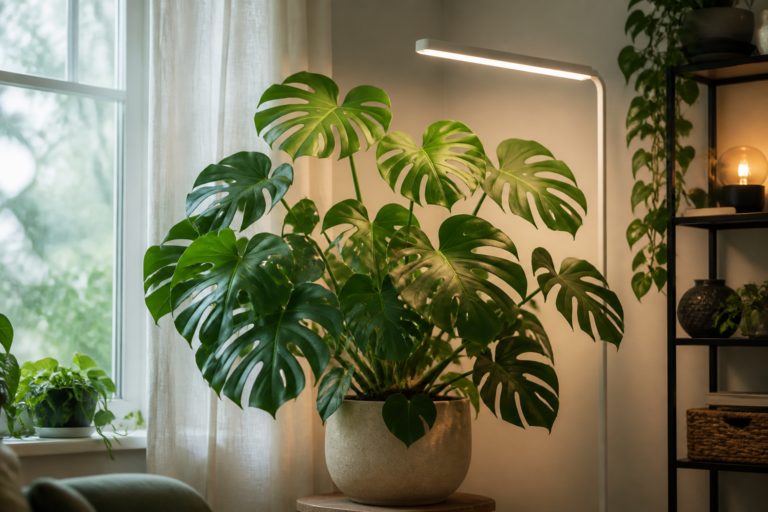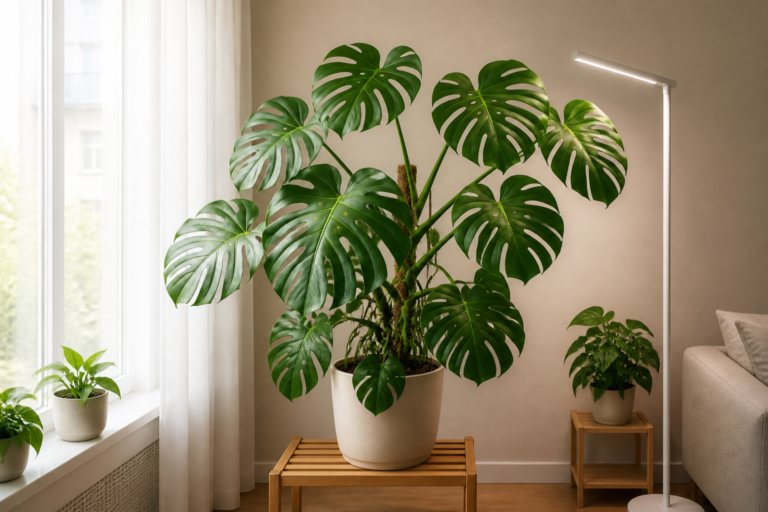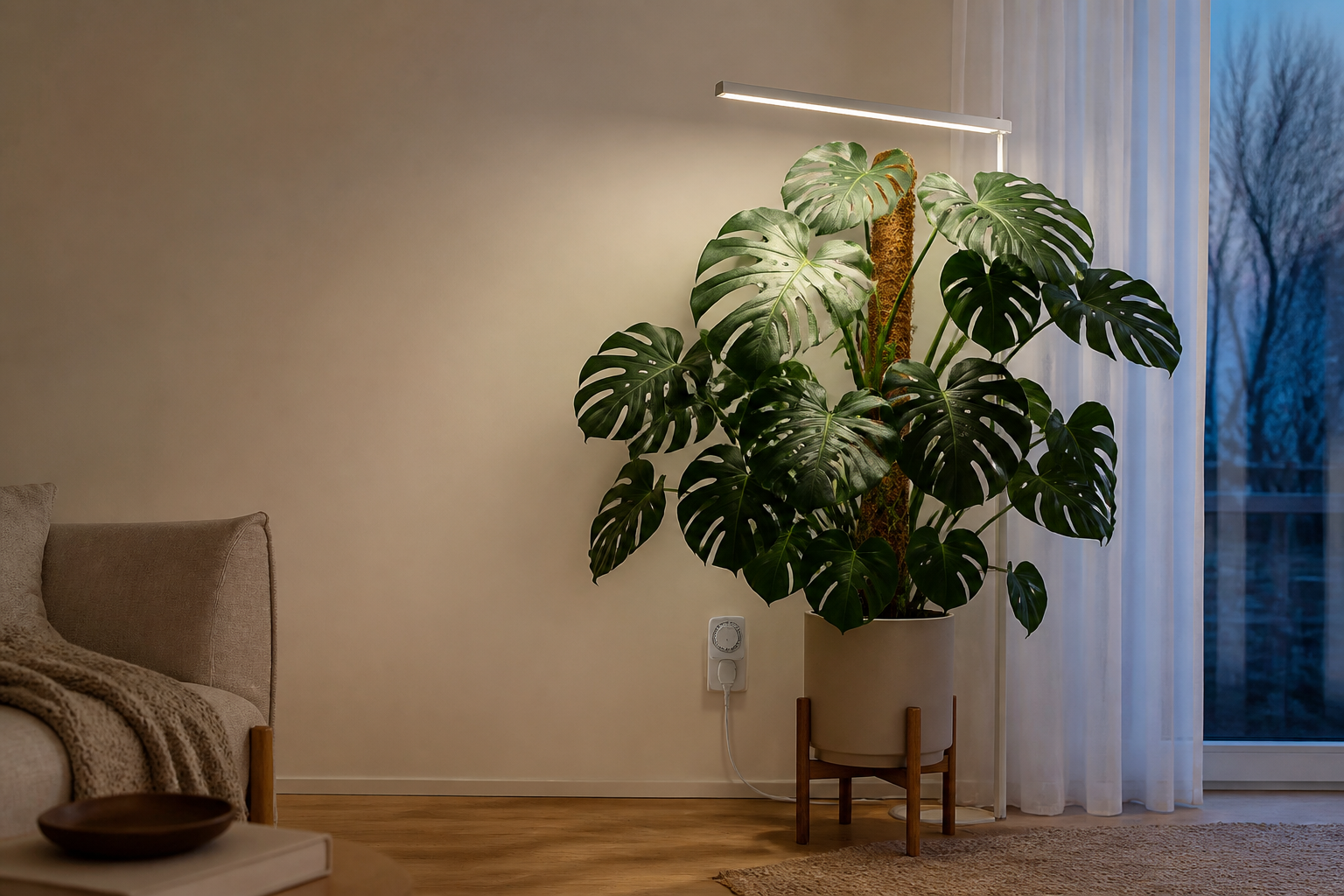
A Monstera grow-light schedule should change with the usable daylight already reaching its leaves, not with a fixed seasonal rule. In winter or a dark room, extend a consistent daytime light window; in bright summer, reduce or skip supplemental hours when the canopy already receives sufficient filtered light. Keep a reliable dark period and adjust gradually.
The right routine is not “more hours whenever growth slows.” A grow light can fill a daylight gap, but it cannot repair wet compact mix, weak roots, pests, or a plant that is simply adjusting to temperature and season. Start with the light at the leaf canopy, then use new growth, drying speed, and exposure damage to decide whether the timer needs a change.
If you are still choosing a fixture or checking its height, begin with the Monstera grow light guide. It explains why the fixture's PPFD map, canopy coverage, and hanging distance matter before you try to fine-tune the daily schedule.
Table of Contents
- What makes a seasonal grow-light schedule work?
- Set the baseline before changing the timer
- Winter: fill a shorter or weaker daylight gap
- Summer: protect the plant from a double dose of light
- Cloudy homes and deep rooms: make the routine dependable
- Use one seasonal table, then read your own plant
- Change watering and canopy setup with the light
- How to log a schedule without turning care into homework
- Conclusion: use a repeatable daytime window
- Frequently Asked Questions
- References
What makes a seasonal grow-light schedule work?
A useful schedule combines natural daylight and supplemental light into one predictable day, with darkness every night. The timer is only one part of the setup: the amount of light at the leaves, the fixture's distance and footprint, direct sun through the window, temperature, and the plant's current growth all change what the same number of hours means.
Light quantity, duration, and distribution work together. A long timer does not make a narrow lamp cover a broad Monstera canopy, and a very bright window can make a long supplemental run unnecessary or excessive. University guidance for indoor lighting recommends observing plant response over several weeks and fine-tuning the system rather than treating one initial setting as permanent. 2
Start from the plant's present conditions. A large Monstera near a bright, filtered window may need little help in summer but appreciate a more dependable daytime supplement in winter. A Monstera several feet into an interior room may need a routine through much of the year. Those are different starting points, even if the plants are the same species.
Set the baseline before changing the timer
Set distance and coverage first, then set a conservative daily window that leaves the plant a real night. Measure from the fixture to the highest active leaf, follow the fixture maker's hanging guidance, and check the center and edges of the canopy. A schedule cannot compensate for an outer leaf that the beam never reaches.
For a first setup, choose a consistent block during the day that complements the window rather than running the lamp around the clock. Iowa State Extension lists 14 hours as a general indoor supplemental-light starting point for common grow-light setups, while also emphasizing later adjustments from growth response. 2 Treat that as a starting reference, not a Monstera-specific command or a reason to ignore direct sun and the fixture's own instructions.
Before extending hours, compare low-light and excess-light symptoms. Long internodes, smaller pale new leaves, and a gradual lean toward the strongest light can support a low-light pattern. Bleached patches, crispy exposed tissue, or damage concentrated on the window- or lamp-facing side point in the opposite direction. The distinction matters more than the season printed on a calendar. 1 3
Winter: fill a shorter or weaker daylight gap
Winter is the season most likely to justify a longer, steady supplemental period, especially in a deep room, behind nearby buildings, or where daylight is shortened by a low sun angle and cloudy weather. The goal is to keep the leaves receiving usable light during the daytime—not to chase summer brightness with an all-night lamp.
Begin by looking at the actual window. Does the plant receive diffuse daylight for only a short part of the day? Has the sun's path moved behind a building? Are curtains closed for most daylight hours? If so, set the timer to create a reliable daytime extension, keep the fixture at a conservative distance, and let the plant experience uninterrupted darkness at night.
Use observations to judge whether the winter schedule is helping:
- New internodes are not becoming progressively longer and thinner.
- The newest leaves are firm and appropriately colored for the plant, rather than consistently pale.
- The canopy is evenly lit, not bright only in the center.
- The potting mix still goes through a sensible wet-to-dry cycle instead of remaining heavy for an unusually long time.
Low light can slow growth and water use, so it is normal to check the pot less often in a dim winter room. 1 Do not answer a persistently wet pot by merely adding hours. Inspect drainage, root health, pot size, and substrate first; an airy Monstera soil mix guide can help you understand the root-zone side of that decision.
Summer: protect the plant from a double dose of light
Summer is when a previously helpful lamp can become an unnecessary second source of intensity. Longer days, a higher sun angle, and direct afternoon beams can transform a calm winter location into a much brighter and warmer one. Reduce supplemental time, dim the fixture, raise it within the maker's safe range, or skip it when the window already gives the canopy sufficient filtered light.
Watch the exposure pattern rather than assuming every summer day is bright. A sheer curtain may keep a sunny window suitable; an unshaded west-facing window can become harsh quickly. Signs such as bleached areas, crisp tan patches, or damage focused on the sun-facing or lamp-facing side mean the plant needs less intensity or a softer exposure—not a longer day. 1 2
Avoid changing every variable at once. If direct sun suddenly reaches the plant, soften or block the beam first. If the plant is otherwise in bright indirect light, shorten the timer before moving the lamp and changing its output together. A single change gives you a clearer answer when you inspect the next leaf.
Summer warmth can also make the mix dry faster. That is a cue to check moisture more often, not a mandate to water on a new schedule. The complete indoor Monstera care guide can help you coordinate water, temperature, roots, and light instead of treating each one in isolation.
Cloudy homes and deep rooms: make the routine dependable
A cloudy home or deep room benefits most from consistency, not from frantic day-to-day timer changes. If the plant lives away from a window, faces a permanently shaded exposure, or receives little useful daylight due to surrounding buildings, a regular grow-light block can give the canopy a more dependable daytime signal through the year.
Set the fixture so it covers the leaves you expect to grow, not just the pot. As a Monstera climbs, the top leaf may move closer to the lamp while lower or outer leaves fall outside the strongest footprint. Recheck placement whenever a new leaf changes the canopy's height or width. A climbing Monstera support can keep stems stable while you position the plant and light, but the support does not eliminate the need to map the beam.
On a run of especially dark days, resist adding multiple hours every evening without evidence. Keep the daytime window consistent, take note of the natural-light change, and observe the plant over the following weeks. A fixture that is too close or too intense can still stress foliage in a cloudy home. The plant's response matters more than whether the weather app calls it a gloomy week.
Use one seasonal table, then read your own plant
Use the table as a decision framework, not as a promise that every home needs the same number of grow-light hours. Start conservatively, change one lever at a time, and retain a predictable night. The exact setting depends on the lamp's published output, its hanging distance, the canopy's size, and the daylight that reaches the leaves.
| Home condition | What changes | Practical schedule move | What to observe before the next change |
|---|---|---|---|
| Winter with short, weak, or obstructed daylight | Usable window light declines; water use may slow | Use a reliable daytime supplement; lengthen only as needed to fill the daylight gap | New internode length, leaf color, canopy coverage, and slower drying mix |
| Bright summer with filtered daylight | Natural light and heat increase | Shorten, dim, raise, or skip supplemental lighting when the canopy is already well lit | Window-facing bleach or scorch, hot spots, and faster drying |
| Summer with direct sun on leaves | Exposure can change rapidly by hour | Diffuse or move out of the direct beam first; do not stack a long lamp run on it | Whether fresh damage stops on exposed leaves |
| Cloudy, north-facing, or deep room | Daylight remains low or uneven | Keep a dependable daytime routine with even coverage; reassess after new growth | Leaning, pale new leaves, long internodes, and shaded canopy edges |
| Plant recently moved or newly put under a lamp | The plant is acclimating to a new light environment | Start more gently and avoid simultaneous changes to distance, output, and hours | New growth and any localized stress, not old damage |
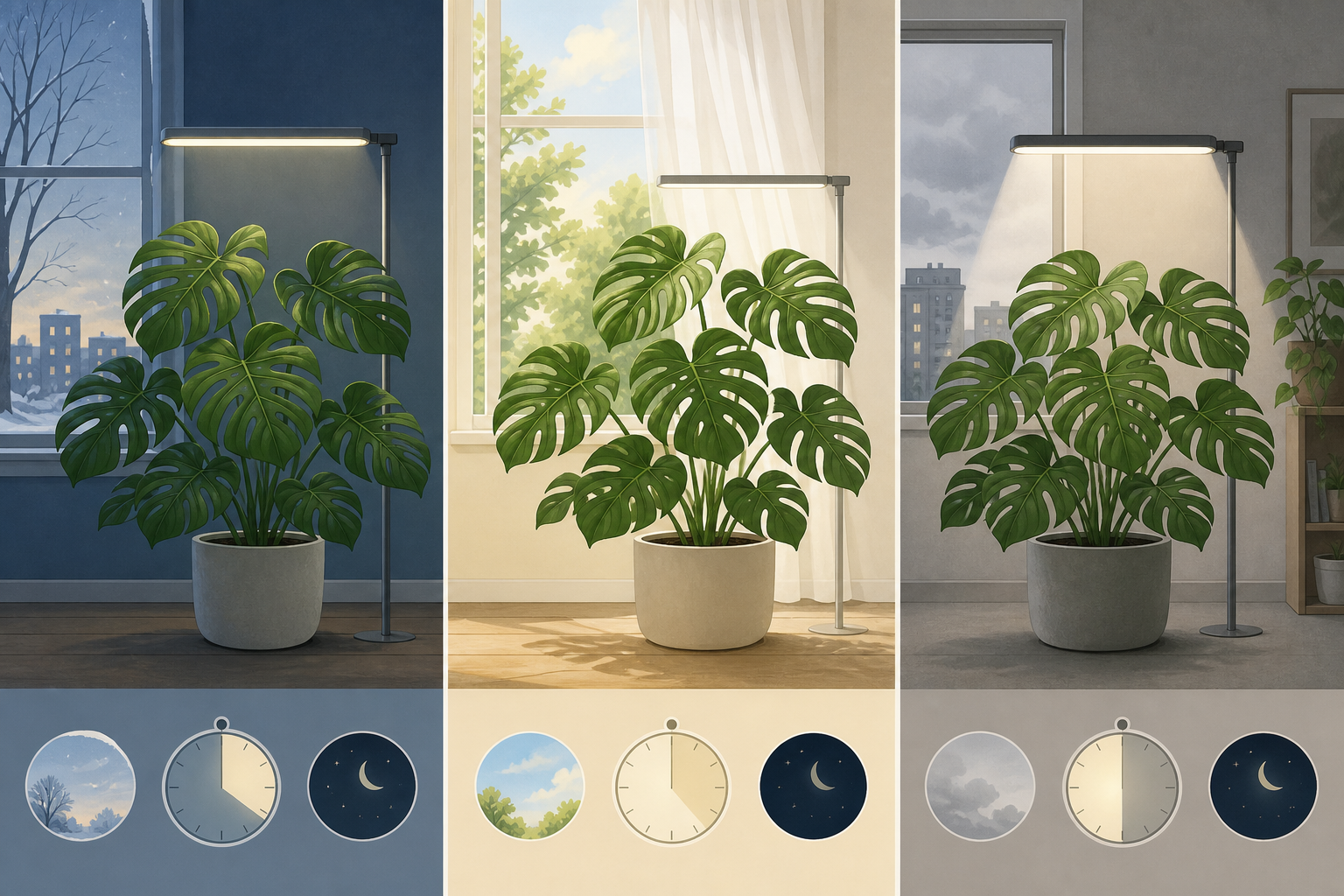
The same fixture may need a different routine as daylight and the room's usable light change.
Change watering and canopy setup with the light
When you increase useful light, a healthy plant may use water more quickly; when usable light falls, the same pot can stay moist longer. That relationship is a reason to check the mix and plant weight more often after a lighting change, not a reason to prescribe a universal watering day. Minnesota Extension similarly notes that lower-light plants use less water and advises checking soil to avoid overwatering. 1
Keep the light review connected to the whole plant. If the mix is compact or slow to drain, extra hours may not solve the problem you see. If the plant is top-heavy or the newest leaves have outgrown the lamp's original footprint, stabilize the stems and re-center the canopy before blaming the timer. A high, supported leaf may now be much closer to the fixture than it was a month earlier.
There is also no need to force feeding because you extended the light period. Only consider nutrition when the plant is actively growing and the root zone is healthy. More light changes the context for water and nutrients; it does not make a stressed root system ready for every other adjustment at once.
How to log a schedule without turning care into homework
A simple record can prevent the common mistake of crediting or blaming the timer for every change. Before adjusting the schedule, take one photo of the whole plant, one of the newest leaf or node, and one showing the lamp-to-canopy relationship. Write down the season, whether direct sun reached the leaves, the timer window, and any change in the plant's location.
Check the same points weekly or when a new leaf appears. You do not need a laboratory. If you have a properly calibrated quantum/PAR meter, readings at the top, center, and outer canopy can add useful detail; otherwise, the fixture's published map and careful observations are a sensible basis for a home setup. 2
The most useful log entries are modest: “outer leaf in shade,” “new top leaf closer to lamp,” “pot still heavy after normal interval,” or “direct sun now hits the right side after 3 p.m.” Those facts make the next adjustment obvious. They also stop you from changing hours, distance, water, fertilizer, and location in the same week.
Conclusion: use a repeatable daytime window
Your Monstera does not need a rigid seasonal clock. It needs a stable daytime light window that reflects the usable daylight in its particular room, enough darkness overnight, and small adjustments as the window, weather, and canopy change. Set coverage and distance first, use winter to fill a real gap, protect against summer's double dose, and let the next growth tell you what to adjust.
Frequently Asked Questions
How many hours should a Monstera grow light run in winter?
There is no single Monstera-specific number that fits every home. Use a consistent daytime block to supplement the daylight that actually reaches the canopy, retain a clear dark period, and adjust gradually based on new growth, lamp distance, and the fixture's published guidance. General indoor-lighting guidance commonly starts at up to 14 hours, then fine-tunes from plant response. 2
Should I reduce Monstera grow-light hours in summer?
Often, yes—if summer brings abundant filtered daylight to the leaves. Shorten, dim, raise, or skip supplemental light when the canopy is already well lit, and give priority to protecting leaves from direct, hot window exposure. Do not assume that every summer location is bright; observe the actual room.
Can I leave a grow light on all night for my Monstera?
No. Build the supplemental hours into a reliable daytime window and leave a consistent dark period. More time is not a substitute for appropriate intensity, coverage, or root-zone care.
Do cloudy days mean I should add extra light every day?
Not automatically. In a consistently dark room, a dependable baseline timer is usually more useful than frequent reactive changes. Note long cloudy periods, but adjust only after you see a pattern in the plant and confirm that fixture placement is even and safe.
Why is my Monstera drying faster after I improved its light?
More usable light can increase a healthy plant's water use, and summer warmth can add to the effect. Check the mix before watering rather than keeping the old schedule. If drying becomes extreme or leaves show damage, review heat, direct sun, potting mix, and lamp distance as well.
References
- University of Minnesota Extension. Lighting for indoor plants and starting seeds. Accessed August 14, 2026.
- Iowa State University Extension and Outreach. How to Determine How Much Supplemental Light to Provide for Indoor Plants. Accessed August 14, 2026.
- UC Statewide Integrated Pest Management Program. High and Low Light. Accessed August 14, 2026.