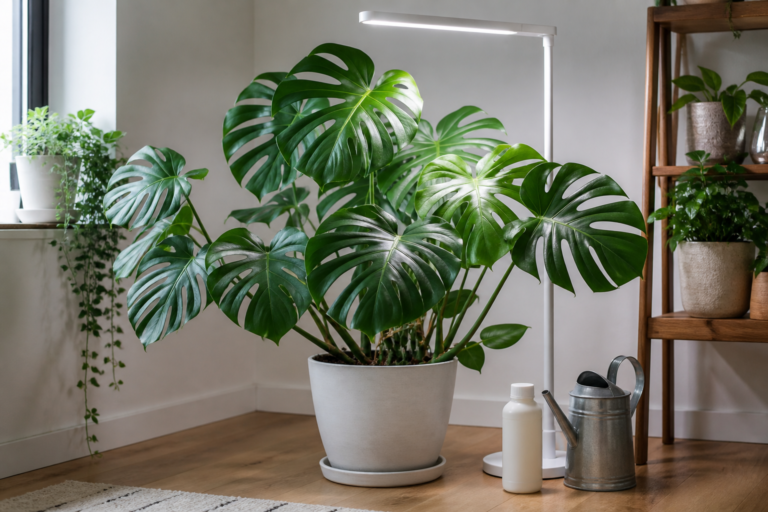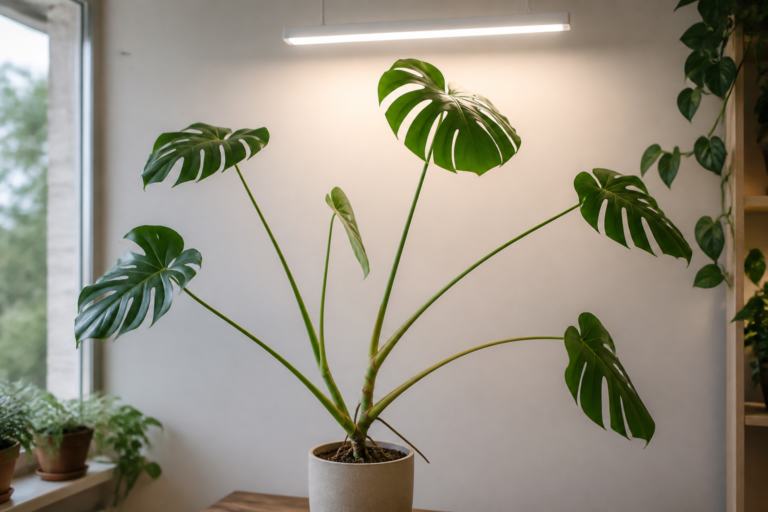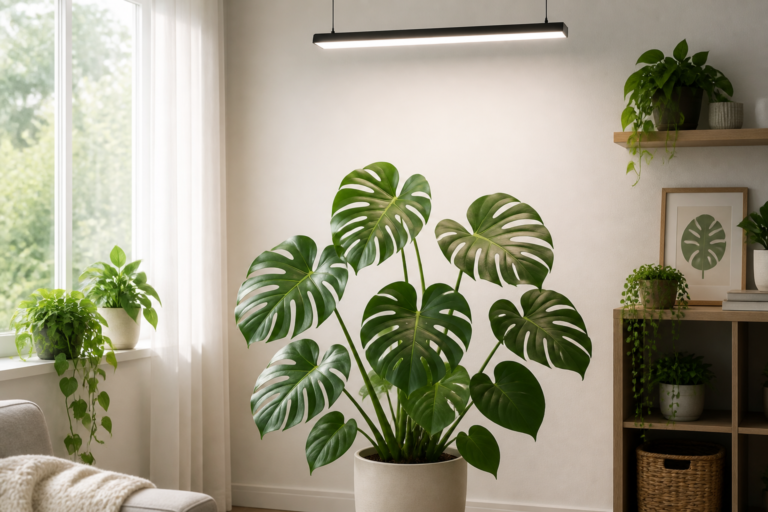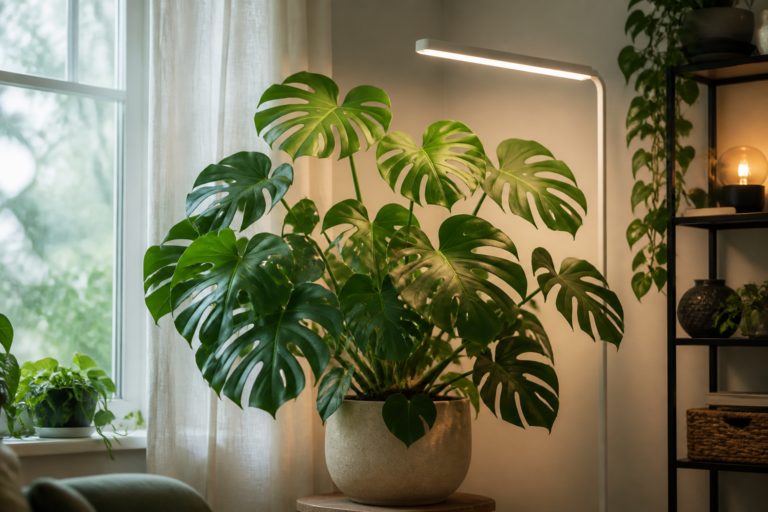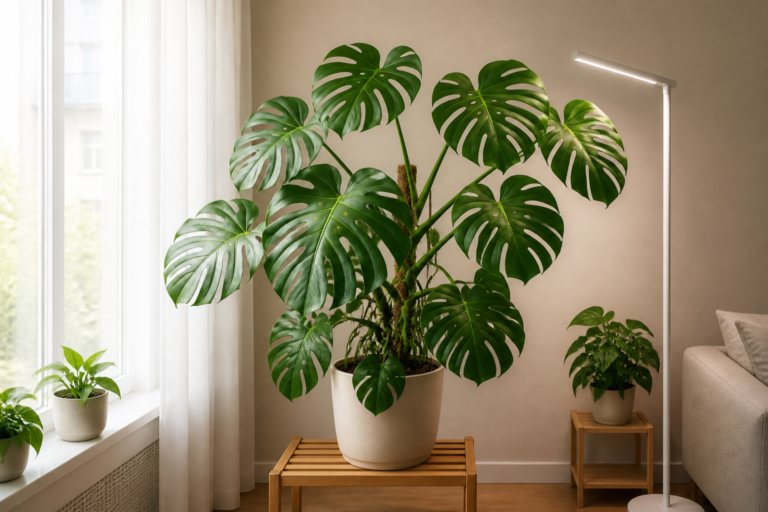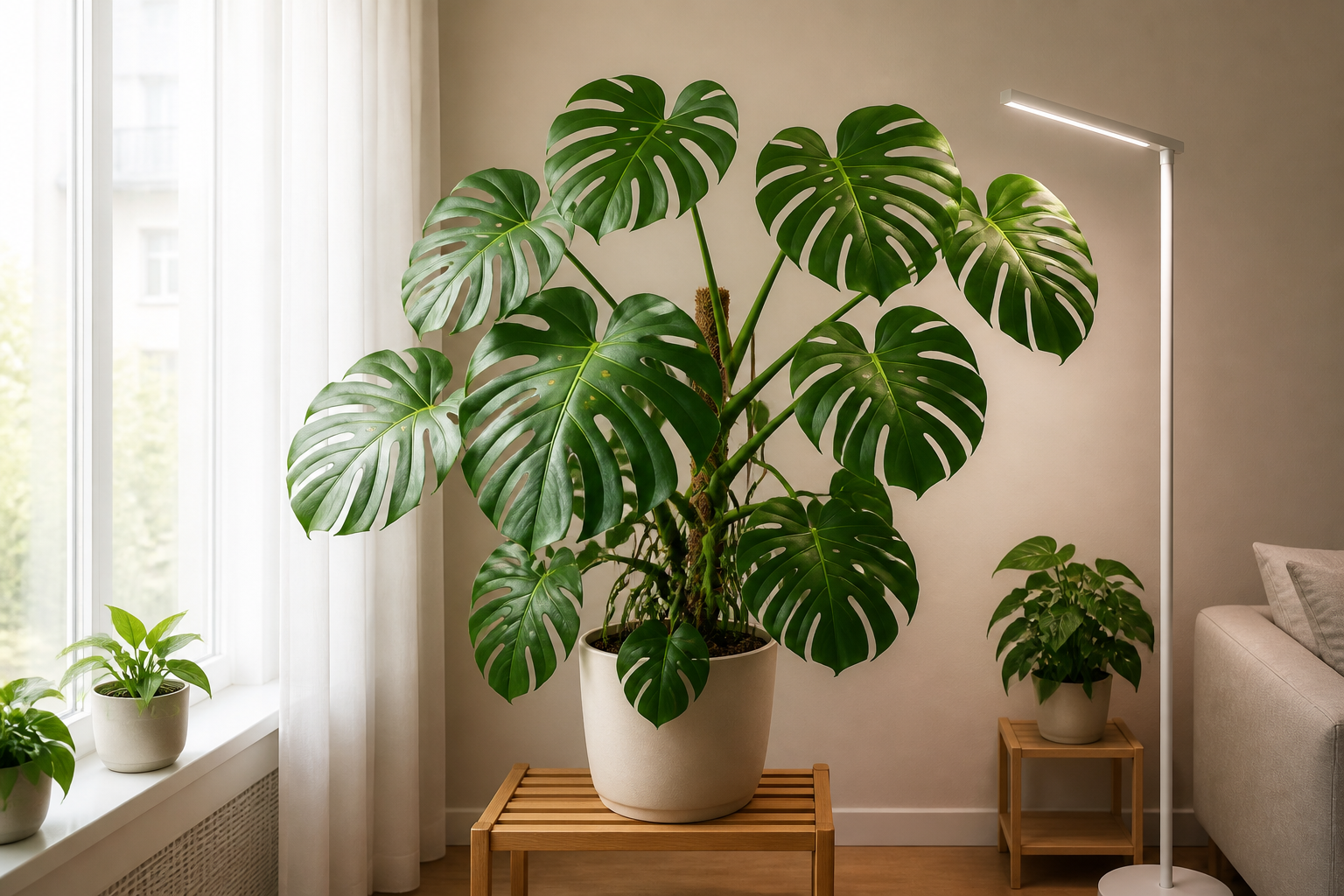
If you are comparing window light vs grow lights for monstera, start with the light pattern your room can repeat. A bright, filtered window may be enough when the whole canopy receives useful light for much of the day. A grow light becomes valuable when distance, weather, seasons, or room placement create a predictable gap. Many homes work best with window light as the baseline and a timed grow light as a gentle supplement.
This guide compares what each source can and cannot do, then gives you a practical way to choose, combine, and adjust them for a Monstera deliciosa. For fixture placement and coverage after you decide supplemental light is necessary, continue to the Monstera grow-light guide.
Table of Contents
- Is window light or a grow light better for a Monstera?
- How window light behaves indoors
- How grow lights change the decision
- Window light vs grow lights: a side-by-side comparison
- When window light is enough
- When a Monstera needs supplemental light
- How to combine window light and a grow light
- Use the whole plant to judge the setup
- A simple decision routine
- Conclusion: choose the light pattern your room can repeat
- Frequently Asked Questions
- References
Is window light or a grow light better for a Monstera?
Neither is automatically better. Window light can provide a broad, natural spectrum with no equipment cost, but it changes with the window direction, glass, curtains, weather, season, and the plant’s distance from the glass. A grow light provides repeatable timing and intensity, yet it covers only the area it is designed to cover and can add heat or glare if placed poorly.
Choose window light when the Monstera is close enough to a bright, unobstructed window for new leaves to develop without long, weak spacing. Choose supplemental light when the plant sits deep in a room, the window is shaded, winter days are short, or the canopy has bright and dim sides. Combining both is often the most forgiving option: let the window supply a daylight baseline, then use a timer-controlled fixture to fill the repeatable low-light period.
How window light behaves indoors
Natural light is free and visually broad, but “bright room” is not the same as bright light at a Monstera leaf. Light drops quickly as a plant moves away from a window. A sheer curtain, exterior building, balcony, tree, tinted glass, or neighboring wall can reduce the usable amount further. The direction matters too: a north-facing window is usually gentler and dimmer, while a south-facing window can deliver stronger direct sun and more heat.
The daily pattern also changes. Summer sun may reach deep into a room, while a winter sun sits lower, days are shorter, and cloudy weather can remove the high-light portion of the day. Illinois Extension notes that indoor plants receive only a small fraction of outdoor light and that both intensity and duration change with the season. Treat a window as a moving light source rather than a fixed specification.
| Window variable | What it changes for a Monstera | Practical check |
|---|---|---|
| Direction | Total intensity and risk of hot direct rays | Watch the newest leaves, not only the view outside |
| Distance | Canopy brightness drops rapidly farther from glass | Compare the front and back leaves |
| Obstructions | Trees, buildings, screens, and curtains reduce light | Recheck after leaves or furniture move |
| Season and weather | Day length and bright-light hours fluctuate | Notice winter slowdown or cloudy-week stretch |
| Window height | Upper leaves may receive more light than lower leaves | Rotate the pot and inspect internode spacing |
Window light also creates an uneven canopy. The leaf nearest the glass may be well lit while a lower or rear leaf remains in shade. Rotating the pot can even out growth, but rotation cannot create light that the room does not provide. If the plant is healthy but the far side repeatedly produces smaller leaves, the issue may be coverage rather than fertilizer.
How grow lights change the decision
A grow light turns a variable part of the room into a controllable routine. You decide when it switches on, where it points, and which part of the canopy it covers. A timer can make the pattern consistent through cloudy weeks and winter, and the plant can stay in a visually convenient location instead of occupying the best window ledge.
The trade-off is that a fixture is not a magic “sun replacement.” Watts describe electricity use, not the amount of plant-usable light reaching the leaf. Iowa State Extension recommends thinking about PPFD at foliage level, fixture distance, angle, and coverage. Moving a light closer raises intensity but can shrink the footprint and increase heat; moving it farther spreads light but may leave the center too weak. A broad fixture over the canopy is often more useful than a bright spot aimed at one leaf.
Grow lights also change the room’s thermal and watering pattern. A bar close to leaves may warm the upper canopy, while a fixture in a cool corner may have little temperature effect. After installing one, watch how quickly the pot dries and whether the brightest leaves curl, bleach, or develop crisp patches. Light changes can alter water use even when the watering calendar has not changed.
Window light vs grow lights: a side-by-side comparison
| Decision factor | Natural window light | Grow light | Best practical use |
|---|---|---|---|
| Availability | Depends on orientation, season, weather, and obstructions | Available wherever a safe outlet and mounting point exist | Use the window first when it is genuinely bright |
| Timing | Naturally follows sunrise, clouds, and sunset | Set by a timer and adjusted intentionally | Use a timer to make a supplement repeatable |
| Spectrum | Broad daylight, filtered by glass and curtains | Depends on the fixture, usually designed for plant growth | Avoid judging by color alone; look at plant response |
| Canopy coverage | Often brightest on the window-facing side | Can be positioned over the full canopy | Choose the source that reaches the leaves you want to grow |
| Heat and glare | Direct sun can heat leaves and pots | Close fixtures can warm leaves or annoy people | Check leaf temperature and room comfort |
| Cost and setup | No fixture purchase or mounting | Fixture, timer, cord management, and possible meter | Add equipment only when the room has a real gap |
| Adjustability | Move the plant, curtains, or pot angle | Change height, angle, duration, or coverage | Change one variable at a time |
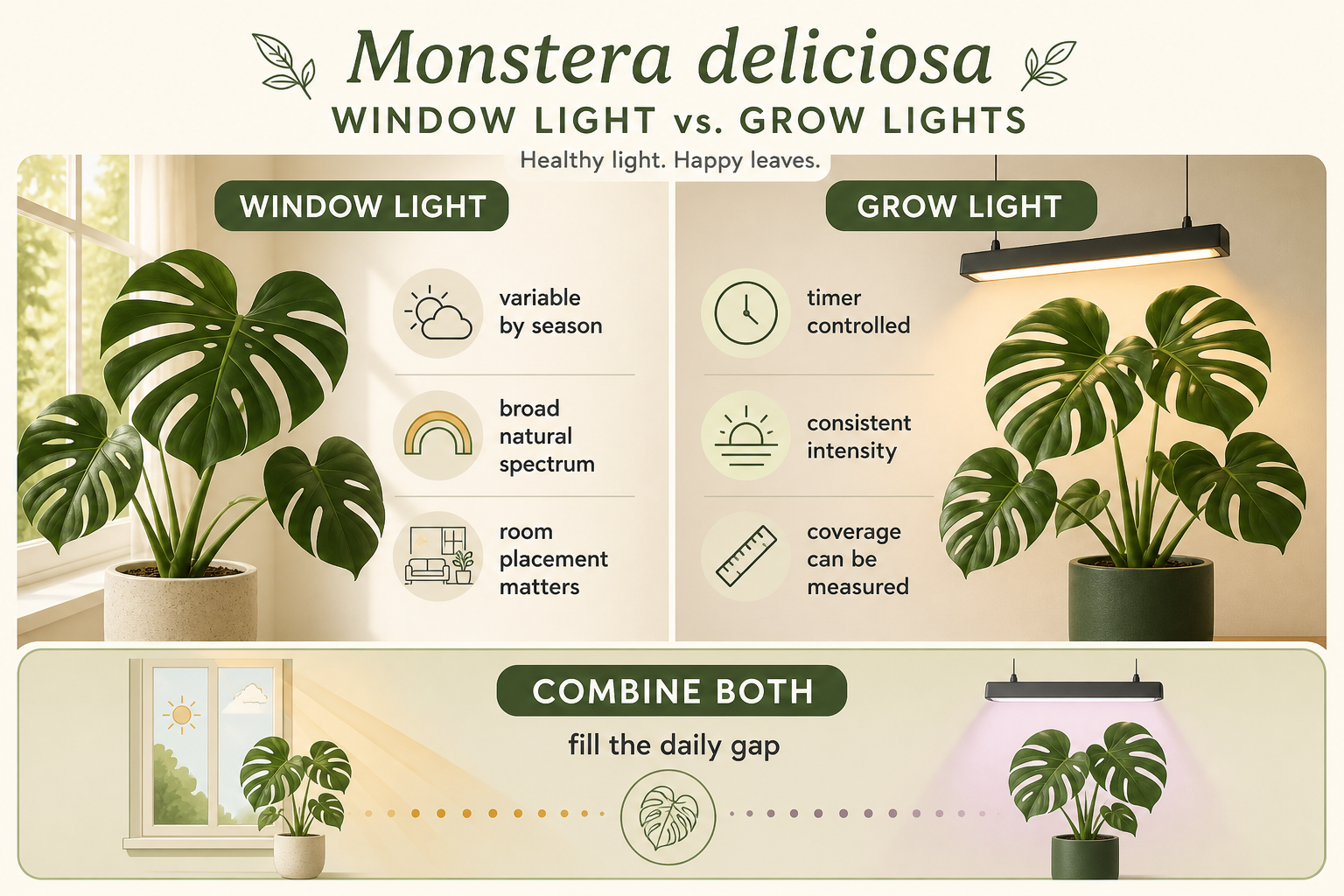
The comparison is not a contest between “natural” and “artificial.” It is a question of consistency at the leaf. A window can be excellent for one plant on one shelf and inadequate for another plant three feet away. A grow light can be helpful over a broad canopy and excessive when a narrow beam sits inches from one leaf. Judge the delivered pattern, not the label on the source.
When window light is enough
Window light is probably doing enough when the Monstera produces steady new growth, the stems do not become unusually long between leaves, and the canopy remains reasonably even after you rotate the pot. New leaves should unfurl with normal size for that plant, and the petioles should not all lean dramatically toward the glass.
The pot’s drying rhythm can provide a second clue. A plant in useful light usually uses water more actively than the same plant in a dark corner, although temperature, pot size, substrate, and humidity also matter. Do not water simply because the calendar says it is time; feel the mix and inspect roots when necessary. If the plant is growing slowly but the leaves are firm, roots are healthy, and the room is cool, slower growth may be a seasonal response rather than a lighting failure.
Filtered light is often a good starting point for a large-leaf Monstera. Strong direct afternoon rays through clear glass can heat the leaf surface and cause pale, crispy, or bleached patches. If a sunny window is the only option, a sheer curtain or a small increase in distance may soften the peak while preserving useful daylight. Turn the pot gradually so one side is not shocked by a sudden change.
When a Monstera needs supplemental light
Consider a grow light when several signals point in the same direction:
- New leaves are noticeably smaller or farther apart than earlier leaves.
- Petioles and stems stretch toward one direction, especially in a deep room.
- The window-facing side grows while the rear side stalls.
- Winter or a long cloudy period causes a clear slowdown and the plant is otherwise healthy.
- The plant must live away from the window for safety, furniture, pets, or room design.
- A mature canopy shades its own lower leaves and one fixture or window cannot reach the whole plant.
One symptom alone is not proof. Small leaves can reflect a young cutting, root stress, a recent repot, or lack of support. Pale leaves can result from nutrition or root trouble, while scorch can come from heat rather than a high daily light total. Use the Monstera light requirements and symptoms guide to compare several clues before moving a fixture close to the plant.
Supplemental light is especially useful when the room’s problem is timing rather than total darkness. A short, dim winter day may need a modest fill, not an all-day blast. A cloudy apartment can use the grow light on dull afternoons while leaving bright window days mostly natural. This approach saves energy and reduces the chance of treating every low-reading moment as an emergency.
How to combine window light and a grow light
Start by mapping the daylight your Monstera already receives. For three to five days, note the brightest window-facing leaves, the dimmest leaves, the time of day the room becomes visibly dull, and whether direct rays heat the foliage. The goal is not a perfect laboratory measurement; it is a repeatable picture of the room.
Next, place the grow light so it fills the weak section of the pattern. A bar above the canopy can soften the front-to-back difference. A side light can help a plant that grows toward a window, but it may need rotation to prevent one-sided growth. Keep the fixture far enough away that leaves do not feel hot or show bleaching, and make sure cords and water stay separated.
Use a timer for a consistent daytime supplement and preserve a dark period overnight. Illinois and Minnesota Extension guidance both emphasize that foliage plants benefit from a dependable daily duration rather than an unbroken light cycle. The exact schedule depends on the natural light already present, the fixture, and the plant’s response. If you want to translate a leaf-level reading into a daily total, use the PPFD, DLI and PAR guide instead of guessing from wattage.
Think of the fixture as a fill light. On a bright day, it may run for a shorter overlap or remain off. During a dull winter afternoon, it can extend the useful period. The seasonal Monstera grow-light schedule can help you turn that idea into a practical winter, summer, and cloudy-home routine.
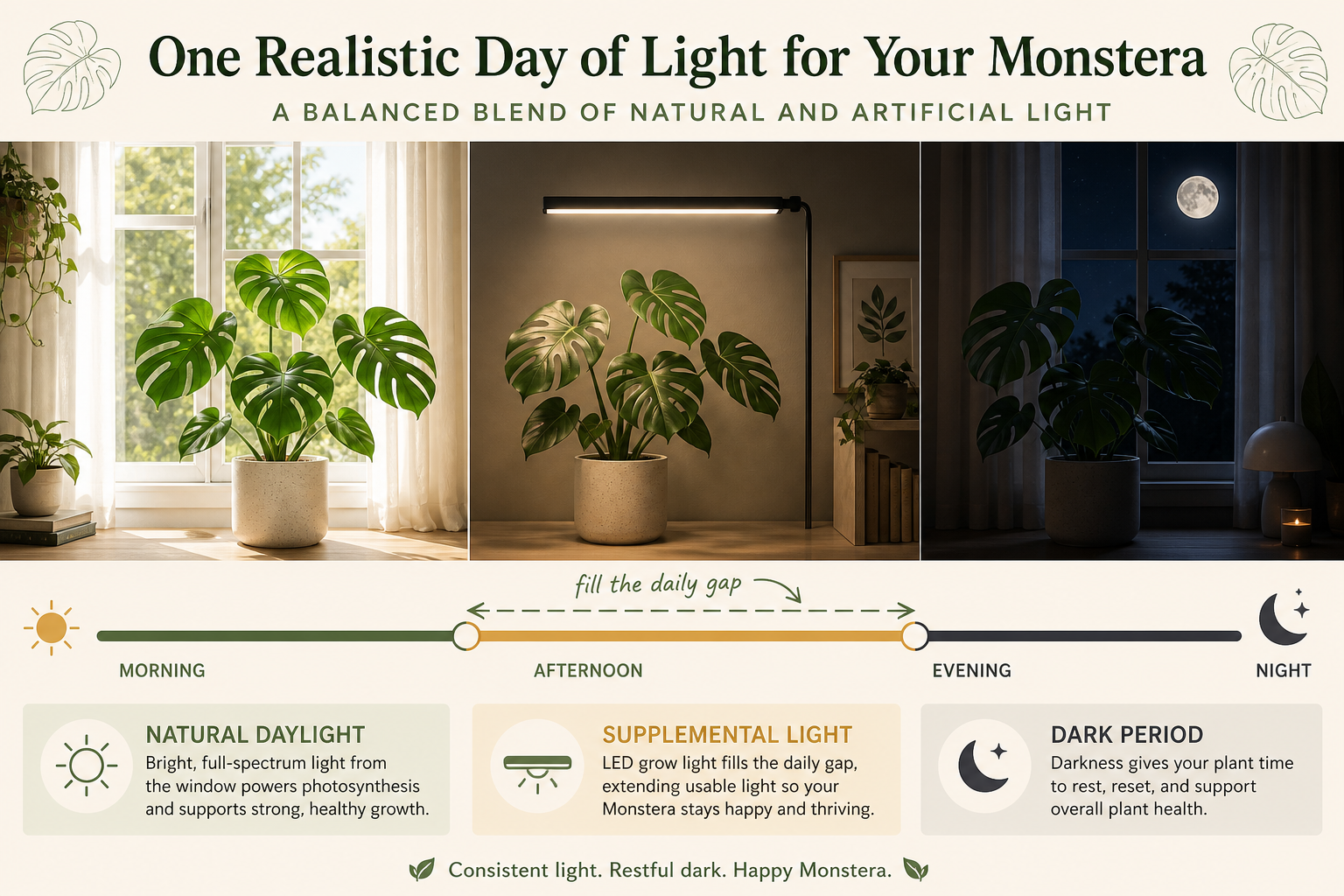
After the first week, change only one lever: fixture height, timer duration, angle, or plant distance. Then wait for new growth instead of reacting to one afternoon’s leaf position. Record the date, which leaves were lit, and whether the soil dried faster. This small log makes a mixed setup much easier to tune.
Use the whole plant to judge the setup
Light is only one part of Monstera performance. A plant with compact roots, dense wet soil, or a damaged root system may fail to respond even after you add a fixture. Conversely, a plant that suddenly grows faster under supplemental light may use water faster and need a more attentive check of the potting mix.
Check that the container drains freely, the substrate has air spaces, and the support lets new leaves mature instead of hanging in shade. Keep temperature and humidity reasonably stable, but do not compensate for weak light with constant misting. The complete indoor Monstera care guide connects lighting decisions with watering, roots, support, and everyday maintenance.
Variegated plants and very young cuttings can respond differently from a vigorous green mature Monstera. Compare each plant with its own previous leaves, not with a photo of a different cultivar. A healthy setup is one that produces repeatable, proportionate growth without scorch, chronic stretch, or a constantly wet pot.
A simple decision routine
- Observe the room before buying anything. Identify the window direction, obstructions, distance to the plant, and the hours when the canopy actually looks bright.
- Inspect the newest growth. Look for normal leaf size, reasonable spacing, and balanced orientation rather than judging by one old leaf.
- Choose the smallest useful intervention. Move the plant closer, open a sheer curtain, rotate the pot, or add a broad supplemental fixture.
- If you add a light, set a repeatable timer. Aim it at the canopy, keep heat and water away from the hardware, and preserve a dark period.
- Review after new growth appears. Adjust one variable at a time and keep the setup that your room and routine can sustain.
Conclusion: choose the light pattern your room can repeat
Natural window light and grow lights are tools for solving different problems. A bright window gives a Monstera broad daylight without extra hardware, but its intensity and duration shift with the room and the season. A grow light adds control and coverage, but it must be positioned, timed, and monitored at leaf level. When the window is close and bright, let it do the work. When the room has a predictable gap, use a timed supplement. In many homes, the most stable answer is not either-or: it is window light for the baseline, a grow light for the weak period, and a dark night for the plant’s complete daily rhythm.
Frequently Asked Questions
Is window light enough for a Monstera?
It can be, especially when the plant sits near a bright, filtered window and produces steady, proportionate new growth. Check the whole canopy, not only the leaf closest to the glass. If the rear side stretches or stalls, improve coverage or add a gentle supplement.
Which window direction is best for a Monstera?
There is no universal winner because climate, season, glass, and obstructions change the result. East or bright filtered south and west exposure can work well, while a dim north window may need help. Watch direct-heat stress and move the plant gradually.
Can I use a grow light with window sunlight?
Yes. Use the grow light to fill the dim part of the day or the darker side of the canopy. A timer and a preserved dark period make the combination predictable. Start conservatively and adjust after new growth rather than running the fixture continuously.
Does a grow light replace sunlight?
A suitable grow light can provide plant-usable light when natural light is insufficient, but it does not automatically reproduce every condition of a window. Coverage, distance, spectrum, heat, duration, and the rest of the room’s care routine still matter.
How do I know if the light is too much?
Look for bleached or crispy patches, persistent leaf curl, unusual heat on the foliage, or a pot that dries much faster than expected. Move the fixture farther away or soften direct sun, then make one change at a time. Confirm that root or watering problems are not causing similar symptoms.
References
- University of Illinois Extension: Lighting | Houseplants — Indoor-light intensity, window direction, seasonal duration, and foot-candle context for houseplants.
- Iowa State University Extension and Outreach: Important Considerations for Providing Supplemental Light to Indoor Plants — Why watts and lumens are limited comparisons, plus PPFD, distance, angle, coverage, and photoperiod considerations.
- University of Minnesota Extension: Lighting for indoor plants and starting seeds — Plant symptoms of insufficient or excessive light, window variability, and timer-based supplemental lighting.
- University of Maine Cooperative Extension: Tips for Growing Houseplants in Maine: Growing Houseplants Under Artificial Lights in Maine — Window distance and season, artificial-light placement, PPFD measurement, and monitoring water use.
- North Carolina Extension Gardener Plant Toolbox: Monstera deliciosa — Botanical and indoor-growing context for Monstera deliciosa.