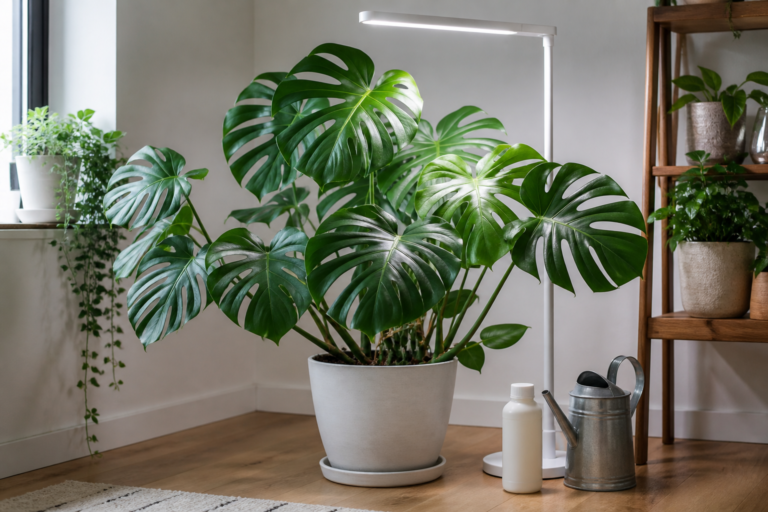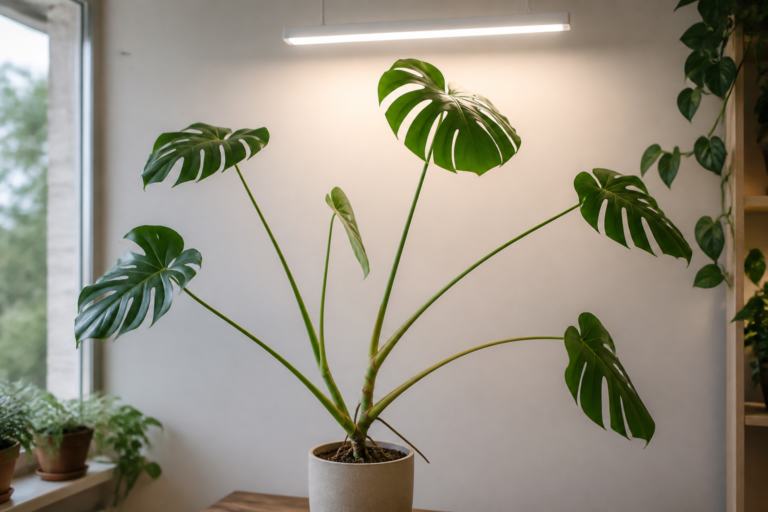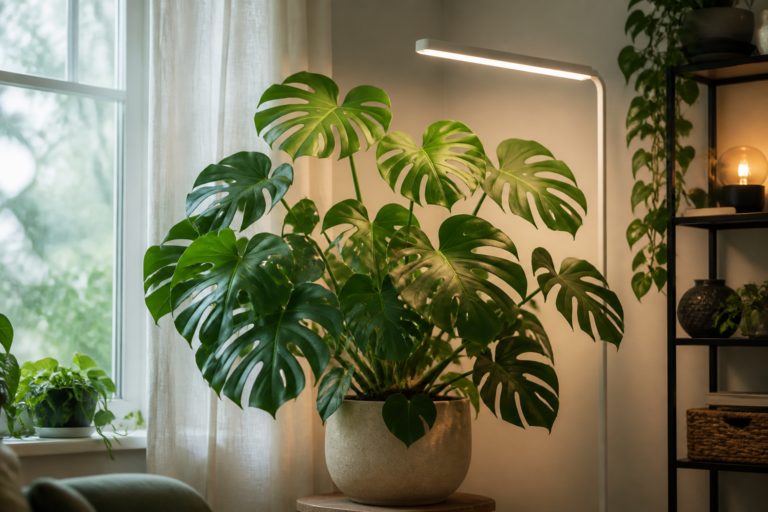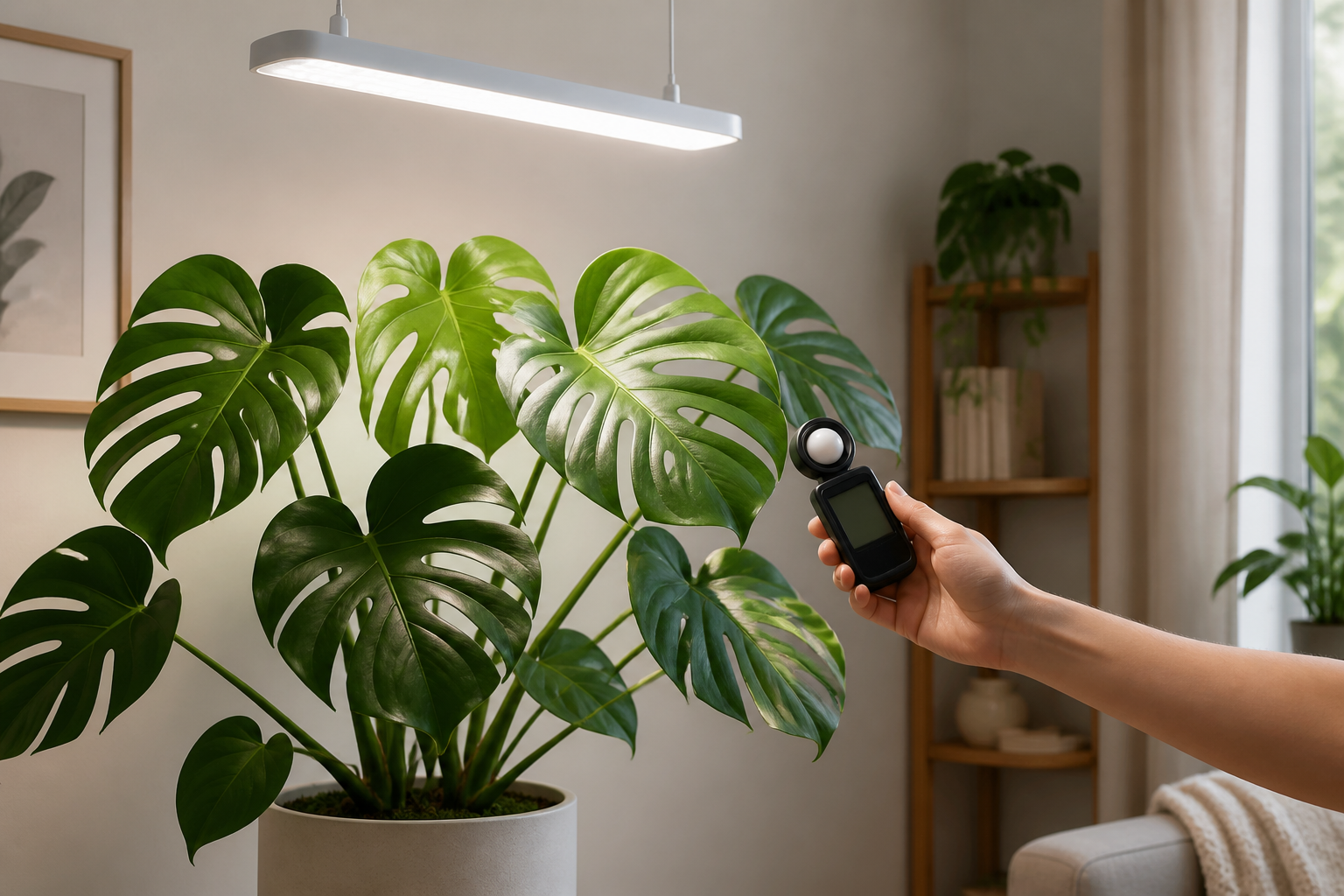
If you are comparing grow lights for a Monstera, learn three terms in this order: PAR is the useful range of light, PPFD is the amount reaching the leaves right now, and DLI is the total received across a day. Together, they explain why a modest-looking fixture can outperform a higher-wattage lamp placed too far away.
The practical takeaway is simple: read a fixture's PPFD map at the real hanging distance, then use the daily hours to estimate DLI. Do not choose by watts or lumens alone. A Monstera's response, canopy coverage, heat, and natural window light still matter, so treat the numbers as a starting point for observation rather than a rigid prescription.
If you are still deciding how to position a fixture, start with the Monstera grow-light guide. This article supplies the measurement vocabulary you need before using a manufacturer's chart or adjusting a timer.
Table of Contents
- What PAR, PPFD and DLI mean for a Monstera
- Why watts and lumens are poor Monstera light targets
- Is there a perfect PPFD or DLI target for Monstera?
- How to calculate DLI from a PPFD reading
- How to measure PPFD at home without fooling yourself
- Turn the measurement into a Monstera setup
- What the plant can tell you when the numbers look confusing
- A five-minute weekly light check
- Conclusion: numbers are a starting point, not a verdict
- Frequently Asked Questions
- References
What PAR, PPFD and DLI mean for a Monstera
These terms describe the same light environment at different levels. Think of them as a sequence rather than three competing scores:
| Term | What it tells you | Typical unit | The beginner question it answers |
|---|---|---|---|
| PAR | The band of light plants can use for photosynthesis, roughly 400–700 nanometres | Wavelength range | Is this light in a plant-useful part of the spectrum? |
| PPFD | The instantaneous density of photosynthetic photons arriving at a surface, ideally measured at leaf level | µmol/m²/s | How much useful light is hitting this leaf right now? |
| DLI | The total photosynthetic light delivered to a square metre during a 24-hour day | mol/m²/day | How much useful light did the canopy receive today? |
PAR is a description of the spectrum, not a brightness rating. PPFD turns that useful spectrum into a momentary reading over an area. DLI adds those readings through the light period, so it captures both intensity and time. Iowa State Extension defines PPFD as PAR delivered over a surface area and DLI as PAR delivered over an area during a 24-hour period. 1
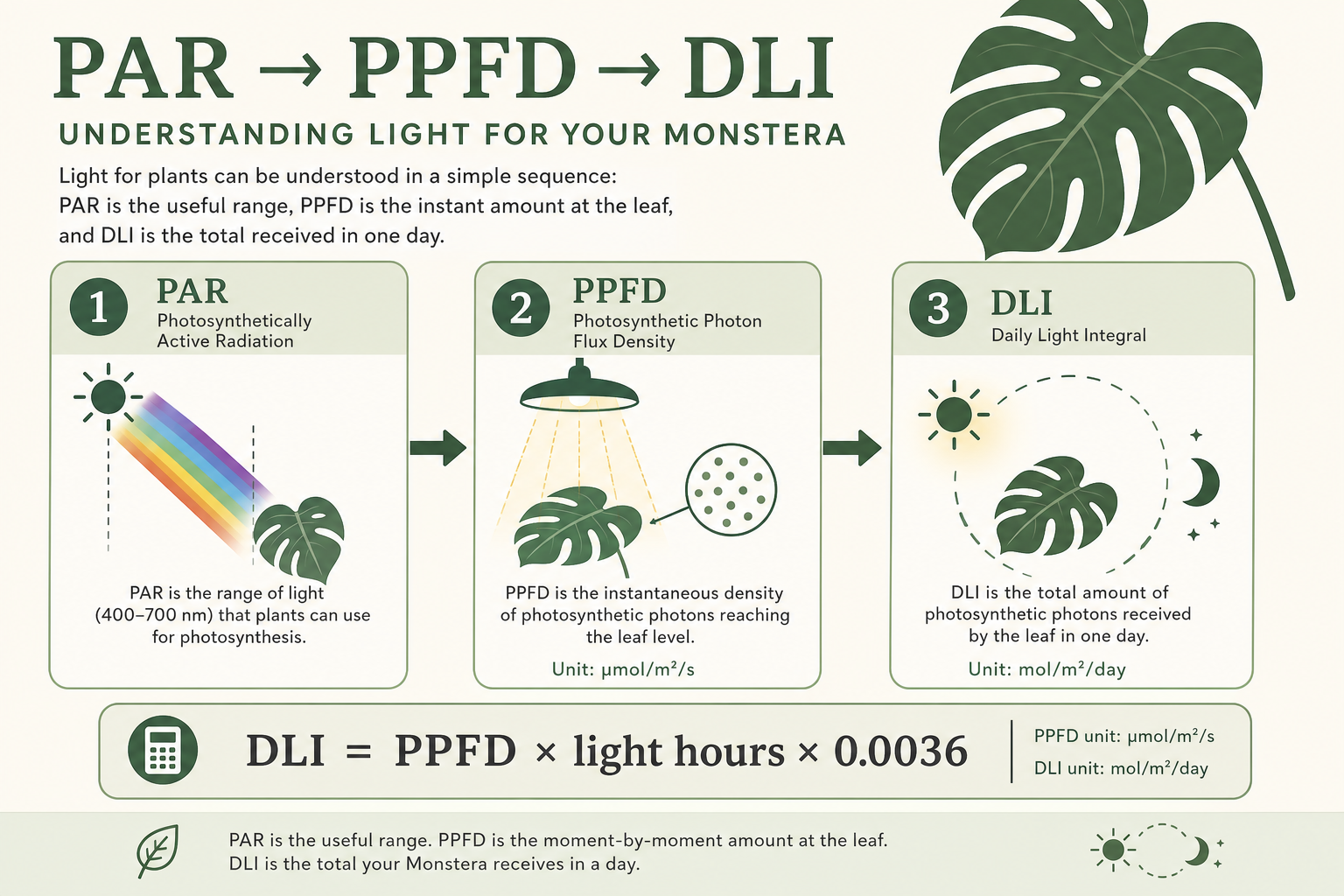
PAR describes the useful range, PPFD measures the moment at the leaf, and DLI adds those photons across a day.
Where PPF fits in
You may also see PPF, or photosynthetic photon flux, on a product page. PPF is the total plant-useful photon output leaving the fixture each second, measured in µmol/s. It does not tell you how evenly those photons land across a Monstera's leaves. PPFD is PPF distributed over an area, after distance, angle, reflectors, and canopy coverage affect the result. A light can have a strong PPF number and still deliver disappointing PPFD at the outer leaves if its beam is narrow or the lamp hangs high.
Why watts and lumens are poor Monstera light targets
Watts describe electrical energy used by the fixture. They do not tell you how efficiently that fixture converts electricity into plant-useful photons, or how evenly the photons reach a broad, layered Monstera. Two LED fixtures with the same wattage can produce different PPF values and very different PPFD maps.
Lumens are closer to a brightness measurement, but they are weighted to human vision. Green and yellow light can look bright to us without proving that the plant is receiving the same useful photon density. Iowa State Extension therefore recommends PPFD or PPF over watts and explains that there is no universal lumens-to-PPF conversion because fixtures have different spectra. 2
Use the specification sheet in this order:
- Find the PPFD map and check the height or distance used for the test.
- Confirm the map covers the whole Monstera canopy, not just the centre leaf.
- Check whether the map was measured with the dimmer at 100 percent or at a lower setting.
- Look for operating temperature, recommended coverage, and a credible measurement method.
- Treat wattage as an energy and heat clue, not as the plant's light dose.
The same principle applies to a window. A bright-looking room can have a much weaker reading at the plant's actual leaves once the glass, curtain, angle, and distance are considered. If the lamp and window overlap, measure the canopy with both on and record the time of day.
Is there a perfect PPFD or DLI target for Monstera?
Not one that can be responsibly printed as a universal rule. Monstera deliciosa is a foliage plant adapted to filtered forest light, but an indoor plant's response depends on leaf size, maturity, variegation, acclimation, temperature, root health, water availability, and how much of the canopy is shaded by other leaves. N.C. State Extension lists Monstera deliciosa as an indoor-capable tropical plant; the measurement numbers still need to be interpreted in the context of your room and plant. 4
Extension guidance can provide useful guardrails without becoming a Monstera prescription. Iowa State groups many foliage houseplants around a low-light DLI of 3–6 mol/m²/day and a medium-light DLI of 6–10; its table is a broad indoor-plant reference, not a species-specific Monstera trial. 1 University of Maine lists philodendrons at roughly 50–250 µmol/m²/s PPFD as a related foliage reference and stresses that plants differ by growth stage. 3
For a beginner, it is reasonable to use those broad bands as a cautious starting conversation: measure a stable canopy reading, calculate the daily total, and watch new growth. A healthy, acclimated Monstera that is producing appropriately sized leaves can tell you more than a target copied from a different room. Variegated plants, recently shipped plants, cuttings, and plants recovering from root stress may need a slower increase even when the meter reading looks modest.
How to calculate DLI from a PPFD reading
When PPFD is reasonably stable during the supplemental period, use this formula:
DLI = PPFD × light hours × 0.0036
The factor converts micromoles per second into moles per square metre per day. Iowa State Extension publishes the same calculation and also gives the reverse equation, PPFD = DLI ÷ (hours × 0.0036). 2
Here are simple examples for a lamp that produces a steady reading at the leaf surface:
| Leaf-level PPFD | Lighted hours | Supplemental DLI |
|---|---|---|
| 100 µmol/m²/s | 12 | 4.32 mol/m²/day |
| 150 µmol/m²/s | 12 | 6.48 mol/m²/day |
| 200 µmol/m²/s | 12 | 8.64 mol/m²/day |
| 200 µmol/m²/s | 14 | 10.08 mol/m²/day |
These are math examples, not promises that every Monstera should receive the last value. If the plant also receives daylight during those same hours, the true daily total is the combined light at the leaf, not the lamp's number added to a guess about the window. A sensor that logs changing light is more useful than multiplying one bright noon reading across the whole day.
The formula also explains why “more hours” is not always the best fix. Raising PPFD from 100 to 200 for the same 12-hour window doubles the calculated supplemental DLI. Keeping 100 PPFD but extending the timer from 12 to 14 hours increases the total more gently. Either change can alter drying speed and temperature, so adjust one variable at a time.
How to measure PPFD at home without fooling yourself
1. Measure where the leaves are
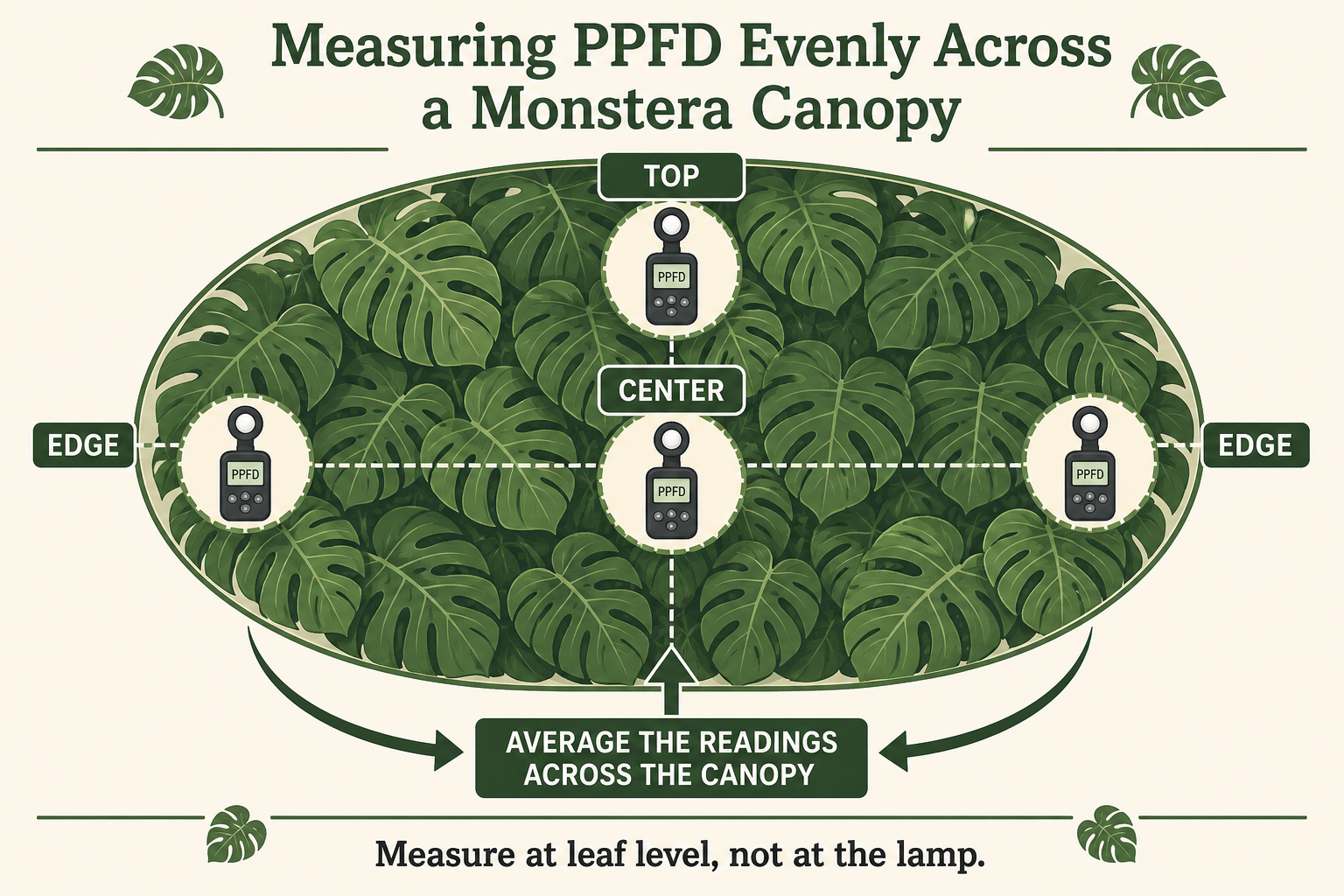
Place a quantum or PAR meter at the top of the canopy, then take additional readings at the middle and outer edges. Keep the sensor orientation consistent. Iowa State recommends measuring at foliage level and calibrating or selecting the correct light-source setting where the device allows it. 1
Do not measure at the lamp and assume the leaf receives the same value. A broad Monstera leaf can sit several inches lower, while a new climbing leaf may reach closer to the fixture than the older leaves. Record the distance, dimmer setting, and whether the window is open to daylight.
2. Look for an average, not a hero number
One centre reading can make a light appear stronger than it is. Take three to five readings across the usable canopy and note both the average and the lowest edge reading. If the outer leaves are consistently much darker, move the fixture higher, add even coverage, or rotate the plant instead of simply increasing intensity at the centre.
Smartphone apps can be useful for comparing one spot with another, but they estimate light through a phone camera and depend on the spectrum and calibration. Use an app as a trend tool, not as laboratory-grade proof. When no meter is available, a manufacturer's map measured at your actual distance is the next-best starting point.
3. Change one lever and wait for new growth
If PPFD is lower than you intended, you can dim less, move the fixture closer, improve coverage, or extend the daytime window. If leaves are bleaching, crisping, or heating, reverse the change. Moving a fixture closer also concentrates light into a smaller area and may raise leaf temperature; Iowa State warns that heat can become a problem when lights are moved close to plants. 1
Give the plant time to respond. Existing holes and scorch marks will not heal, and one old leaf cannot grade a new setup. Use the newest leaf, internode length, posture, colour, and drying pattern as the next evidence. A consistent dark period matters too; running the lamp through the night is not a safe shortcut to a higher DLI.
Turn the measurement into a Monstera setup
Start with the canopy, not the product box. A large Monstera may need a wider, softer spread than a compact plant, and a moss pole can lift new leaves into a brighter zone. Re-check the PPFD map whenever the plant grows taller or the lamp is raised. If the top leaf is bright but the lower leaves sit in deep shade, the plant is receiving a very uneven dose.
Then choose a repeatable daytime block. A timer makes the light predictable and makes the DLI calculation meaningful. Keep a dependable dark period, especially when the room is warm or the plant is already receiving long daylight from a window. The seasonal Monstera grow-light schedule explains how to adjust that block around winter, summer, and cloudy rooms.
Finally, connect light to the root zone. A Monstera under a stronger lamp may dry faster, while a dim winter corner may stay wet for longer. Check the potting mix before watering rather than copying the old calendar; compare the result with this airy Monstera soil mix guide if the pot stays heavy or compact. Light can change water use, but it cannot compensate for damaged roots, pests, or poor drainage.
What the plant can tell you when the numbers look confusing
Low PPFD or a low DLI often appears first in new growth: longer gaps between leaves, smaller blades, paler colour, slower unfurling, or fewer mature fenestrations. A leaning stem and a canopy that reaches toward the brightest side are clues that coverage is uneven. These signs are not proof of low light by themselves, so inspect roots, pests, temperature, and watering as well.
Excessive PPFD, heat, or an abrupt change can show up as bleached patches, crisp margins, curled edges, or a leaf surface that feels unusually hot. A meter reading can be “reasonable” at the centre while a narrow beam overheats one leaf. Diffuse the source, increase distance, lower output, or acclimate in stages. The Monstera light requirements and symptoms article gives a symptom-first comparison when you are unsure whether the plant is asking for more light or less.
The best setup is the one that produces steady, healthy new growth across the canopy without forcing you to rewrite watering, temperature, and placement every few days. PPFD and DLI help you make a measured change; the plant tells you whether that change fits the room.
A five-minute weekly light check
- Photograph the whole plant and newest leaf from the same angle.
- Note window exposure, lamp distance, timer hours, and dimmer setting.
- Take top, centre, and edge PPFD readings if you have a meter.
- Calculate the supplemental DLI and record whether daylight overlapped.
- Change only one variable, then wait for a new growth checkpoint.
This small log is enough to separate a light problem from a watering or root problem. For broader routine guidance, use the complete indoor Monstera care guide and keep the light measurement as one part of the whole-plant picture.
Conclusion: numbers are a starting point, not a verdict
PAR tells you which part of the spectrum matters, PPFD tells you what reaches a leaf now, and DLI tells you how that dose accumulates through the day. Measure at canopy level, calculate with the real timer, check coverage and heat, and let the next Monstera leaf confirm whether the setup is working. Once the numbers make sense, return to the Monstera grow-light guide for fixture distance and coverage decisions.
Frequently Asked Questions
What does PPFD stand for in Monstera care?
PPFD means Photosynthetic Photon Flux Density. It estimates the density of plant-useful photons reaching a surface each second, measured in µmol/m²/s. For a Monstera, the useful reading is at the leaf canopy, not at the bulb or the wall behind the plant.
What is a beginner-friendly DLI for a Monstera?
There is no universal Monstera DLI target. Broad extension tables place many foliage houseplants in low or medium DLI categories, but cultivar, acclimation, canopy size, window light, heat, and root health change the result. Start with a measured, stable setup and adjust from new growth rather than forcing a number.
Can I use lumens instead of PPFD?
Lumens can help compare visible brightness, but they are weighted to human vision and do not have a universal conversion to plant-useful photons. Prefer a PPFD map, a calibrated quantum meter, or a consistent comparison tool designed for grow lights. Watts alone are even less informative about the light reaching the leaves.
How many hours should a Monstera grow light run?
Use enough daytime hours to fill the natural-light gap while keeping a reliable dark period. The correct hours depend on PPFD, window light, season, heat, and the plant's response. Calculate DLI from the leaf-level reading, then make small timer changes rather than leaving the lamp on all night.
Does a higher PPFD always make a Monstera grow faster?
No. More photons can be useful when the plant is acclimated and the root zone, temperature, water, and coverage support active growth. A sharp increase can cause heat or bleaching, and a high centre reading cannot fix shaded outer leaves. Increase gradually and judge the next leaf, not a single old mark.
References
- Iowa State University Extension and Outreach: Important Considerations for Providing Supplemental Light to Indoor Plants — Definitions of PAR, PPF, PPFD and DLI, leaf-level measurement, photoperiod, and indoor-plant light ranges.
- Iowa State University Extension and Outreach: How to Determine How Much Supplemental Light to Provide for Indoor Plants — DLI and PPFD calculations, fixture coverage, and why watts and lumens are not interchangeable with plant light.
- University of Maine Cooperative Extension: Tips for Growing Houseplants in Maine: Growing Houseplants Under Artificial Lights in Maine — PPFD measurement, growth-stage context, and related foliage-plant guidance under artificial lights.
- North Carolina Extension Gardener Plant Toolbox: Monstera deliciosa — Botanical and indoor-growing context for Monstera deliciosa.