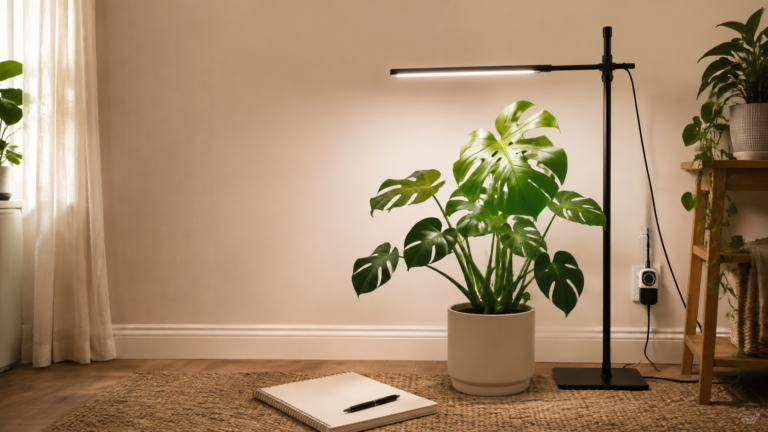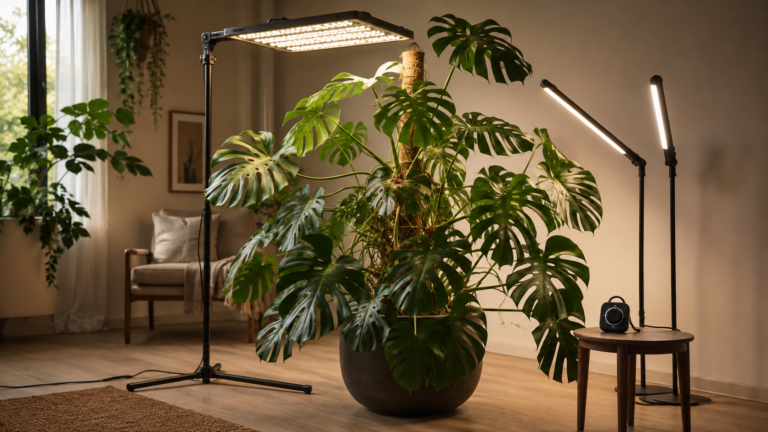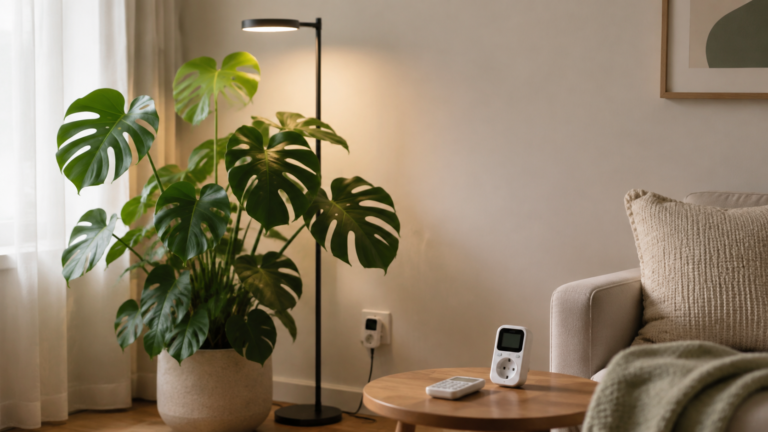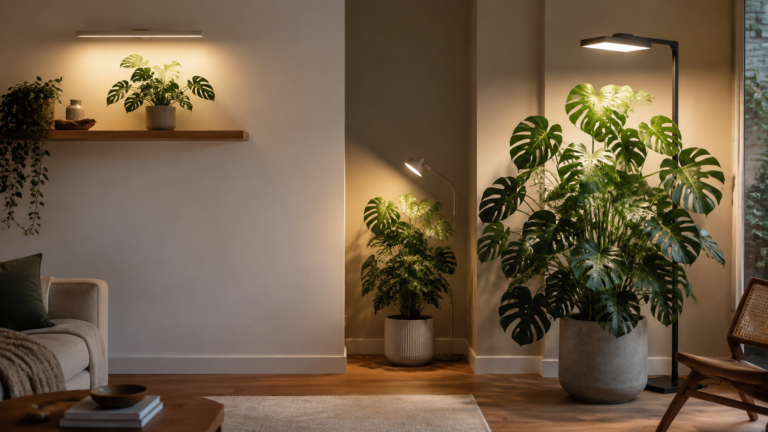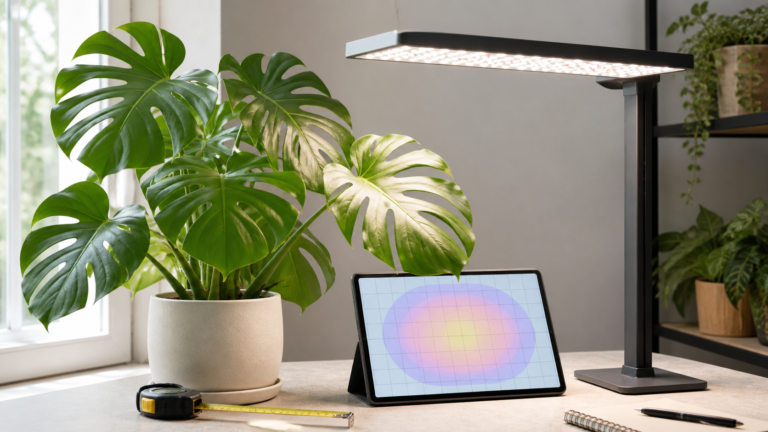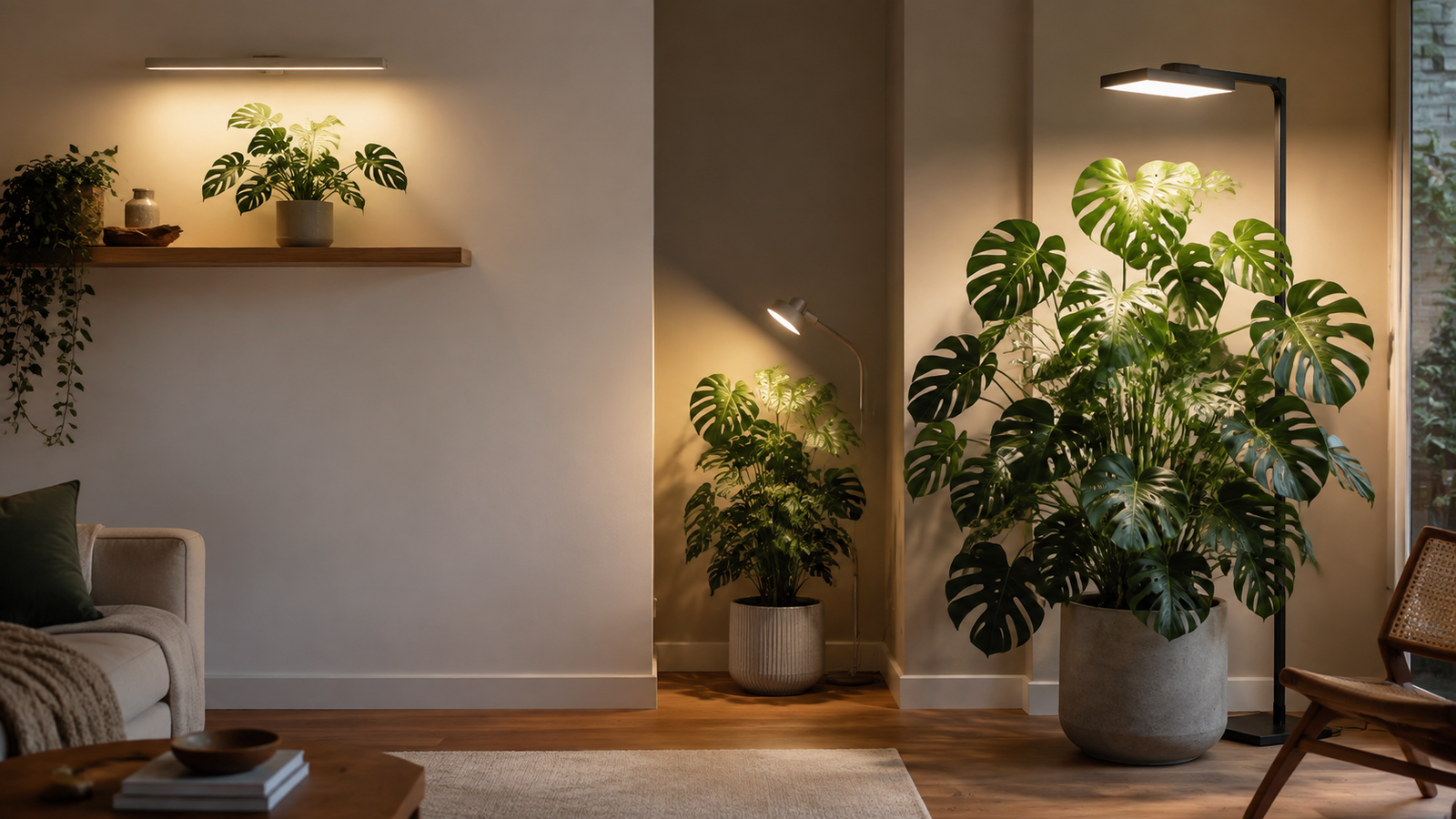
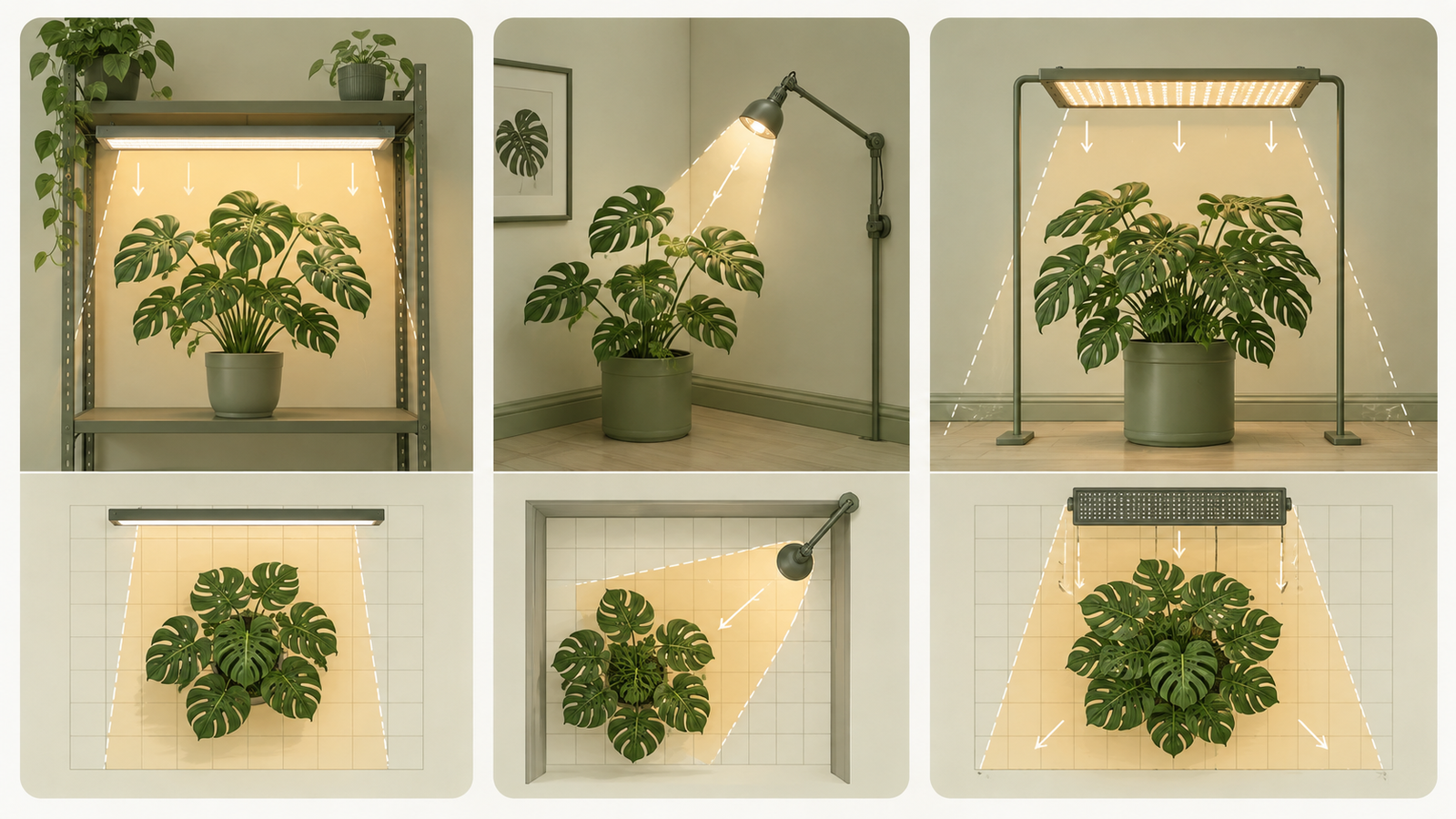
The best Monstera grow light depends on where the plant lives. Use a slim bar for a shallow shelf, an adjustable arm or bulb for a directional corner, and a broad panel or stand for a floor plant. Match the fixture footprint to the canopy, follow the manufacturer's distance first, and test centre and edge leaves before adding output.
Table of Contents
- Which Monstera setup fits a shelf, corner, or floor plant?
- What changes when a Monstera grows on a shelf?
- How should you light a Monstera in a corner?
- What does a floor-plant setup need?
- How do shelf, corner, and floor fixtures compare?
- How do canopy shape and fixture footprint affect coverage?
- How should distance, height, and side light change?
- How can you manage glare, heat, cords, and timers?
- How do you test a setup before buying another fixture?
- What should you check before blaming the fixture?
- Conclusion: choose the placement you can maintain
- Frequently Asked Questions
- References
Which Monstera setup fits a shelf, corner, or floor plant?
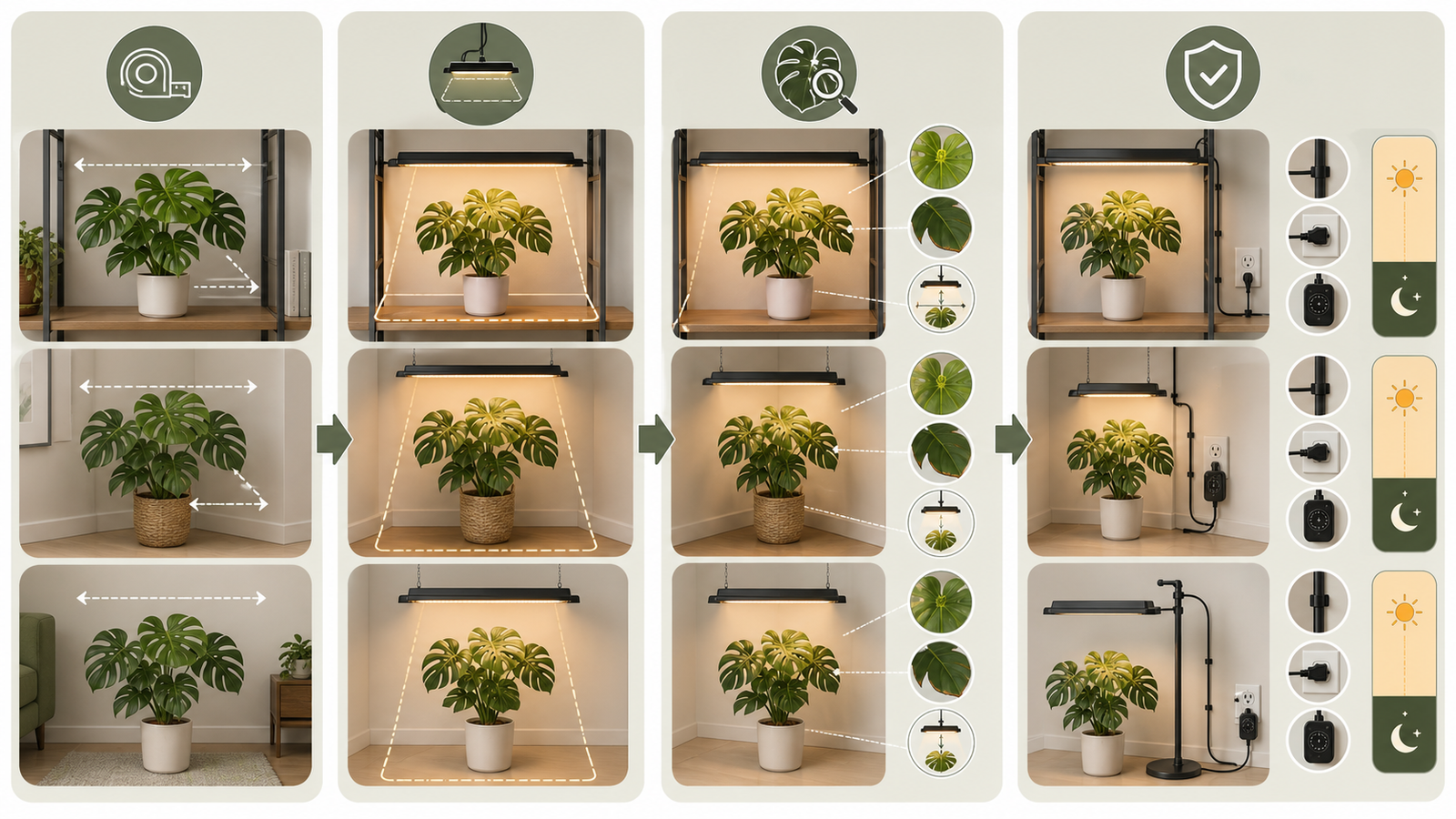
Start with the plant's actual position, not a favourite fixture shape. A shelf usually has a shallow, rectangular footprint and a fixed top or underside. A corner has two walls, a darker rear side, and limited viewing angles. A floor plant has a taller, deeper canopy and more exposure to people, pets, and moving air. Those constraints determine whether light should come from above, from one side, or from a broad field.
Monstera deliciosa is naturally a climbing plant, and mature leaves can become very large.1 That three-dimensional habit makes an apparently bright lamp misleading: the top leaf may be well lit while lower leaves and the growth point sit in a different intensity zone. The University of Minnesota classifies Monstera among medium-light houseplants, while North Carolina Extension advises bright indirect to moderate light and caution with intense direct sun.3 A good artificial setup recreates consistent, indirect coverage rather than chasing the highest number.
Before choosing a fixture, record three measurements:
- Canopy width: the widest leaf-to-leaf span, including leaves that will unfurl soon.
- Canopy depth: the distance from the front leaf plane to the rear stem or wall.
- Mounting envelope: the height, depth, and clearance available for the lamp, stand, cord, and future growth.
Use those measurements with the published coverage map for the exact model. Wattage, lumens, and a product photograph cannot tell you whether the outside leaves receive useful light.
What changes when a Monstera grows on a shelf?
A shelf is the most space-efficient placement, but it is also the least forgiving of fixture depth. A horizontal LED bar mounted beneath the shelf above, or attached to the rear upright, usually spreads light across a compact canopy without projecting into the room. For a small plant, a short bar can cover the whole leaf plane; for a trailing or climbing specimen, check whether stems extend past the shelf edge.
Keep the bar centred over the active growth point rather than over the pot rim. If the newest leaf leans toward one end, slide or rotate the plant before increasing power. The shelf itself can block side light, so turn the pot a quarter turn every week or two if growth is consistently directional. A reflective, pale wall behind the plant can soften the shadow side, but it will not replace direct coverage for leaves hidden behind a pole.
Shelf installations also need mechanical checks. Confirm that the shelf can carry the lamp, plant, and water-filled pot together. Leave room to lift the pot out without brushing the diodes, and keep the power supply away from the watering path. Secure the cord along the rear edge so it cannot become a loop that catches a hand or pet. If the bar has a diffuser, use it to reduce glare at eye level; never cover vents with fabric or foliage.
An under-shelf bar is a good match when the canopy is broad but shallow. It is a poor match when a tall Monstera has leaves above and below the shelf line, because the lower leaves may remain shaded. In that case, a slim vertical accent light beside the upright can fill the lower zone more gently than moving the bar dangerously close to the top leaf.
How should you light a Monstera in a corner?
A corner setup is about direction. Two walls reduce reflected daylight and create a rear side that the plant rarely faces. An adjustable arm, gooseneck, or directional bulb lets you aim into that dark wedge while keeping the fixture visually tidy. Place the light so its beam crosses the canopy, not just the nearest leaf, and leave enough swivel to follow new growth.
Measure the corner diagonally: the lamp may need to sit in front of the plant to reach the back leaves. A wall-mounted arm can save floor space, while a weighted table base works for a smaller specimen. Keep the light and its driver clear of the wall and curtains according to the manufacturer's instructions. If the wall becomes warm or the beam shines into a sofa or bed, lower the output or change the angle before changing the photoperiod.
Corners often benefit from side light, but side light can exaggerate one-sided growth. Rotate the pot slowly and watch the newest leaf rather than reacting to a single older leaf. The aim is a stable, repeatable direction that reaches the active canopy. If one side remains thin after several weeks, add a low-intensity fill from the opposite side or reposition the plant; do not simply double the main lamp's hours.
When a corner Monstera climbs a moss pole, the top may approach the fixture while the lower leaves stay in shadow. A modular moss pole for climbing Monstera can keep the stem upright and make the light angle easier to repeat. Support changes the geometry; it does not remove the need to inspect the lower canopy.
What does a floor-plant setup need?
A floor Monstera has the widest mounting envelope and the greatest chance of uneven height. A broad panel on a stable stand can cover a full, mature canopy from above. A tall vertical bar or two adjustable arms can work when the plant is narrow but high. Choose the format that keeps the centre and outer leaves inside the model's useful footprint without placing a hot source against the newest leaf.
Stability is the first floor-plant requirement. Select a stand with a wide base, route the cord along a wall, and keep the pot and stand out of a walkway. Test the setup with the pot freshly watered, because weight and balance change. In homes with cats, dogs, or children, use a tip-resistant stand and a protected cable route; a perfectly measured beam is not useful if the lamp can be pulled down.
Floor plants also receive more ambient room light, so supplement only the deficit. A plant beside a bright window may need a side fill during cloudy weeks, while a plant in a deep room may need the fixture to carry the full daily light period. Compare the same leaf zones at the same time of day for at least two weeks. New leaves, petiole angle, and sustained stretching are more informative than a single photograph.
If the canopy is very deep, one overhead panel can still leave rear leaves dark. Move the panel forward only within its clearance range, or use a second side source with lower output. A second fixture should widen the footprint, not create two overlapping hotspots at the top of the plant.
How do shelf, corner, and floor fixtures compare?
The table below is a starting comparison. Manufacturer coverage data and your measured canopy always outrank a generic format recommendation.
| Placement | Good fixture format | Coverage pattern | Strengths | Watch-outs |
|---|---|---|---|---|
| Shelf | Slim LED bar or compact under-shelf panel | Narrow, even wash across a shallow leaf plane | Tidy, low visual clutter, easy timer and height control | Shelf depth, blocked side light, heat and cord clearance, limited room for growth |
| Corner | Adjustable bulb, gooseneck, or wall/desk arm | Directional beam aimed across the dark wedge | Reaches a shadowed side, easy to angle, small footprint | One-sided growth, wall glare, unstable bases, rear leaves still shaded |
| Floor plant | Broad panel on stand, tall bar, or two coordinated arms | Larger overhead or vertical field for a deep canopy | Handles tall plants, wider leaves, flexible seasonal placement | Tip risk, pets and traffic, long cords, larger glare and heat envelope |
Do not treat “bar,” “bulb,” or “panel” as a performance grade. A well-positioned bar can outperform a powerful panel that is too far away, while a modest corner bulb can solve a rear-side gap that an overhead lamp cannot reach. Compare the fixture's beam angle, dimming range, thermal design, and tested map at the height you can actually maintain.
How do canopy shape and fixture footprint affect coverage?
Think of light as a footprint laid over leaves. A shelf canopy is usually a rectangle viewed from below. A corner canopy is a fan or wedge because the fixture approaches from one direction. A floor canopy may be an oval with leaves at several elevations. The fixture should be wider than the most important leaf zone, with enough overlap to account for movement and the next unfurling leaf.
Mark the canopy's centre, left edge, right edge, front edge, and rear edge with removable tape on the shelf or floor. Then compare each mark with the manufacturer's coverage diagram. If a chart reports PPFD at a grid of distances, use the closest height and note the centre-to-edge falloff. Do not infer PPFD from wattage or from a phone-camera brightness reading.
The parent Monstera grow-light guide explains how to use a published PPFD map, adjust for canopy height, and add a second fixture only when shaded edges remain. This article adds the room geometry: the same map can succeed on a shelf and fail in a corner if the fixture cannot be centred.
For a deep canopy, side light can be more efficient than raising the main lamp's intensity. Aim the secondary source at the shadowed leaves and keep the growth point in the primary field. When two beams overlap, check the centre leaf for bleaching or crisp margins. Uniformity matters more than making every zone equally bright.
How should distance, height, and side light change?
Follow the fixture manufacturer's distance and dimmer guidance first. If no model-specific chart is available, the often-quoted 12–24 inch LED distance is only an initial reference, not a universal Monstera prescription.2 Diodes, optics, wattage, ambient daylight, and canopy reflectance vary too much for a single number to be safe.
For a shelf, begin at the bar's recommended height above the highest leaf and raise the fixture as the plant grows. For a corner arm, set the beam so it crosses the canopy at a shallow angle rather than pointing straight into one leaf. For a floor panel, use the stand height and dimmer together: moving a fixture higher broadens coverage but lowers intensity, while dimming can protect a close centre leaf without leaving edges unlit.
A practical way to compare settings is to keep hours constant and change one lever at a time. Record height, dimmer percentage, room daylight, and which leaves look brightest. If the edge remains dark, change angle or add side fill before extending the schedule. Supplemental-light guidance recommends a timer and a daily period that leaves a dark interval; many indoor plants receive roughly 12–14 hours, with 10–16 hours as a broad upper range depending on conditions.2
You can estimate daily light exposure with DLI = PPFD × hours × 3,600 ÷ 1,000,000, but only when PPFD is measured or credibly mapped at the leaf plane. The equation cannot correct for a beam that misses half the canopy. Use it to compare a shelf, corner, and floor schedule after coverage is physically aligned.
How can you manage glare, heat, cords, and timers?
Light quality includes how safely and comfortably the setup runs every day. Use a diffuser or shield when a shelf bar sits at eye level. Angle a corner light away from seating and reflective glass. For a floor stand, keep the panel above head height or behind the canopy only if the manufacturer allows that orientation. Never drape cloth over a fixture to hide glare, and do not place foliage against vents.
Bright light can increase leaf temperature and speed the pot's dry-down. Check the potting mix and the complete indoor Monstera care guide before changing watering or fertilizer. A dry surface alone is not a watering signal; feel the root-zone moisture and inspect drainage. Increased light may justify a shorter interval, but it does not justify watering on a fixed calendar.
Keep drivers and plugs above splash level, use a drip loop where appropriate, and secure slack so a plant cannot pull the lamp. A timer should control a consistent daytime block, with a true dark period overnight. If the room is used as a bedroom, select a timer and dimming mode that do not add flashing indicators or sudden brightness at night.
How do you test a setup before buying another fixture?
Run a two-week baseline before judging a new arrangement. Photograph the same leaves from the same angle, note the newest leaf's position, and record the pot's dry-down time. Check the centre, upper, outer, and rear canopy separately. Iowa State Extension recommends monitoring plants over time and using additional fixtures or side lighting when taller plants show symptoms at distant parts.2
Use this sequence:
- Set the fixture at the manufacturer's starting distance and a conservative dimmer setting.
- Keep the photoperiod and watering approach consistent for the first week.
- On days 3, 7, and 14, inspect leaf colour, texture, petiole angle, and the growth point.
- If only the edges stretch or remain much darker, adjust angle, height, or side fill—not every setting at once.
- If the centre develops pale patches, crisp margins, or unusual heat, increase clearance or reduce intensity before extending hours.
Measure a corner plant after rotating it and a floor plant after its stand is moved. If the response changes simply because the pot turned, direction and coverage—not fixture power—are likely the limiting factors. A shelf plant that looks fine from the front may still have a shaded rear leaf; inspect from above and behind when possible.
What should you check before blaming the fixture?
Light is only one input. Before replacing a bulb or adding a panel, check whether the plant recently moved, the window changed seasonally, or a curtain now blocks daylight. Also inspect pests, dust, root damage, compacted mix, cold drafts, and a support that lets the stem flop away from the beam. A new leaf that is smaller or less fenestrated can reflect maturity and stress, not just lamp output.
Use the Monstera light requirements guide to compare symptoms such as stretching, bleaching, scorched margins, and uneven growth. Then verify the fixture's actual position and operating schedule. A timer that resets after a power interruption can create a light pattern very different from the one you intended.
For climbing specimens, align the support before aligning the light. A stable pole keeps the growth point in a repeatable place; a leaning stem makes every distance measurement drift. If you add a second fixture, label its role in your notes as “edge fill,” “lower canopy,” or “rear side.” That simple description prevents accidental doubling of the entire daily dose.
Conclusion: choose the placement you can maintain
Shelf, corner, and floor plants do not need identical fixtures because they do not present identical canopies. A slim bar is efficient for a shallow shelf, an adjustable directional source reaches a difficult corner, and a broad panel or coordinated pair covers a tall floor plant. In every case, start with the manufacturer's distance and coverage map, use 12–24 inches only as a fallback reference, and judge the result by centre-to-edge leaf response.
The best setup is the one you can keep centred, cool, secure, and on a repeatable timer. Measure the canopy, match the footprint, correct one variable at a time, and let new growth—not a brighter-looking room—tell you whether the placement works.
Frequently Asked Questions
Is a bar light better than a bulb for a Monstera on a shelf?
A bar is often easier to centre over a shallow shelf and can wash several leaves evenly. A bulb can work for a small plant if its beam reaches the whole canopy. Compare the model's coverage map, not the fixture category, and leave clearance for the next leaf.
Can one grow light cover a Monstera in a corner?
Yes, when the fixture can be aimed across the full canopy and the rear leaves remain inside its useful footprint. A directional arm is usually easier to position than a fixed overhead lamp. Rotate the plant gradually and add low-output side fill only after a controlled trial.
How many lights does a large floor Monstera need?
There is no universal number. Start with one fixture if its published map covers the active canopy at a safe height. Add a second only when measured edge or lower-canopy shade persists, using it as targeted fill rather than automatically doubling intensity and hours.
Should a floor plant light shine from above or the side?
Above light usually gives the most even starting geometry for a broad canopy. Side light is useful for a deep or wall-shadowed plant, especially when the top already receives enough intensity. Combine directions carefully so one leaf zone does not become a hotspot.
Will a grow light make a Monstera dry out faster?
Brighter light can raise leaf temperature and increase water use, but room temperature, airflow, pot size, and mix also matter. Check root-zone moisture and drainage each time, then adjust watering gradually instead of following a fixed calendar.
References
- University of Connecticut Home & Garden Education Center: Monstera deliciosa — Mature-leaf size, climbing habit, light acclimation, and common indoor-care considerations. 2020.
- Iowa State University Extension and Outreach: How to Set Up Supplemental Lights for Indoor Plants — Fixture distance, side lighting, timers, photoperiod ranges, and monitoring guidance. 2026.
- University of Minnesota Extension: Lighting for Indoor Plants and Starting Seeds — Relative light needs for common houseplants, including medium-light Monstera. 2026.
- North Carolina Cooperative Extension: Monstera deliciosa (Ceriman, Cutleaf Philodendron, Hurricane Plant) — Moderate-light guidance and caution with harsh direct sun. 2026.