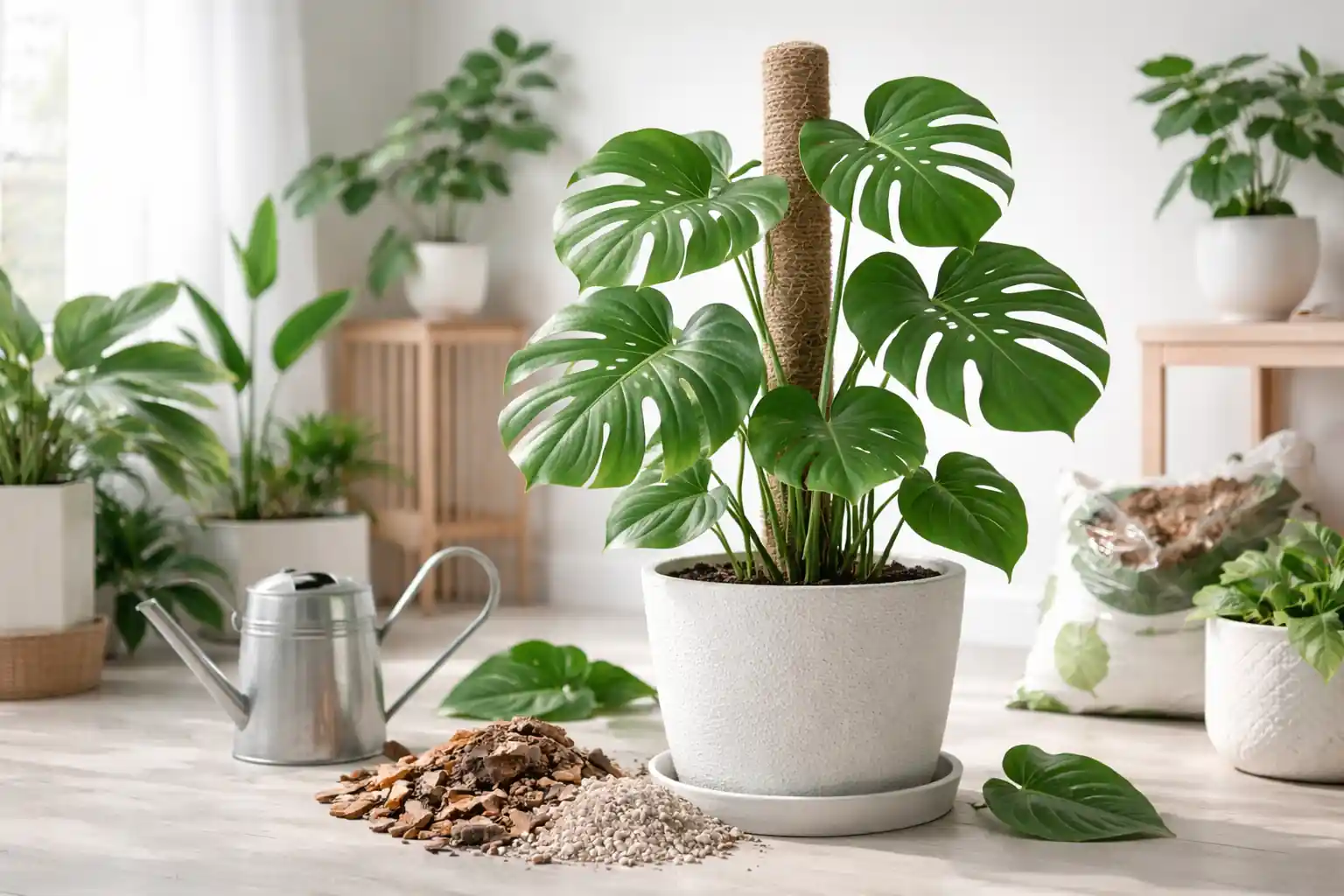
A practical pot-picking framework that prevents “mystery yellow leaves” by making drying speed and watering cues predictable in any home.
Building on our Monstera Care for Beginners Indoors — the ultimate starter guide covering light, watering, soil, and more — this deep-dive focuses on one critical variable: choosing and using plastic pots the right way.
Table of Contents
Quick answer
Yes—plastic pots work for Monstera deliciosa when you control three things: drainage, pot size, and mix airiness. Plastic holds moisture longer than porous terracotta, so it’s often easier in bright/dry homes and riskier in low-light/cool/humid homes.
Use plastic confidently if:
- The pot has drainage holes (non-negotiable).
- You sized up only 1–2 inches wider than the root ball. (see our full When to Repot Monstera Deliciosa guide for exact timing and signs).
- Your mix is chunky and airy (bark + perlite/pumice).
Avoid / adjust plastic if:
- Your pot stays wet ~2+ weeks in winter, or
- You’re in low light, a cool room, or high humidity (slow drying = higher root stress risk).
“At-a-glance” decision mini-table
Plastic pot: good idea when…
| Your home condition | Plastic pot? | Make it safe by… | Watering cue |
|---|---|---|---|
| Bright indirect light + average humidity | Yes | Standard aroid-style chunky mix | Water when top 2″ dries |
| Low light or winter slow-down | Caution | Smaller pot + extra aeration | Wait until pot feels much lighter |
| Very dry / warm room (vents, sun, AC) | Great | Plastic helps buffer dryness | Don’t let it go crispy-dry |
Rule that prevents most problems: match the pot to the drying speed you actually get at home, not the pot you wish you had.
The safest setup
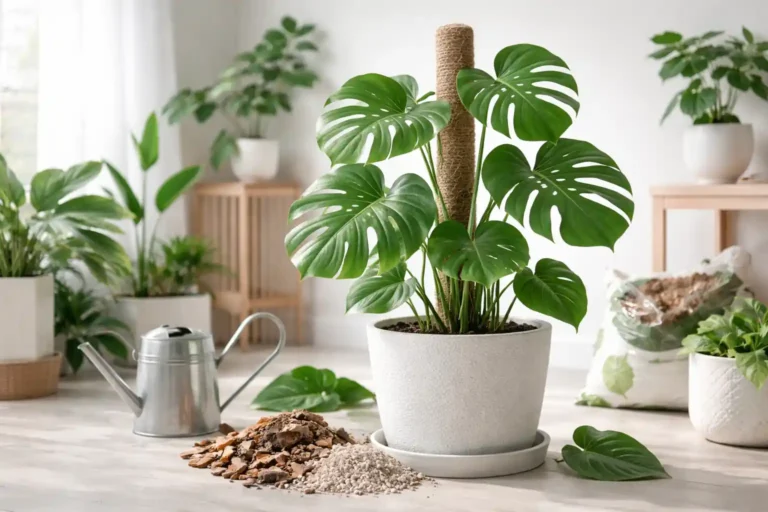
Safest, simplest setup: a plastic nursery pot with holes inside a decorative outer cachepot. It gives you reliable drainage and looks good.
Two-pot method (30-second version):
- Keep your Monstera in a nursery pot with drainage.
- Place it inside a decorative outer pot.
- Water until it drains.
- Pour off runoff so roots never sit in water.
Ready for a clean, décor-friendly setup that’s still 100% plant-safe? Shop our full range of indoor planters → (Choose from thickened PP root-control pots, semi-transparent breathable orchid planters, or stylish resin cachepots — all designed for tropical plants like Monstera.)
Common definitions
- Cachepot: a decorative outer pot (often no drainage) that holds a nursery pot inside.
- Overpotting: moving to a pot that’s too large, so mix stays wet longer than roots can use.
- Chunky/airy mix: a potting blend designed to hold moisture and maintain air pockets.
“Slow drying” warning box
If your Monstera dries slowly (especially in winter):
Plastic can still work, but you must reduce pot size jumps and increase aeration. If the pot stays damp for long stretches and you see repeated yellowing, consider switching to terracotta or rebuilding the mix chunkier.
Yellow leaves quick triage
Pot-related yellow leaves usually come from one of these:
- No drainage (water has nowhere to go)
- Overpotting (too much wet mix, too long)
- Mix collapse/compaction (air pockets disappear)
- Plastic + low light + winter watering habits (slow dry = stressed roots)
What to do first: check drainage, confirm pot size, then fix the mix (airier), then adjust watering cues.
Why pot choice matters for Monstera
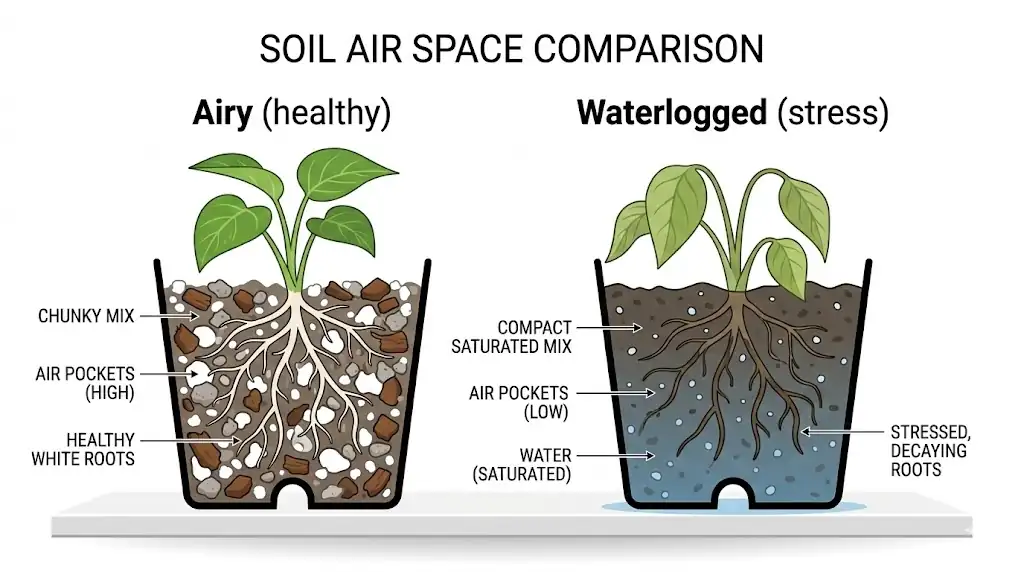
Monsteras want a root zone that’s evenly moist but airy—not soggy, not bone-dry. When potting mix stays waterlogged, the air spaces in the mix fill with water, and roots struggle to get oxygen. That’s why poor drainage and constantly wet mix are such common triggers for root rot in containers.
Your pot affects:
- How fast the mix dries (plastic slows drying; unglazed terracotta speeds it up)
- How forgiving watering is (some pots make “one extra watering” a big deal)
- How stable the plant is (Monsteras get heavy—especially with a support pole)
Plastic pots for Monstera: when they’re a great choice (and when they’re risky)
What plastic does well
- Moisture stability: Plastic doesn’t “breathe,” so the mix dries more slowly—helpful in bright spots, warm rooms, or dry air.
- Lightweight + practical: Easier to move a large Monstera for cleaning, rotating, or seasonal light shifts.
- Root monitoring options: Nursery pots (and especially semi-clear ones) make it easier to spot circling roots and moisture patterns.
Where plastic can backfire
Plastic becomes risky when your plant is already using water slowly:
- Low light (growth slows → less water use)
- Cool rooms (evaporation slows)
- High humidity (slower drying)
In those situations, plastic can keep the mix damp long enough that roots stay under-oxygenated.
Rule of thumb we use:
If your Monstera’s pot takes more than ~10–14 days to dry meaningfully in winter, plastic may be too forgiving—unless you adjust the mix and pot size.
The 3 pot features that matter most (material is #3)
1) Drainage holes are non-negotiable
A Monstera pot should have real drainage holes so excess water can exit and air can return to the mix. If water can’t escape, wet soils favor root rot and plants rarely recover once roots are badly damaged.
Best practice: water thoroughly until it drains, then empty the saucer/cachepot so the inner pot isn’t sitting in water.
2) Pot size: don’t “upsize for growth”
Overpotting is one of the biggest Monstera pitfalls because a large volume of mix stays wet longer than roots can use it. (full step-by-step signs & season in our When to Repot Monstera guide).
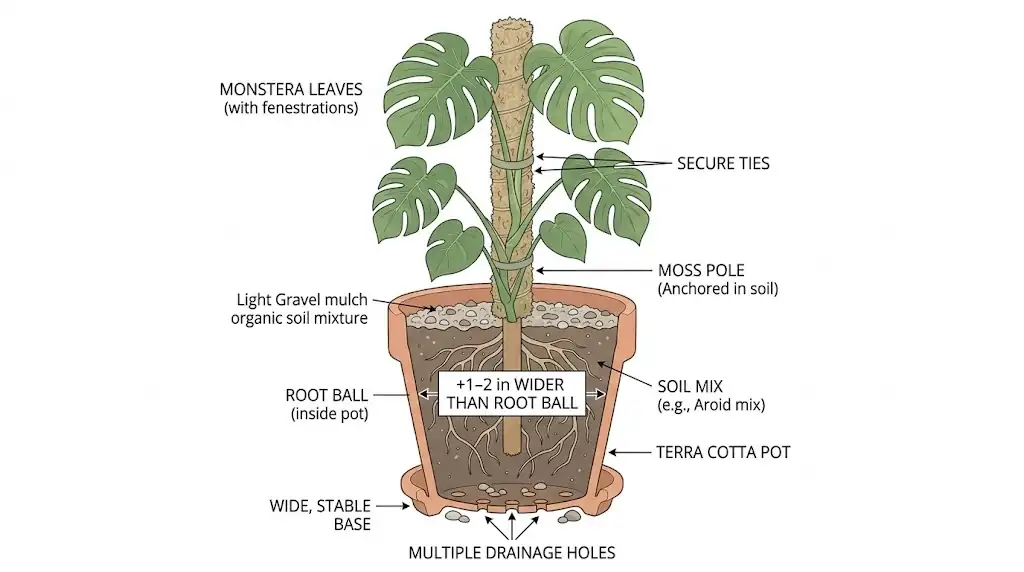
A solid, plant-safe guideline is to choose a pot that’s about 1–2 inches wider than the root ball when repotting (sometimes a touch more for very large specimens, but resist big jumps).
3) Shape + stability: Monsteras are top-heavy
A tall, narrow pot can tip once your plant climbs. Prefer a pot with:
- a wide base
- a heavier outer cachepot if the inner pot is light plastic
- room to anchor a moss pole or support
(A sturdy moss pole can be a game-changer for leaf size and upright growth—this is one place we’d consider a quality pole worth it.)
Pro tip for maximum leaf size and upright growth:
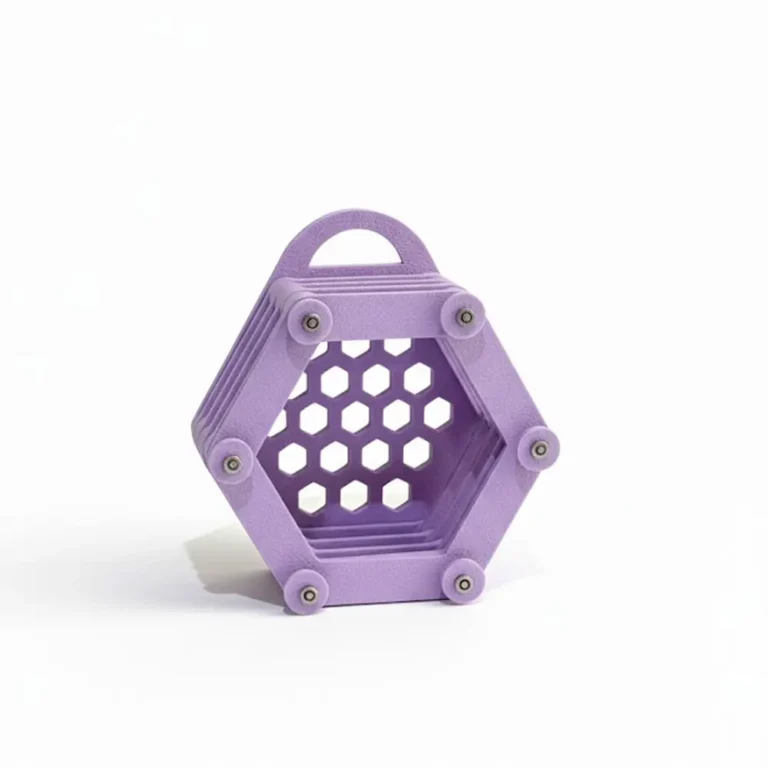
Pair any pot with a sturdy support. Our Modular Moss Pole for Monstera & Philodendron is designed exactly for this — hexagonal airflow, stackable up to 60 cm, perfect aerial root grip.
The easiest “good-looking AND safe” setup: the two-pot method
If you love decorative planters with no holes, use a plastic nursery pot with holes inside a cachepot. This gives you drainage without sacrificing style (and it’s great for protecting floors).
Steps:
- Keep your Monstera in a drainage-hole plastic pot.
- Place it inside a decorative outer pot.
- When you water, either:
- take the inner pot to the sink/shower to drain fully, or
- water lightly, then pour out any collected water after ~10–20 minutes.
This approach aligns with basic container drainage guidance: avoid standing water around roots.
Skip the “rocks at the bottom” trick
Putting rocks/gravel in the bottom doesn’t improve drainage the way people think; it can create a more saturated zone in the pot.
Match the pot to your home (the decision guide)
Pick the row that matches your space. Each one gives you a complete, repeatable setup: pot choice → mix tweak → one watering cue.
How to decide (fast):
- Plastic/glazed = non-porous → dries slower.
- Terracotta/fabric = porous → dries faster.
Monstera baseline: bright indoor light with no strong direct sun; peaty soil-based potting mix; allow soil to dry some between waterings; reduce watering fall–late winter.
Decision table (copy/paste friendly)
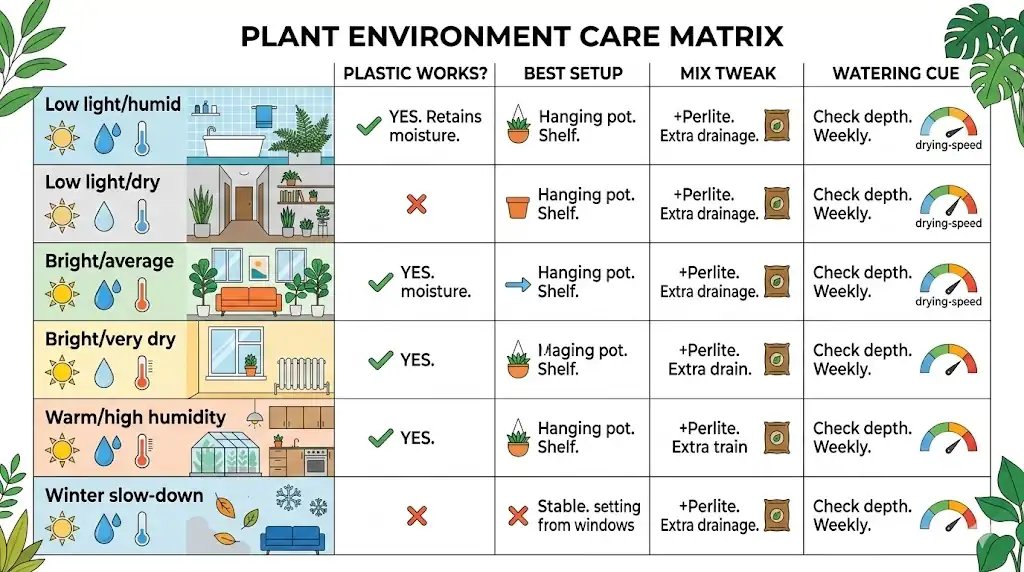
| Your home conditions (drying speed) | Plastic pot works? | Best pot setup | Mix tweak (keep it airy) | Watering cue to follow |
|---|---|---|---|---|
| Low light + higher humidity (north window, bathroom, winter) | Sometimes | Prefer terracotta or smaller plastic with multiple drainage holes | Extra chunky/aerated (increase bark + perlite/pumice) | Water only when top 2–3 in (5–8 cm) is dry and the pot feels much lighter |
| Low light + dry air (heated apartment, winter) | Yes, with care | Plastic is fine, but do not overpot | Chunky mix; don’t compact | Water only when the mix is clearly drying—avoid “weekly top-offs” |
| Bright indirect light + average humidity (most homes) | Yes (ideal) | Nursery pot (holes) inside a cachepot (two-pot method) | Standard aroid-style chunky mix | Water when top ~2 in (5 cm) dries; water through and drain fully |
| Bright light + very dry air (sunny room, vents, AC) | Yes (great) | Plastic helps buffer dryness; consider a stable/heavier outer pot | Add a slightly more moisture-holding base (keep structure chunky) | Don’t let it go crispy-dry; aim for “evenly moist, airy” |
| Very warm + high humidity (summer humidity, greenhouse vibe) | Caution | Terracotta or plastic with aggressive aeration | Chunky mix + high airflow | If the pot stays wet a long time, extend intervals (slow-drying = higher risk) |
| Winter for most homes (slower growth) | Caution | Plastic still works—adjust habits | More aeration, less watering | Expect slower drying; don’t follow summer frequency |
Non-negotiables
- Drainage holes + empty the saucer/cachepot after watering.
- Pot size: move up in small steps; oversized pots stay wet longer.
- Skip “rocks at the bottom”: it doesn’t improve drainage the way people think and can leave a wetter zone in containers.
Your home conditions directly tie into light & humidity — for precise lux recommendations and seasonal adjustments, see our Monstera Light Requirements guide.
The soil mix that makes plastic pots “safe” (oxygen first)
Key principle: In a plastic pot, the pot walls don’t “breathe,” so root oxygen comes almost entirely from air pockets in the mix. If the mix collapses or stays saturated, roots lose oxygen and problems start.
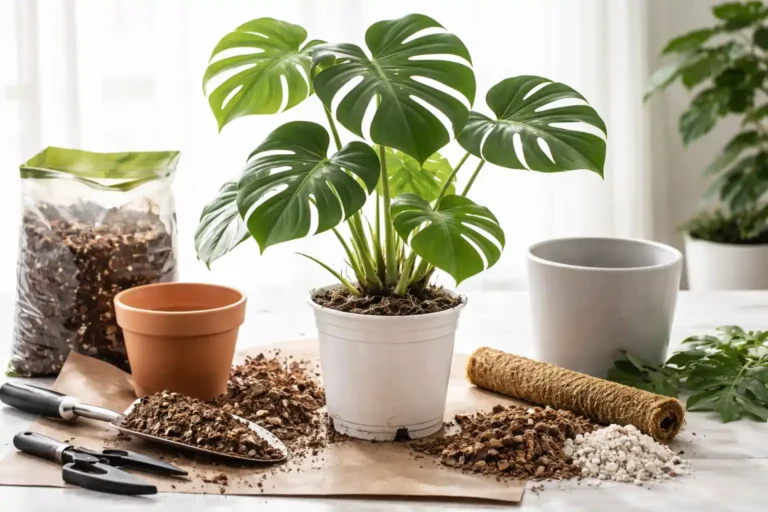
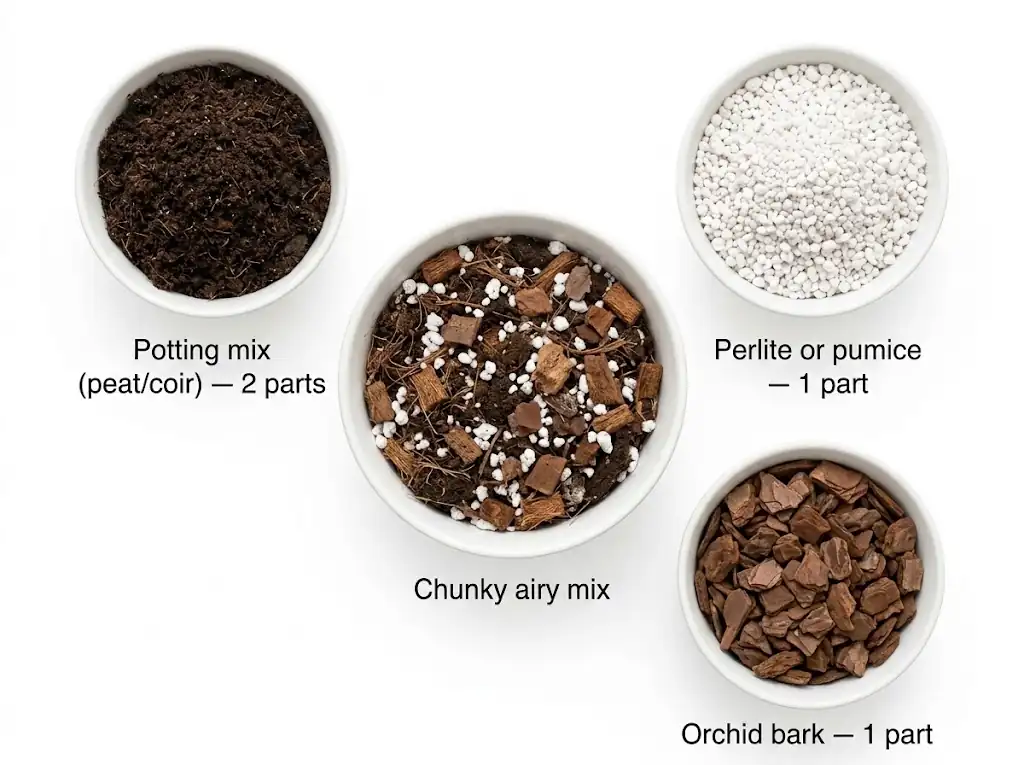
A reliable Monstera mix (plastic-pot friendly, by volume)
Use “parts” by volume (any scoop/cup works—just keep the ratio consistent):
- 2 parts peat-based or coco-coir-based potting mix
- 1 part perlite or pumice
- 1 part orchid bark (or fine pine bark)
Why this works (one sentence): the peat/coir holds steady moisture, while perlite/pumice + bark keep the mix chunky and airy so water drains and oxygen stays available. This also fits mainstream Monstera guidance that favors a peaty, well-drained potting mix with regular watering while letting the mix dry some between waterings.
How to mix it (so it stays airy)
- Measure your parts loosely (don’t pack the scoop).
- Combine dry ingredients and mix thoroughly.
- Pot up and avoid compressing the mix—lightly tap the pot to settle instead.
- Water once to settle, then top up only if the surface drops.
Tune the recipe to your home (simple adjustments)
Plastic holds moisture longer than porous terracotta, so you “tune” drying speed mainly by adjusting air space in the mix.
- Humid / low light / cool seasons (slow drying):
Increase aeration: add 25–50% more bark and/or perlite (keep the mix visibly chunky). - Very bright / warm / dry air (fast drying):
Keep it chunky, but add 10–20% more potting mix (peat/coir) for a bit more moisture buffering.
Cat-household note (trust & safety)
- Monstera deliciosa is toxic to cats if chewed (oral irritation, drooling, vomiting, difficulty swallowing). Keep plants out of reach, and store potting components sealed so curious cats don’t mouth or scatter them.
- Practical tip: don’t “recycle” cat litter into potting mixes—clumping agents/salts can behave unpredictably in containers and may attract digging.
Watering in plastic pots: a simple, repeatable routine (no calendar)
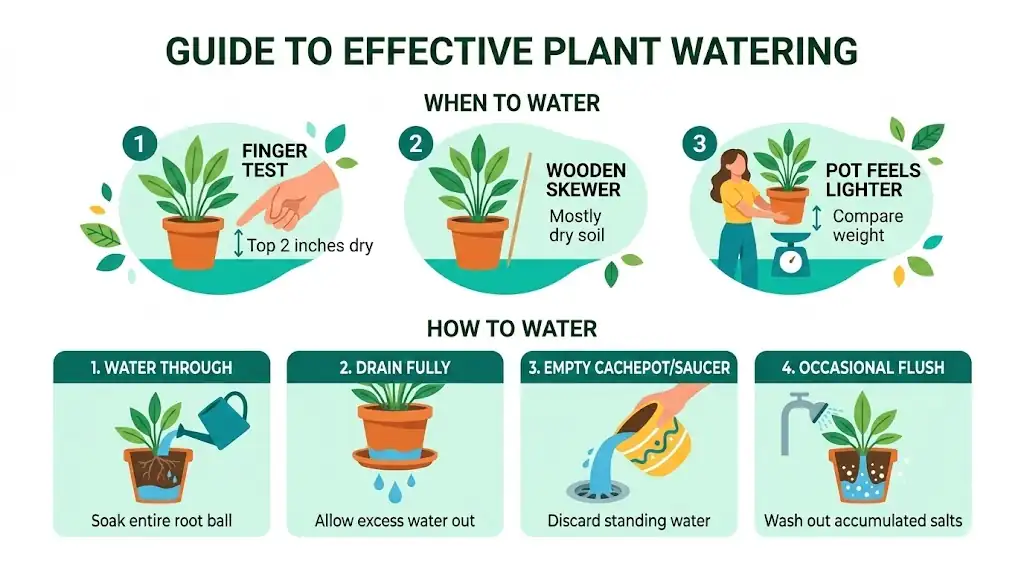
Goal: keep the mix evenly moist but airy—never waterlogged. Plastic pots dry more slowly, so timing depends on dryness checks, not the day of the week.
When to water (use 3 quick checkpoints)
Water only when at least 2 of these are true:
- Top-layer test: the top 2 inches (5 cm) feels dry (finger or wooden skewer).
- Pot-weight test: the pot feels noticeably lighter than right after a full watering.
- Growth/season reality: in active growth, water “regularly” but still let the mix dry some between waterings; in fall–late winter, expect slower drying and reduce frequency.
How to water (4 steps that prevent “mystery yellow leaves”)
- Water thoroughly until water runs out of the drainage holes (aim for full saturation, not a small “top-off”).
- Let it drain completely (sink/shower is ideal for 2–5 minutes).
- Empty the saucer/cachepot—don’t let the inner pot sit in runoff.
- Salt control (especially if you fertilize): occasional full watering with drainage helps reduce salt buildup; leaving drained water in saucers can worsen it.
Why this works for Monstera: Monstera deliciosa does best when you water during the growing season while letting the soil dry some between waterings, then reduce watering from fall through late winter.
Bottom watering
Bottom watering can help rehydrate a pot evenly when the mix has become very dry, but it’s not “set-and-forget.”
How to do it safely
- Place the pot (with drainage holes) in a tray of water for 10–20 minutes, then remove and drain fully.
- If you bottom-water often, do a top-water flush occasionally to help prevent mineral/fertilizer salt buildup.
Safety note: pets, kids, and sap
Monstera (Swiss cheese plant) contains irritating compounds that can cause oral irritation, drooling, vomiting, and difficulty swallowing if chewed by pets. If you suspect ingestion, contact your veterinarian or a pet poison hotline promptly.
We can share general, evidence-informed plant care guidance, but if you have concerns about pet safety, allergies, or persistent plant health issues you can’t resolve, consider consulting a veterinarian or a qualified horticulture professional.
Quick checklist: our “right pot” standard for Monstera
- ☐ Drainage holes (multiple is better)
- ☐ Only 1–2″ wider than the root ball (avoid big jumps)
- ☐ Chunky, airy mix (bark + perlite/pumice)
- ☐ Stable base for a moss pole (or heavier cachepot)
- ☐ Water thoroughly, then drain completely
- ☐ In low light/humid seasons: slow down watering
Key Points (action-first)
- Choose drainage and pot size first; material comes after.
- Plastic pots are great in bright light and/or dry air because they dry more slowly.
- In low light, cool rooms, or high humidity, plastic can stay wet too long—use a chunkier mix or switch to terracotta.
- Repot in small steps; overpotting is a common root-rot trigger.
- Use the two-pot method for style + safety (nursery pot inside a cachepot).
- Skip rocks/gravel layers; they don’t “fix drainage.”
- Water by dryness + pot weight, not a weekly schedule.
- Make stability part of the plan—Monsteras + moss poles get heavy.
FAQ
Is terracotta better than plastic for Monstera?
Terracotta is often more forgiving in low light or humid homes because it dries faster. Plastic is often better in bright/dry homes because it buffers against rapid drying.
Can I keep my Monstera in a plastic nursery pot forever?
Yes—many healthy Monsteras live long-term in nursery pots, especially when placed inside a decorative cachepot. Just stay on top of drainage and refresh the mix as it breaks down.
Should I use a self-watering pot?
They can work, but they raise the difficulty level because the mix can stay wetter than Monstera roots like. If you try one, use a very airy mix and monitor drying closely.
How do I know the pot is too big?
If the pot stays wet for a long time (especially in winter) and you’re seeing yellowing, droop, or slow growth, the root zone may be staying too saturated.
What’s the safest way to make a decorative pot work?
Use the two-pot method, and always pour off excess water after watering.
Conclusion
Yes—plastic pots are a reliable choice for Monstera deliciosa and often the most practical option for large, top-heavy plants. The setup only works when you control the three variables that most often cause “mystery yellow leaves”: drainage, pot size, and air space in the mix.
Bottom line (quote-ready):
- Use plastic only with real drainage holes so excess water can exit and oxygen can return to the root zone.
- Size up modestly (typically 1–2 inches wider than the root ball) to avoid a pot that stays wet longer than roots can use.
- Make the mix airy and chunky (bark + perlite/pumice + a quality base) so roots stay oxygenated even when the pot holds moisture.
- Match pot to drying speed: plastic shines in bright/dry homes; in low light, cool rooms, or high humidity, switch to terracotta or keep plastic but increase aeration and reduce watering frequency.
For a clean, décor-friendly approach that’s still plant-safe, the most dependable method is the two-pot setup: keep the Monstera in a drainage nursery pot and place it inside a decorative cachepot, then empty runoff after watering. This makes watering predictable without risking soggy roots.
Want the full Monstera journey?
- Start here → Monstera Care for Beginners Indoors
- Master soil → Best Soil for Monstera
- Know exactly when to repot → When to Repot Monstera Deliciosa
Ready to build the perfect setup today?
Reference List
Missouri Botanical Garden. (n.d.). Monstera deliciosa (Plant Finder).
Bunt, A. C., & Kulwiec, Z. J. (1971). The effect of container porosity on root environment and plant growth. II. Water relations. Plant and Soil, 35, 1–16. doi:10.1007/BF01372627
Milks, R. R., Fonteno, W. C., & Larson, R. A. (1989). Hydrology of horticultural substrates: II. Predicting physical properties of media in containers. Journal of the American Society for Horticultural Science, 114(1), 53–56. doi:10.21273/JASHS.114.1.53
Bunt, A. C. (1991). The relationship of oxygen diffusion rate to the air-filled porosity of potting substrates. Acta Horticulturae, 294, 215–224. doi:10.17660/ActaHortic.1991.294.23
Bilderback, T., & Fields, A. (2008). Measuring air-filled porosity for container substrates. Combined Proceedings of the International Plant Propagators’ Society, 58, 129–131.
Criscione, K. S., Owen, J. S., & Fields, J. S. (2025). Stratified soilless substrates decrease the vertical gravitational water gradient altering Helianthus root morphology. Plant and Soil, 514, 287–307. doi:10.1007/s11104-025-07385-8
University of Maryland Extension. (2023, March 10). Potting and repotting indoor plants.
University of Arkansas System Division of Agriculture. (n.d.). Repotting houseplants [PDF].
Chalker-Scott, L. (n.d.). The Myth of Drainage Material in Container Plantings: “Add a layer of gravel…” [Extension fact sheet]. Washington State University.
American Society for the Prevention of Cruelty to Animals (ASPCA). (n.d.). Swiss cheese plant (Monstera deliciosa). Toxic and Non-toxic Plants database.