At TropicalPlantKit, most of us didn’t start as “staghorn fern experts.”
We started exactly where you might be right now—staring at a mounted plant with antler-shaped leaves and wondering:
Is this supposed to look like this?
Am I watering it right?
Why are some leaves brown but others still growing?
This page exists to answer those questions before frustration sets in.
If you’re new to staghorn ferns, this is your starting point. Not a care schedule. Not a checklist. But a clear explanation of how these plants work, so every decision you make afterward actually makes sense.
Table of Contents
What Are Staghorn Fern
Staghorn ferns belong to the genus Platycerium, a group of true ferns in the Polypodiaceae family. They are not orchids, even though they’re often mounted and grown without soil.
In nature, Platycerium species grow attached to trees, not rooted in the ground. This single fact explains nearly everything about their structure, watering needs, and mounting preferences.
Once you understand that staghorn ferns evolved above the forest floor, most beginner mistakes suddenly become obvious—and avoidable.
Staghorn Ferns Are Ferns—Not Orchids
Staghorn ferns are often mistakenly grouped with orchids because both are mounted, epiphytic plants. Botanically, however, staghorn ferns belong to the fern genus Platycerium, within the family Polypodiaceae. They reproduce by spores, not flowers, and follow a completely different life strategy.
Understanding that Platycerium are true ferns adapted to tree canopies, not soil, is the first step to growing them well. This distinction explains nearly every care decision that follows, from mounting to watering.
Why Staghorn Ferns Look So Different From Other Houseplants
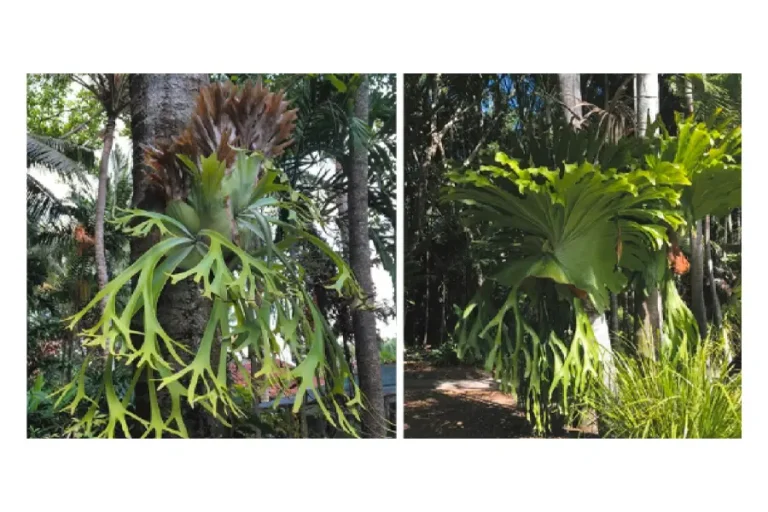
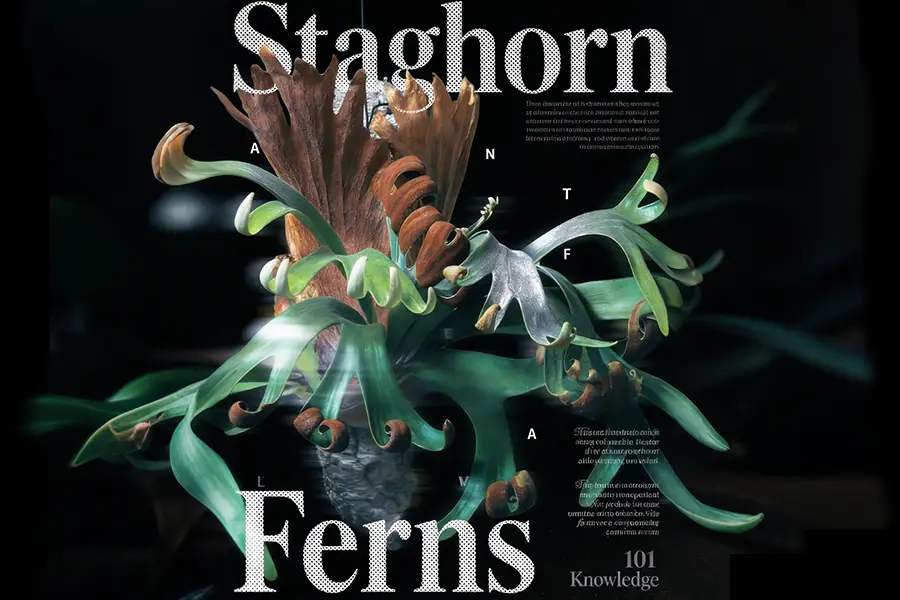
Staghorn ferns don’t have “normal” leaves. They have two completely different types of fronds, each with a job.
The first are the fertile fronds, the long antler-shaped leaves that most people notice first. These fronds are responsible for photosynthesis and spore production. Depending on species, they may grow upward, spread sideways, or cascade downward in long ribbons. As the plant matures, spores form on the underside of these fronds. After several months—or sometimes over a year—older fertile fronds naturally yellow and fall away. This is normal, not a sign of decline.
The second type are the shield fronds, also called basal or sterile fronds. These grow tightly against the plant’s base, gradually turning from green to brown as they mature. Many beginners try to remove them, assuming they’re dead leaves. In reality, shield fronds are one of the most important survival adaptations of Platycerium.
Shield fronds protect the rhizome, retain moisture, and act as a natural funnel. Rainwater, fallen leaves, insect remains, and even bird droppings are collected and slowly broken down into nutrients. Because staghorn ferns do not root into soil, this system replaces the role of the ground itself. It is one of the most elegant nutrient-capture strategies in the plant world.
We go deeper into this mechanism in our future article on how epiphytic plants feed themselves without soil next week, which pairs especially well with understanding mounted ferns.
Staghorn Fern Anatomy
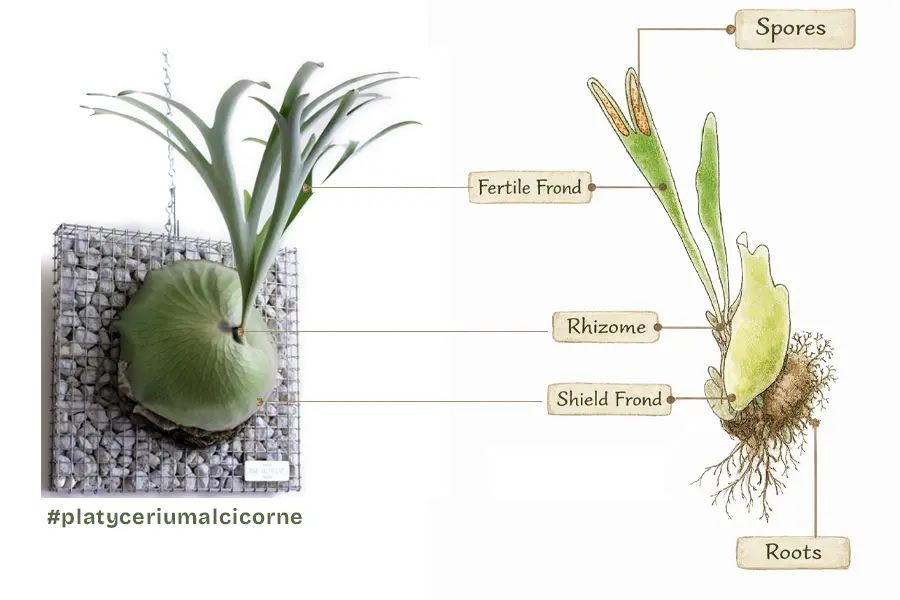
| Plant Part | Short Description |
|---|---|
| Fertile Frond | Antler-shaped fronds used for photosynthesis and spore production. |
| Spores | Reproductive structures located on the underside of fertile fronds. |
| Shield Frond | Basal frond that protects the rhizome and helps store moisture and nutrients. |
| Rhizome | Central growth point from which all fronds and roots develop. |
| Roots | Anchor the plant to its mount and absorb water from the growing medium. |
The White “Fuzz” Has a Purpose
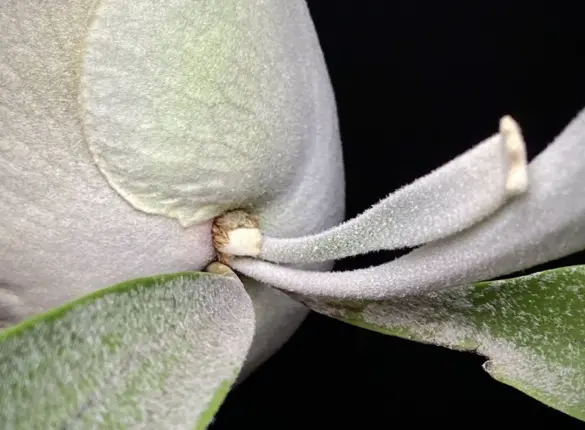
Most Platycerium species are covered in fine white hairs known as stellate trichomes. These are not cosmetic. They reflect harsh sunlight, reduce water loss, and protect the frond surface from excess moisture.
This is why we always caution against wiping staghorn fern leaves. Once trichomes are damaged, they do not regenerate, and the plant becomes more vulnerable to dehydration and sun stress. If dust accumulates, airflow—not cleaning—is the solution.
The Rhizome: Where Everything Begins
At the center of every healthy staghorn fern is the rhizome, the growth point from which all fronds and roots emerge. If the rhizome is damaged or rots, recovery is unlikely.
When we evaluate staghorn fern health in our studio, the first thing we check is not leaf color, but rhizome firmness and attachment. Some species naturally produce pups around the rhizome, eventually forming large clusters. These offsets can be separated once they develop independent roots.
How Many Staghorn Fern Species Exist?
How Many Types of Staghorn Ferns Are There? The answer is :i n the wild, there are 18 recognized original species of Platycerium. While hybrids and cultivars are now widespread, these original species form the foundation of all modern breeding.
We find it most practical to understand Platycerium by geographic origin, because origin closely predicts temperature tolerance, growth rhythm, and seasonal behavior.
If You’re New, Start With Australian Species, Australian staghorn ferns are the most forgiving and beginner-friendly. This group includes Platycerium bifurcatum, veitchii, hillii, and superbum.
These species tolerate:
- Cooler temperatures
- Lower humidity
- Short dry periods
- Minor care mistakes
That’s why most beginner staghorn ferns sold globally come from this group. If you’re choosing your first plant, this is the safest place to start.
| Region | Species Name (Scientific) | Care Difficulty |
|---|---|---|
| Southeast Asia | Platycerium ridleyi | ★★★★★ |
| Southeast Asia | Platycerium coronarium | ★★★★☆ |
| Southeast Asia | Platycerium grande | ★★★★☆ |
| Southeast Asia | Platycerium holttumii | ★★★★☆ |
| Southeast Asia | Platycerium wallichii | ★★★★☆ |
| Southeast Asia | Platycerium wandae | ★★★★☆ |
| Oceania (Australia) | Platycerium willinckii | ★★★☆☆ |
| Oceania (Australia) | Platycerium veitchii | ★★☆☆☆ |
| Oceania (Australia) | Platycerium bifurcatum | ★☆☆☆☆ |
| Oceania (Australia) | Platycerium hillii | ★★☆☆☆ |
| Oceania (Australia) | Platycerium superbum | ★★☆☆☆ |
| South America | Platycerium andinum | ★★★★★ |
| Africa | Platycerium alcicorne | ★★★☆☆ |
| Africa | Platycerium ellisii | ★★★★☆ |
| Africa | Platycerium stemaria | ★★★★☆ |
| Africa | Platycerium madagascariense | ★★★★★ |
| Africa | Platycerium quadricdichotomum | ★★★★☆ |
| Africa | Platycerium elephantotis | ★★★★☆ |
Difficulty scale:
★☆☆☆☆ = very easy (beginner friendly)
★★★★★ = very difficult (expert level indoors)
Southeast Asian Species: Heat-Loving but Air-Hungry
Species native to Thailand, Vietnam, Malaysia, the Philippines, and Indonesia include Platycerium ridleyi, P. coronarium, P. grande, P. holttumii, P. wallichii, and P. wandae.
These are often the most visually dramatic staghorn ferns, capable of enormous size under ideal conditions. They tolerate heat well but struggle with cold, stagnant air, and prolonged dampness. In summer, ventilation is critical. In winter, they must be protected indoors.
Many collectors underestimate how much airflow these species require. We cover this in more detail in our indoor airflow setup guide for mounted plants, especially relevant for apartment growers.
Australian Staghorn ferns Species
If you are new to staghorn ferns, Australian species are the most forgiving. This group includes Platycerium bifurcatum, P. veitchii, P. hillii, P. superbum, and P. willinckii.
These species tolerate cooler temperatures, lower humidity, and occasional dryness. P. bifurcatum can even survive light frost outdoors, though it looks best when kept above 10 °C. Because of this resilience, most “beginner staghorn ferns” sold worldwide come from this group.
As we just mentioned , if you’re choosing your first mounted fern, we strongly recommend starting here before moving on to Southeast Asian or African species.
South American Species: One Species, Very Specific Needs
South America contributes only one species: Platycerium andinum. It naturally grows at high elevations in Peru and Bolivia, where temperatures are cooler and airflow is constant.
This species dislikes heat and humidity. In cultivation, it rarely reaches the massive size seen in nature, but it rewards experienced growers with elegant, elongated fronds. We consider P. andinum an advanced plant best grown with climate awareness.
African Species: Seasonal and Characterful
African Platycerium species include P. alcicorne, P. ellisii, P. stemaria, P. madagascariense, P. elephantotis, and P. quadric dichotomum. Many are smaller but visually distinctive, and most follow clear seasonal growth and dormancy cycles.
These species require growers to adjust watering and care throughout the year. Treating them like constantly growing tropical plants often leads to decline. Understanding seasonal rhythm is essential, and we explore that rhythm further in our dry-season vs rainy-season care article.
Why Seasonality Matters in Care
In the wild, most staghorn ferns experience alternating wet and dry seasons. During rainy periods, they expand fertile fronds and store resources. During dry seasons, growth slows, and stored moisture sustains the plant.
In temperate climates, we can mirror this pattern. Many growers allow partial rest during peak summer heat or winter dryness, while encouraging growth in spring and autumn. With greenhouses, year-round growth is possible, but it is not mandatory for healthy plants.
Why Light, Airflow, and Mounting Matter More Than Watering Schedules
One of the most common beginner mistakes is treating staghorn ferns like regular houseplants—watering on a schedule, keeping them in low light, or placing them in still indoor air.
Staghorn ferns prefer bright, filtered light, not deep shade. Direct summer sun can burn them, but too little light leads to weak growth.
Airflow is equally important. In nature, these plants are constantly exposed to moving air. Indoors, stagnant air is often a bigger problem than underwatering. Gentle air circulation makes an enormous difference.
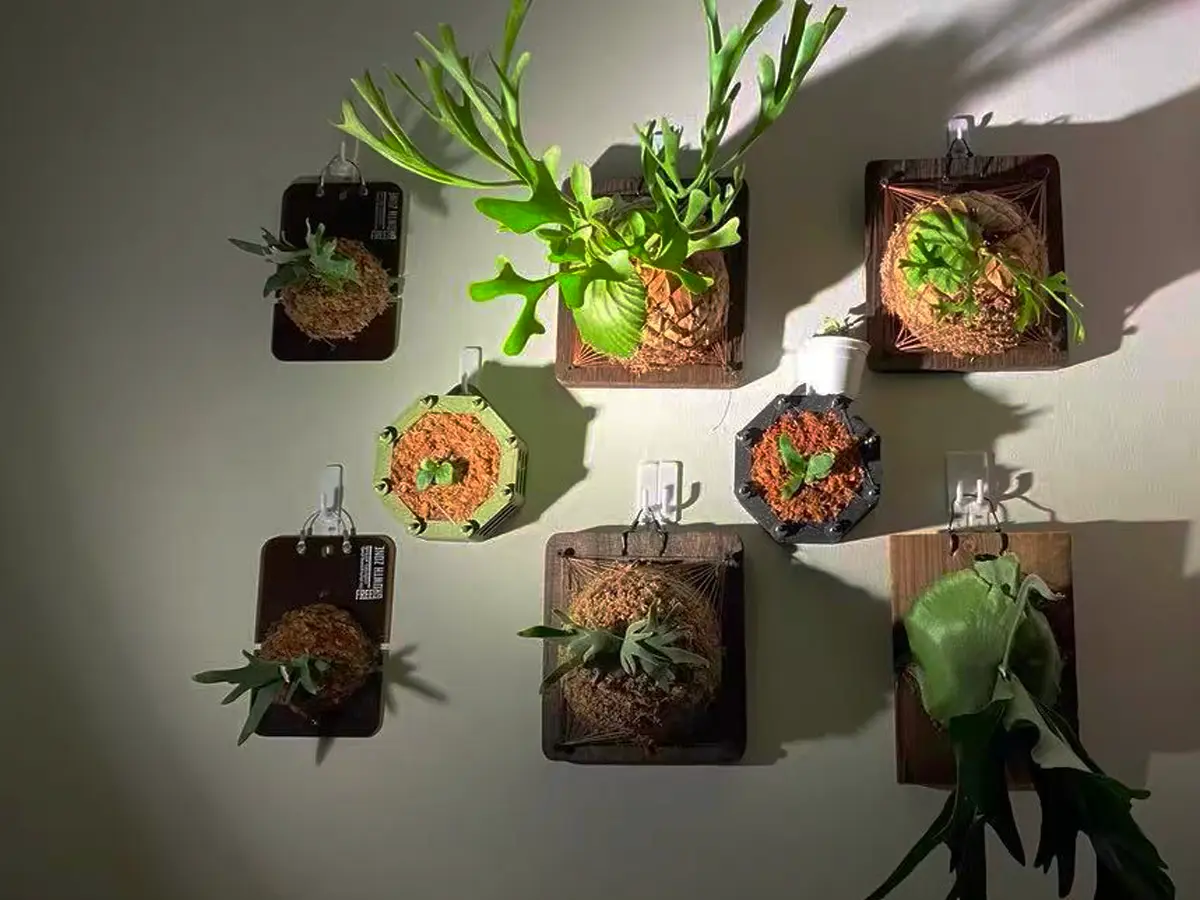
Mounting also plays a role. While staghorn ferns can survive in pots, mounting them on wood or cork allows them to dry evenly and breathe properly. This is why we design most of our growing systems around mounted epiphytic plants, not soil-based setups.
A Simpler Way to Think About Watering
Instead of asking “How often should I water?”, ask:
Is the plant dry right now?
Is the environment warm and bright, or cool and dim?
During active growth, water thoroughly once the mounting medium dries. In cooler or darker conditions, reduce frequency. Never keep the rhizome constantly wet.
This plant evolved to store water during rainy periods and slow down during dry ones. You’re not forcing growth—you’re supporting a rhythm that already exists.
Why We Prefer Mounted Staghorn Ferns (Especially Indoors)
While staghorn ferns can technically survive in pots, we almost always recommend mounting them, especially for indoor growing. Mounting isn’t just an aesthetic choice—it closely mirrors how staghorn ferns live in nature.
In the wild, Platycerium species attach themselves to tree trunks or branches, growing vertically with their roots exposed to air rather than buried in soil. Rainwater runs through quickly, excess moisture drains away, and constant airflow keeps the rhizome healthy. When we mount staghorn ferns indoors, we’re not forcing a trend—we’re recreating their original growth logic in a controlled environment.
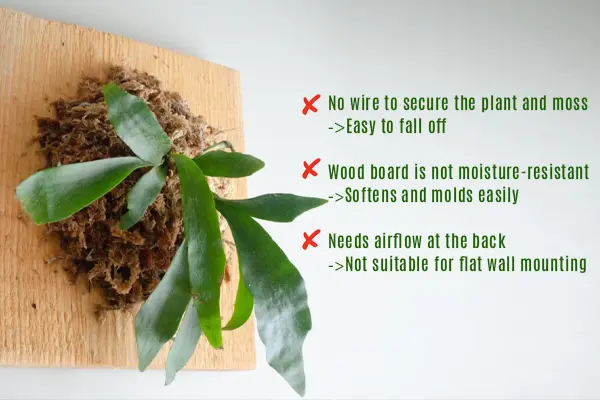
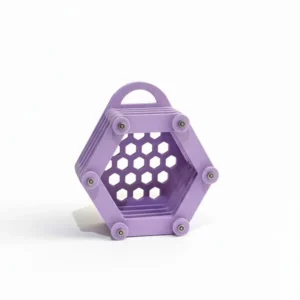
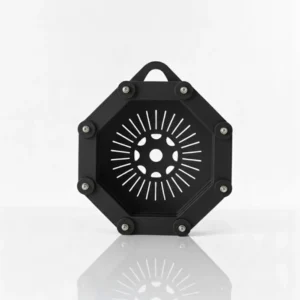
We commonly mount staghorn ferns onto wood boards, cork bark, acrylic panels, or lightweight plastic wall mounting boards, depending on the space and visual style. The plant is secured to the surface and grown using sphagnum moss as the primary growing medium. This combination allows the roots to stay lightly moist while still receiving oxygen, dramatically reducing the risk of rot compared to dense potting mixes.
Wall Planter Recommend
7cm Mini Size hanging planter for Mini Plant or Plant Handwork
Original price was: $19.00.$15.58Current price is: $15.58.Cheese-Style Mounting Board for Vertical Planting
Price range: $25.20 through $55.80Indoor Hanging Planter for Staghorn Ferns to to Hang Your Moss Ball
Price range: $32.00 through $58.50Transparent Acrylic Wall Mount Board for Staghorn Fern
Price range: $26.00 through $31.00


Sphagnum moss plays a critical role here. It holds moisture evenly, dries predictably, and provides a stable yet breathable environment for epiphytic roots. If you’re new to this medium, we recommend reading our in-depth guide, Sphagnum Moss: What It Is and How We Use It in Tropical Plant Care, which explains why it behaves so differently from soil and how to use it correctly indoors.
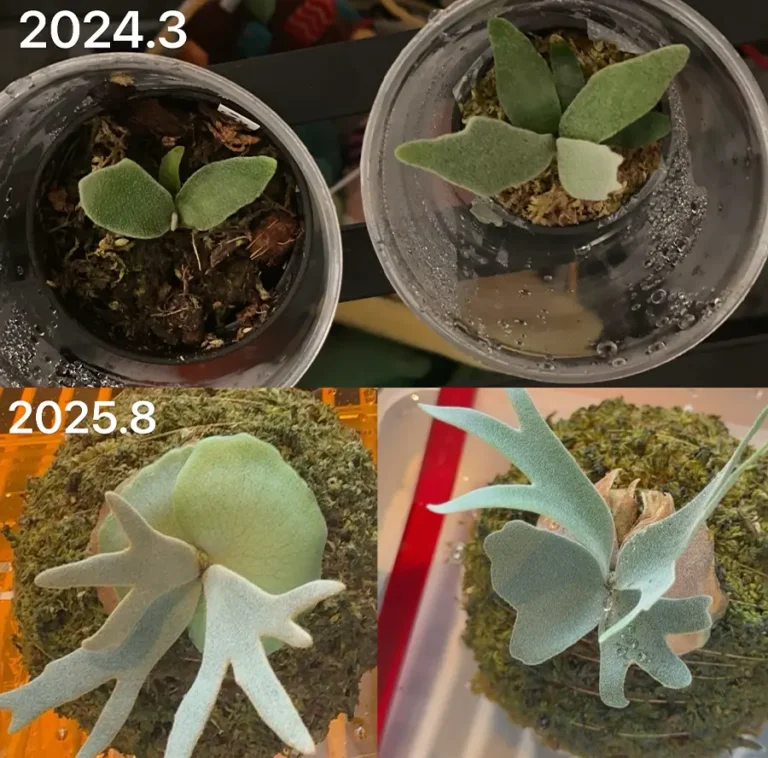
Mounted staghorn ferns also dry more evenly after watering, which makes care more forgiving for beginners. Instead of water pooling at the bottom of a pot, moisture disperses across the moss and evaporates naturally. Over time, this encourages stronger root systems, healthier rhizomes, and more defined frond shapes.
Visually, mounted plants develop into the sculptural forms staghorn ferns are known for—shield fronds layering naturally, fertile fronds extending outward with balance and intention. Functionally, mounting improves airflow, simplifies watering decisions, and aligns the plant’s environment with how it evolved to grow.
This is why most of the accessories and tools we design at TropicalPlantKit—from mounting boards to epiphyte-friendly hardware—are built specifically for mounted epiphytic plants, not traditional soil-based houseplants. Our goal isn’t just to help plants survive indoors, but to help them grow in a way that feels natural, stable, and sustainable long-term.
Final Thoughts
Staghorn ferns are not difficult plants—but they are specific plants. Once you understand how their leaves work, why their shield fronds matter, and how their native climates shaped their behavior, everything becomes more intuitive.
They are living systems, not decorations. And when grown with respect for their biology, they become some of the most rewarding plants you can grow indoors.