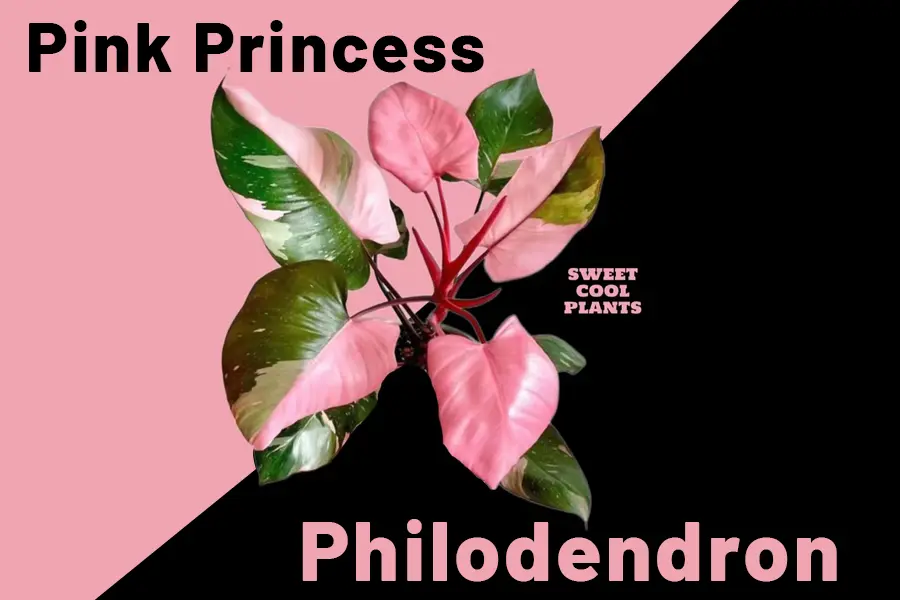
If you’re searching for a plant that feels part botanical, part artwork, Philodendron ‘Pink Princess’ (PPP) is exactly that. Even after years of growing tropical plants in our studio—over a hundred pots across Monstera, Anthurium, Philodendron, Begonia, and staghorn ferns—Pink Princess is still one of the plants we stop to admire every week. No two leaves look the same, and when the lighting and genetics align, you get those unmistakable bubble-gum pink sectors that collectors obsess over.
But here’s the truth many beginners don’t hear:
Pink Princess isn’t hard to grow. It’s just a plant that reacts very honestly to light, node stability, and potting mix. Once you understand those three things, PPP becomes one of the most rewarding philodendrons you can grow indoors.
Table of Contents
What Makes Philodendron Pink Princess Unique?
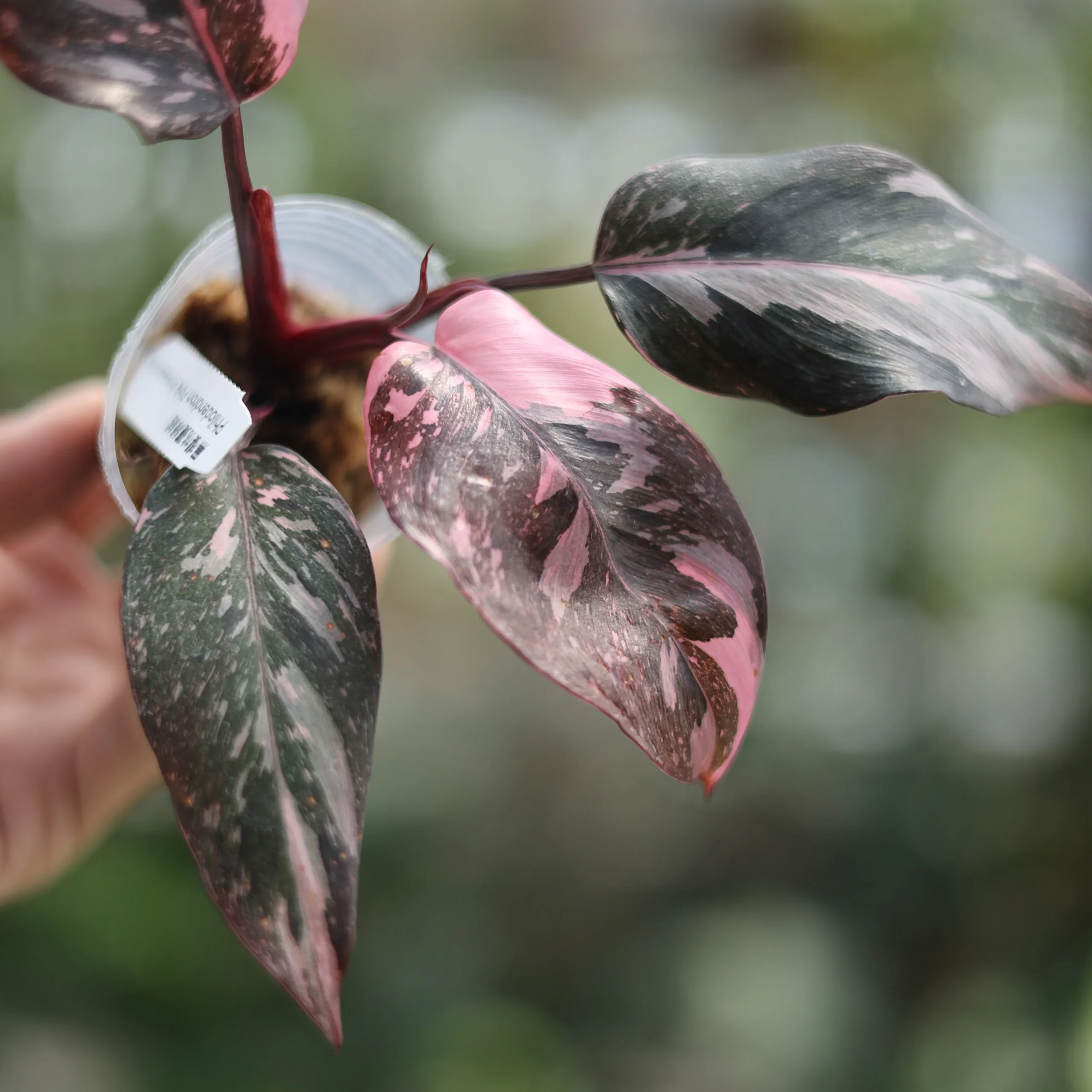
Philodendron ‘Pink Princess’ is a hybrid selection of Philodendron erubescens, created for its naturally occurring pink variegation. The coloration occurs due to chlorophyll-deficient zones within the leaf tissue. Because the pink areas contain little to no chlorophyll, they cannot photosynthesize—so how much pink your plant can support depends on the health of the green tissue and the conditions you provide.
Identifying traits
• A climbing philodendron with semi-matte, burgundy-toned leaves
• Variegation in pink streaks, patches, or large sectors
• Compact growth when given bright light
• Highly sensitive to changes in light and node strength
Why the variegation matters
Pink Princess carries both normal green cells and mutated pink/white cells. The ratio shifts as the plant grows, which is why some PPPs show:
• High pink in one season
• Very little pink the next
• Sudden reversion
• Sudden dramatic color return after a chop
It’s a plant with personality—and understanding its genetics helps you grow it well.
Pink Princess vs. Pink Congo: A Crucial Distinction
This is one of the most common questions we receive from beginner growers.
Pink Princess
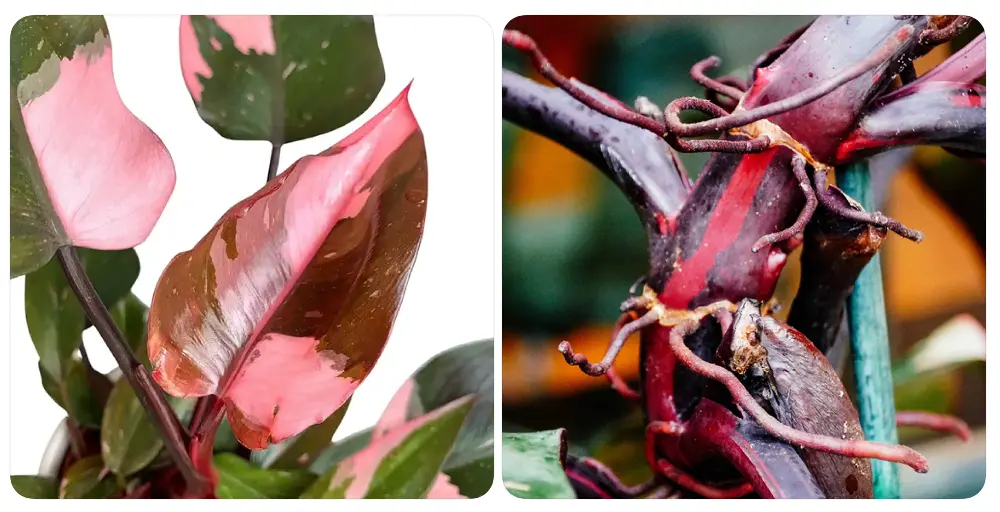
• True variegated plant
• Pink appears at random based on node tissue
• Pink stays pink as the leaf ages
• Stable if provided good light
Pink Congo
• Pink is artificially induced by chemical treatment
• Leaves turn green again over time
• Not genetically variegated
• Not related to PPP
If your plant’s pink flushes fade entirely to green within months, you’re not dealing with a Pink Princess.
Light Requirements: The Most Important Factor
When people ask us why their Pink Princess has stopped producing pink, we almost always start with the same question: “How much light is it getting?”
PPP is far more light-hungry than a typical philodendron.
Ideal Light Levels
• Bright, indirect light for 8–10 hours daily
• Under grow lights: 100–200 μmol/m²/s PPFD
• East- or southeast-facing windows are near perfect
Signs your PPP needs more light
• New leaves show little to no pink
• Stretched internodes (long gaps between leaves)
• Deep green, dull coloration
Signs your light is too strong
• Crispy pink areas (pink burns faster than green)
• Washed-out leaf color
• Bleaching near leaf edges

We’ve had the best results using full-spectrum LED grow lights set at a modest intensity rather than placing the plant too close to a bright southwest window.
If you want to dive deeper into how we set up indoor lighting for tropical plants, you can refer to our Monstera light guide (internal link).
Soil & Potting Mix: Airy, Structured, and Fast-Draining
Pink Princess roots love oxygen. Dense or peat-heavy soil slows growth and increases your risk of root rot, especially in lower light.
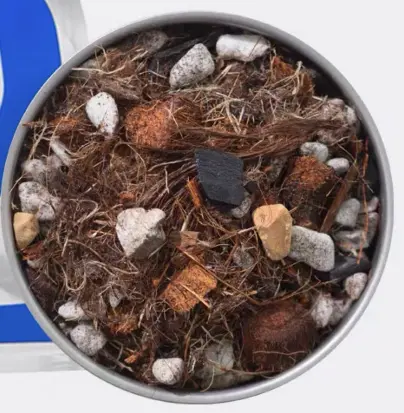
Below is the exact mix we use in our studio—a variation of our standard aroid formula with slightly more structure to support climbing.
Tropical Plant Kit PPP Potting Mix
| Ingredient | Ratio | Purpose |
|---|---|---|
| Orchid bark (medium grade) | 30% | Airflow + structure |
| Coco chips or coco coir blend | 25% | Moisture balance |
| Perlite or pumice | 20% | Drainage + root oxygen |
| Shredded sphagnum moss | 15% | Slow moisture release |
| Horticultural charcoal | 10% | Keeps mix fresh |
This structure encourages active root exploration, which leads to larger leaves and better color.
Repotting frequency
Pink Princess doesn’t require frequent repotting. Every 18–24 months is enough, or sooner if you see roots circling or pushing upward from the stem base.
We almost always size up by 2–3 cm only. Oversized pots slow root metabolism and cause unpredictable watering cycles.
Watering: Consistent While Avoiding Oversaturation
Because PPP contains less chlorophyll in pink zones, it grows more slowly than a fully green philodendron. This means its water usage is more modest.
Our general rhythm:
• Water when the top 40–50% of the mix has dried
• Expect weekly watering during spring/summer
• Stretch to every 7–12 days in autumn/winter
Signs your watering is perfect
• Firm, upright leaves
• No yellowing
• New leaves unfurl cleanly
Signs of overwatering
• Soft petioles
• Yellow patches on green zones
• Mushy roots
• Sudden collapse of a leaf with heavy pink sectors
If you live in a low-humidity environment (below 45%), your potting mix may dry very fast. In this case, lightly increasing the sphagnum ratio can help stabilize moisture.
Humidity and Temperature
Pink Princess is adaptable, but thrives best in warm, moderately humid conditions.
| Condition | Ideal Range |
|---|---|
| Humidity | 60–75% |
| Temperature | 20–28°C |
| Minimum safe temperature | >15°C |
If your humidity is lower, don’t panic—PPP does fine in 45–50% with correct watering. Higher humidity mainly reduces leaf edge crisping and encourages smoother unfurling.
Fertilizer: Feed Lightly but Consistently
We fertilize Philodendron ‘Pink Princess’ lighter than other Philodendrons because excessive nitrogen often pushes faster green growth, sometimes overshadowing variegation.
Feeding schedule
• Growing season (spring–summer): Diluted NPK fertilizer every 2 weeks
• Low-light season: Every 4–6 weeks
• Supplement with calcium–magnesium monthly for leaf strength
Look for formulas around 3–1–2 or 5–3–2, which match the nutrient ratio tropical foliage naturally uses.
Growth Habit: Why a Moss Pole Makes a Difference
Pink Princess is a climber. Without support, it will grow horizontally, produce smaller leaves, and sometimes revert because the nodes are not aligned toward light.
With a moss pole, you’ll notice:
• Larger leaves
• More symmetrical variegation
• Shorter internodes
• Stronger aerial roots
We use both traditional sphagnum poles and our TropicalPlantKit hollow moss poles (if you want to place internal link to your moss pole product page). These structures allow the plant to anchor and grow vertically, mimicking natural forest conditions.
Reversion: Why It Happens and How to Fix It
This is the biggest concern for most PPP owners.
Why reversion occurs
• Low light
• Node tissue dominated by green cells
• Extended periods of stress
• Excess nitrogen
• Plants grown horizontally instead of upright
How to prevent reversion
• Provide steady, bright indirect light
• Encourage upright climbing toward light
• Rotate your pot every 1–2 weeks
• Avoid overly rich fertilizer
If your PPP has already reverted
There is a way to rescue it:
Step 1: Examine the stem and find the last node with visible pink streaks.
Step 2: Cut above that node.
Step 3: Propagate the variegated section.
Step 4: Allow the new plant to root in sphagnum under bright conditions.
If there is no variegation left inside the node tissue, the plant cannot “recover” pink, because variegation is not created by environment—it is simply expressed or suppressed by it.
Propagation: How We Get the Most Stable Results
PPP is one of the easier collector plants to propagate because the nodes are clearly spaced and aerial roots develop readily.
Our propagation method
- Select a cutting with 1–2 nodes and at least one healthy leaf.
- Remove lower leaf if necessary to expose the node.
- Root in one of the following: • Straight sphagnum moss • Perlite in a semi-hydro container • Water (fastest but acclimation required)
- Maintain humidity at 60–80% during rooting.
- Transition to soil once roots reach 5–7 cm.
Because variegation is genetic within the node, the pattern of the mother plant does not determine the pattern of the propagated plant. The node itself must contain variegated tissue.
Common Problems and How to Troubleshoot
Brown spots on pink
• Light intensity too high
• Pink tissue burns faster—reduce exposure
Yellow leaves
• Overwatering
• Root suffocation
• Sudden temperature drop
Small leaves
• Insufficient light
• No vertical support
• Weak root system
Pale green color
• Lack of nutrients
• Insufficient chlorophyll input from low-light positioning
Entirely green new leaves
• Node reversion beginning
• Evaluate stem immediately
If pests appear, PPP is most prone to spider mites, mealybugs, and thrips. Matte surfaces make early detection easier—wipe leaves regularly.
Why Some Pink Princesses Produce More Pink Than Others
Even among plants grown in identical conditions, the variegation levels differ. This is because PPP is a chimeric plant with multiple cell layers. The distribution of mutated cells varies from plant to plant, node to node.
Factors influencing your plant’s color
• Balance of green vs. pink tissue in the active node
• Light stability
• Root health
• Genetic variance within the plant line
• Whether the plant is climbing or trailing
A well-grown PPP produces marbled pink that is stable across multiple leaves—not just one lucky shot.
Pink Princess Price, Rarity, and Market Shifts
When PPP first hit the market, it was rare and very expensive. Tissue-culture propagation has since made it more accessible, but high-variegation specimens or mature climbing plants remain sought after.
Factors affecting price include:
• Size of pink sectors
• Stability of color over multiple leaves
• Internodal spacing (tight = desirable)
• Root health
• Whether it is TC (tissue culture) or seed/vegetative grown
Seed-grown PPPs do not exist (genuine variegation is not seed-stable), so be cautious with mislabeled plants.
FAQ About Philodendron Pink Princess
What kind of light does the Pink Princess Philodendron need?
Bright, indirect light is crucial. The pink parts of the leaves lack chlorophyll, so the plant relies heavily on the green parts. Insufficient light will cause the plant to revert (produce more green leaves and lose pink variegation). Too much direct sun can scorch the pink parts easily.
How do I get more pink variegation on my plant?
Maximize the amount of bright, indirect light it receives. You can use a grow light if your natural light is low. Additionally, proper care—including appropriate watering, soil, and temperature—ensures the plant is healthy enough to support the energy-intensive pink leaves.
What does “reversion” mean, and can I fix it?
Reversion is when the plant starts producing solid green leaves, losing the pink variegation. This is usually a sign of insufficient light. To fix it, move the plant to a brighter location. You may also need to prune off the fully green stems or leaves to encourage new growth from a more variegated node.
How often should I water my Pink Princess?
Water when the top 1–2 inches of soil are dry to the touch. They prefer consistently slightly moist soil but are prone to root rot if overwatered. Ensure your pot has excellent drainage.
What is the best soil mix for this plant?
The PPP needs an airy, well-draining, and rich soil mix—often called an aroid mix. A good combination includes a standard potting mix blended with chunky materials like orchid bark, perlite, and/or coco coir to ensure root aeration and prevent compaction.
Does the Pink Princess require high humidity?
Yes. As a tropical aroid, it thrives in moderate to high humidity (50-80%). Low humidity (below 50%) can cause the leaf edges and tips to turn brown or crispy, especially on the delicate pink sections. Using a humidifier or pebble tray is recommended in dry climates.
When and how should I fertilize it?
Fertilize during the active growing season (spring and summer), typically once every 2–4 weeks, using a diluted, balanced liquid houseplant fertilizer. Reduce or stop fertilization during the slow growth period in winter.
Why are the tips of my pink leaves turning brown?
Browning tips are often caused by low humidity, insufficient watering (letting the soil get too dry), or mineral build-up from tap water/fertilizer. Focus on increasing humidity and ensuring consistent, proper watering.
Should I provide a support pole for my Philodendron Pink Princess?
Yes. The PPP is a climbing Philodendron (Philodendron erubescens hybrid). Providing a moss pole or stake encourages the plant to climb, which often results in larger and more mature leaves with improved variegation.
If you’d like, you can continue exploring more aroid care in our Monstera Care Guide for Beginners or our upcoming Variegated Philodendron Troubleshooting Guide
References
Boyce, P. (2014). Plant lighting for horticulture. Academic Press.
Cheng, S., & Lee, W. (2020). Light spectrum effects on foliage plant variegation. Journal of Horticultural Science, 55(3), 245–257.
Croat, T. B. (1983). A revision of the genus Philodendron. Missouri Botanical Garden Press.
Mott, K. A., & Michaelson, O. (2019). Chlorophyll distribution and variegation in ornamental foliage plants. Plant Physiology Review, 67(2), 112–129.
Pridgeon, A. M. (2013). Indoor Ornamental Aroids: Cultivation and Physiology. Greenwood Press.