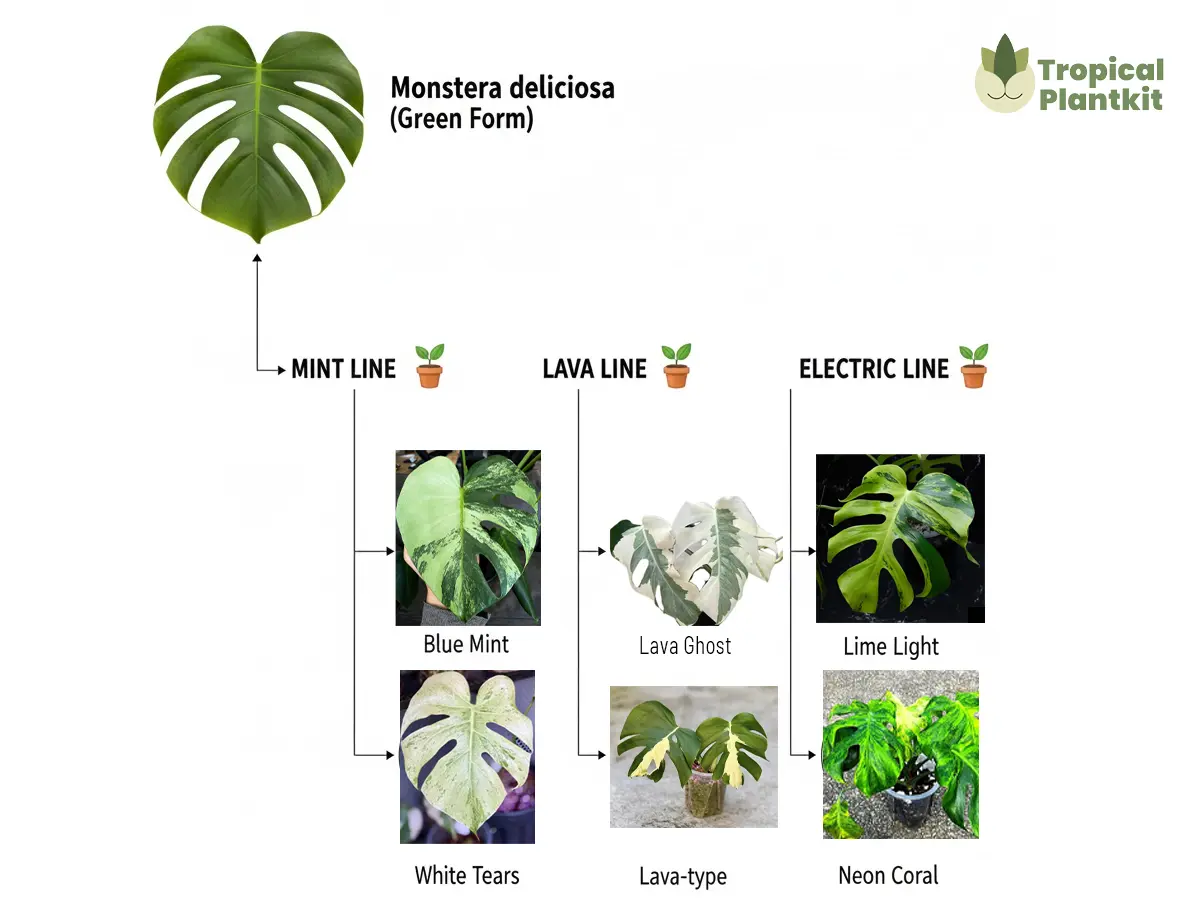
If you spend any time around variegated Monsteras today, you’ve seen the same three words repeat themselves across listings, auctions, and social posts: Mint, Lava, and Electric. They look authoritative. They sound specific. They often come with dramatic price differences.
And yet, when growers compare notes, something becomes obvious very quickly:
plants sold under the same name don’t always behave the same way, and plants with very similar traits often carry completely different names.
This article is written to clarify that gap.
Rather than treating Mint, Lava, and Electric as “real varieties” or dismissing them as pure marketing, we will look at what they actually are: informal naming systems built around observable traits. We’ll trace how these systems formed, what biological phenomena they are tied to, where they break down, and how to read them responsibly as a buyer, educator, or collector.
The botanical baseline: one species, many expressions
From a taxonomic and horticultural standpoint, nearly all plants discussed under Mint, Lava, or Electric naming are the same species:
Monstera deliciosa Liebm. (family Araceae)
There is currently no formally registered cultivar under international horticultural rules (ICNCP) for Mint, White Lava, Electro Light, or Devil Monster. To qualify as a cultivar, a plant must show distinctness, uniformity, and stability when propagated vegetatively over time—criteria that most of these plants do not meet (Brickell et al., 2016).
What does exist is variegation, usually arising from somatic mutation in the shoot apical meristem. In aroids, this commonly produces chimeras—plants composed of genetically different cell layers. These chimeras are often sectorial or mericlinal and are well known for their instability (Tilney-Bassett, 1986; Marcotrigiano, 1997).
Mint, Lava, and Electric are therefore attempts to organize unstable phenomena visually, not genetically.
Why trade-name lineages formed at all
Between roughly 2018 and 2022, three pressures reshaped the Monstera market:
- Demand for variegated plants exploded globally.
- Most attractive mutations proved difficult to stabilize or reproduce reliably.
- Online sales rewarded immediate visual impact more than long-term performance.
Under these conditions, sellers needed language that could describe what a buyer was seeing right now, even if that description had no predictive power. Instead of cultivars, the market produced descriptive lineages—clusters of names grouped by appearance, tone, or visual drama.
Mint, Lava, and Electric are the three most influential of these clusters.
The Mint lineage: classifying color temperature, not genetics
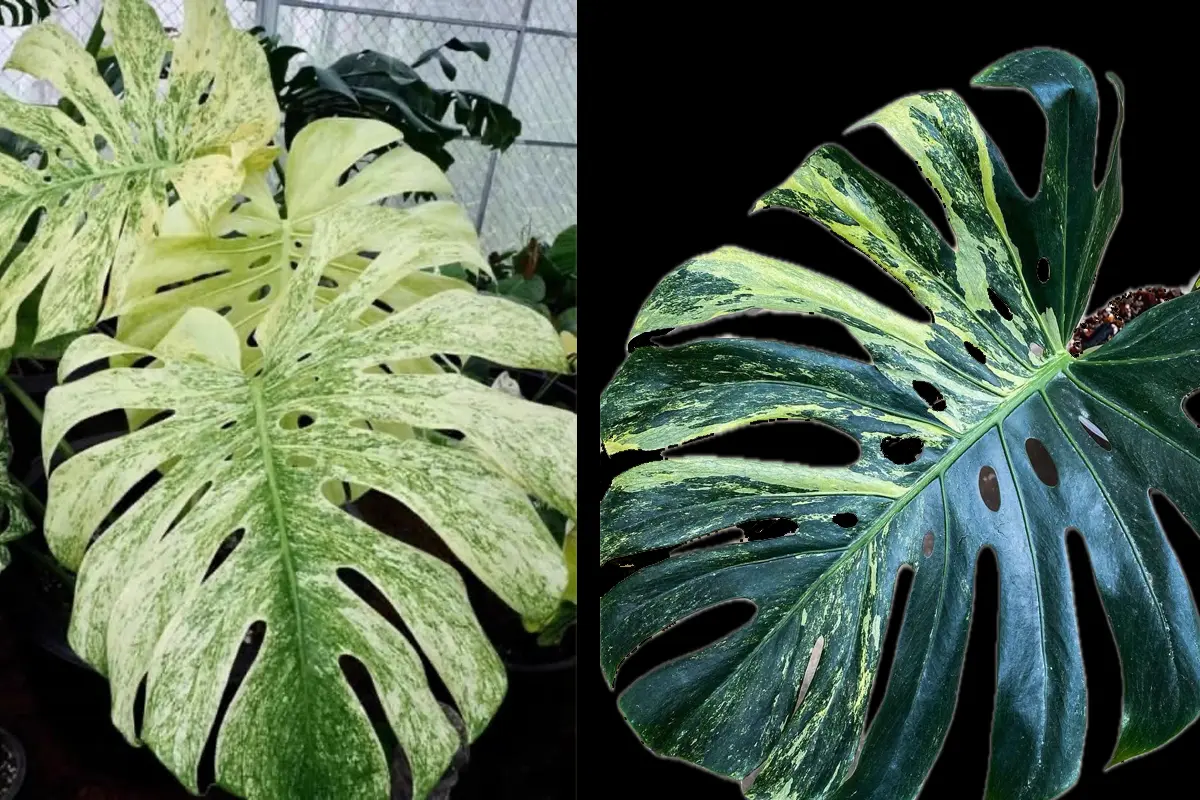
The word Mint did not originally mean “greenish white” in a vague sense. It emerged to describe variegation that behaved differently from the two older reference points in Monstera culture: Albo and Aurea.
Where Albo presents high-contrast, sharply bounded white tissue, and Aurea expresses warm yellow pigment, Mint plants appeared cooler, softer, and more diffuse. Their variegation often showed grey-white or pale cream tissue, muted green backgrounds, and blurred boundaries between pigmented and non-pigmented zones.
From a physiological perspective, this aligns with partial chlorophyll deficiency rather than complete chlorophyll absence. Research on variegated foliage plants shows that gradients in chlorophyll concentration—rather than binary “on/off” pigment states—produce these desaturated tones (Marcotrigiano, 1997).
As the term gained popularity, it expanded into sub-names such as Siam Mint, Blue Mint, Full Mint, Sphinx Mint, and White Tears. These labels typically emphasize origin stories, perceived coolness of tone, or coverage density. Importantly, none of them define a stable genetic condition.
Mint expression is also highly sensitive to environment. Light intensity, spectral composition, nitrogen availability, and leaf age all influence chlorophyll accumulation. Studies of variegated leaves show that tissues initially low in chlorophyll can later increase pigment content, visually “sharpening” or reverting toward green (Tilney-Bassett, 1986).
This is why Mint plants often change character dramatically over time. The name describes a moment, not a destiny.
The Lava lineage: describing movement and pattern behavior
If Mint focuses on color temperature, Lava focuses on motion.
The Lava label emerged to describe variegation that looks explosive or fluid—fractured sectors, radiating streaks, irregular islands of pale tissue that appear to “flow” across the leaf. The metaphor of molten material is visual, not biochemical.
Developmentally, these patterns are consistent with late-arising somatic mutations occurring during leaf expansion. When mutated tissue appears after the leaf primordium has begun to unfold, it can produce chaotic, non-repeating patterns rather than clean sectors (Marcotrigiano, 1997).
This also explains why Lava-type expressions are notoriously unstable. Because they often arise from sectorial chimeras, they are unlikely to reproduce consistently through cuttings. Subsequent leaves may show weaker patterns, different shapes, or none at all.
Terms such as White Lava, Lava-type, or Lava sport should therefore be read as descriptive snapshots, not lineage claims. They tell you how a particular leaf looked—not how the plant will behave in the future.
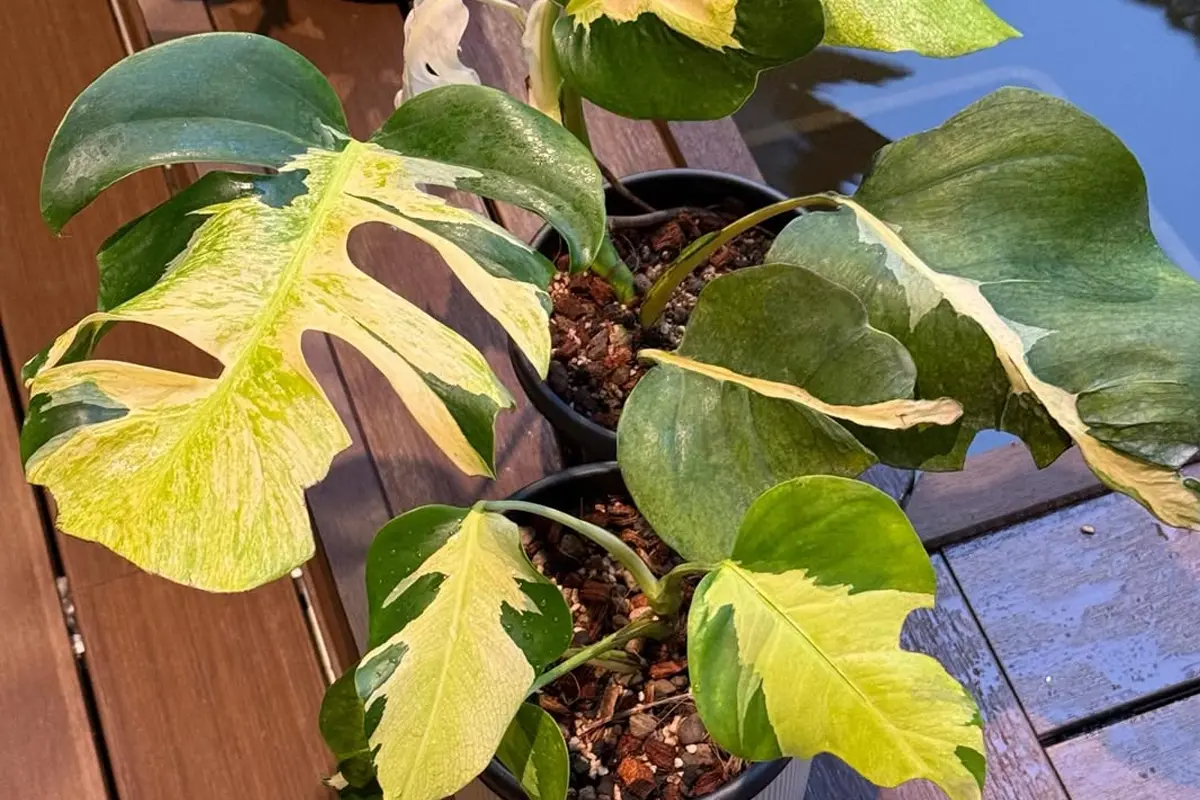
The Electric lineage: brightness as a market signal
Electric naming prioritizes luminance and contrast. Plants labeled Electro Light, Lime Light, or Neon Coral typically show very bright variegation—near-white, yellow-green, or fluorescent-looking tissue that reads dramatically on camera.
From a physiological standpoint, these traits often correspond to extreme suppression of chlorophyll, which can reduce photosynthetic capacity and long-term vigor. Research on leaf physiology confirms that heavily chlorophyll-deficient tissue contributes less to carbon gain and can stress the plant over time (Smith et al., 2017).
The most famous example in this lineage is Devil Monster. Scientifically speaking, Devil Monster is best understood as a legendary individual, not a reproducible category. Comparable cases exist across ornamental horticulture, where singular, extreme phenotypes gain symbolic status without becoming cultivars (Brickell et al., 2016).
Electric names, more than any other group, reflect how visual impact translates directly into market value, regardless of stability.
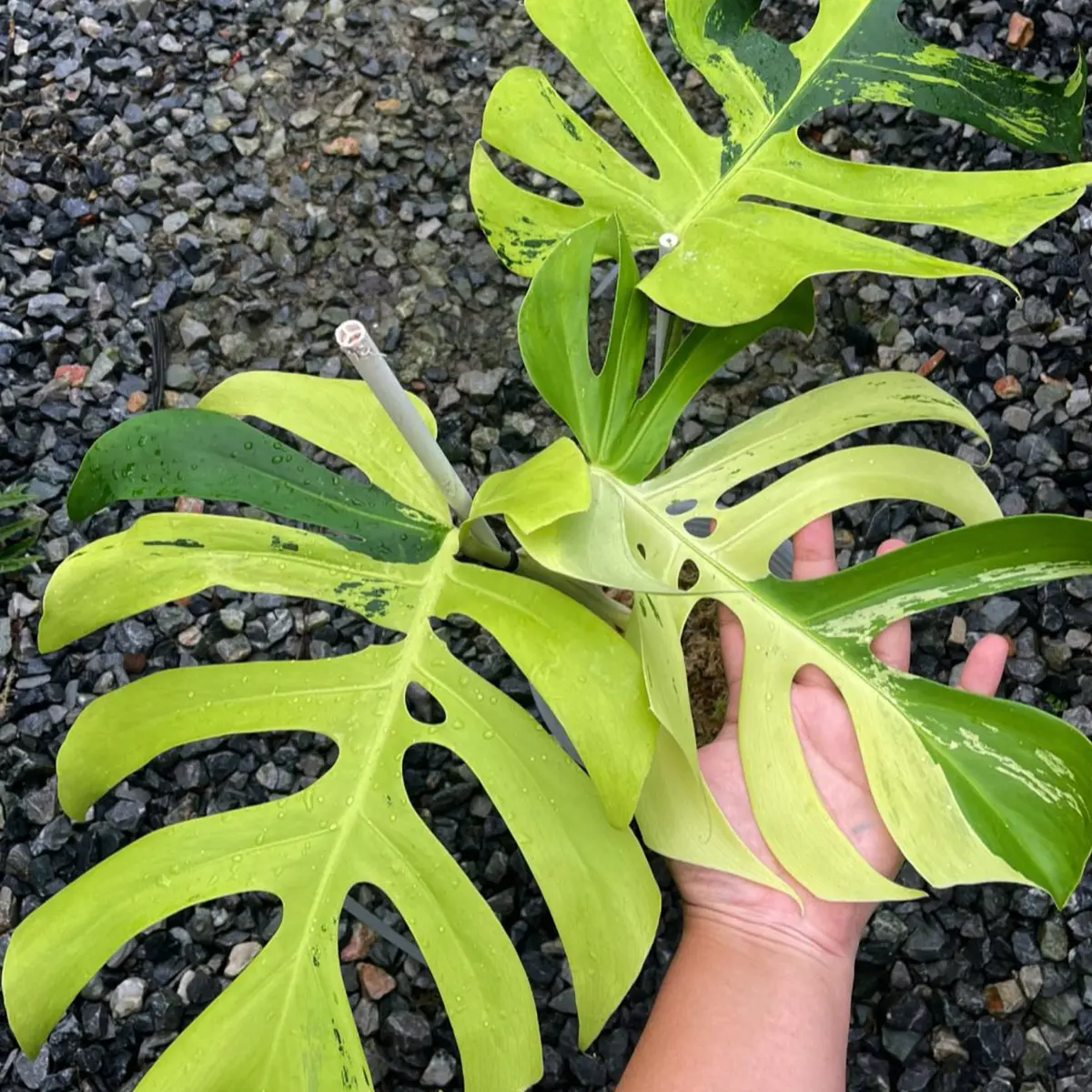
Overlap is inevitable—and not inherently wrong
One reason these systems confuse people is that they operate along different descriptive axes. A single plant can legitimately be:
- Mint-toned (cool color temperature),
- Lava-patterned (dynamic spatial behavior),
- Electric-bright (high luminance and contrast).
Name stacking occurs because sellers are layering descriptors, not inventing genetics. Problems arise only when these descriptors are presented as guarantees of future appearance.
How to read these names responsibly
From an educational and practical standpoint, the name matters far less than the plant’s history. When evaluating any Mint, Lava, or Electric Monstera, more reliable questions include:
- How many consecutive leaves show the advertised trait?
- Is the plant grown from a node, seed, or tissue culture?
- Has the plant reverted or shifted expression before?
- Under what light conditions were the photos taken?
- Is this the exact plant being sold?
These factors have far greater predictive value than the trade name itself.
Conclusion: names as tools, not truths
Mint, Lava, and Electric did not arise from ignorance. They arose from a need to describe fleeting beauty in a fast-moving market. Used carefully, they can be helpful visual shorthand. Used carelessly, they create unrealistic expectations.
As editors, growers, and long-term plant people, we believe clarity matters more than mystique. These names describe appearance, not inheritance. They help map the landscape—but they are not the terrain itself.
Understanding that distinction is what turns a buyer into a collector, and a collector into a grower.
References
- Brickell, C. D., Alexander, C., David, J. C., Hetterscheid, W. L. A., Leslie, A. C., Malécot, V., & Xiaobai, J. (2016). International Code of Nomenclature for Cultivated Plants (ICNCP). International Society for Horticultural Science.
- Marcotrigiano, M. (1997). Chimeras and variegation: Patterns of deceit. HortScience, 32(5), 773–784.
- Tilney-Bassett, R. A. E. (1986). Plant Chimeras. Edward Arnold. Retrived from:
https://journals.ashs.org/hortsci/view/journals/hortsci/32/5/article-p773.xml - Smith, W. K., Vogelmann, T. C., DeLucia, E. H., Bell, D. T., & Shepherd, K. A. (2017). Leaf form and photosynthesis. BioScience, 47(11), 785–793.
- Tilney-Bassett, R. A. E. (1986).Plant Chimeras. Edward Arnold.https://archive.org/details/plantchimeras0000tiln