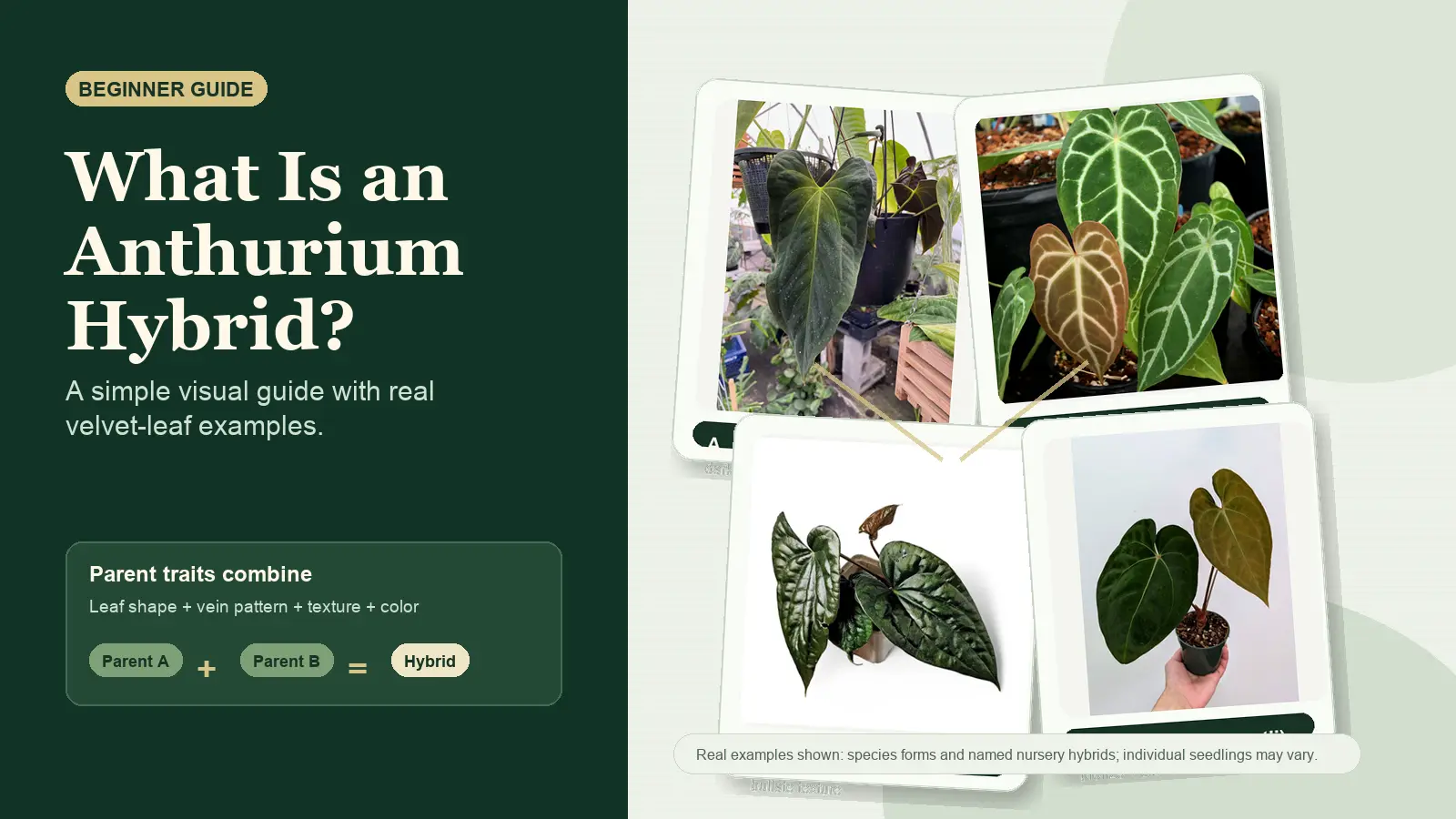
If you’ve started browsing plant shops, collector groups, or aroid marketplaces, you’ve probably noticed that the most talked-about Anthuriums are rarely just a single species. Instead, you’ll see listings with names like Anthurium radicans × luxurians, magnificum × regale, or simply “Red Crystallinum hybrid.” These are hybrids — and they make up the most exciting, most traded, and often most valuable corner of the Anthurium hobby today.
But what does “hybrid” actually mean? And how do you make sense of all those names as a beginner?
This guide breaks it all down simply, and walks you through the most important, market-relevant hybrid examples that collectors are actually buying and breeding right now.
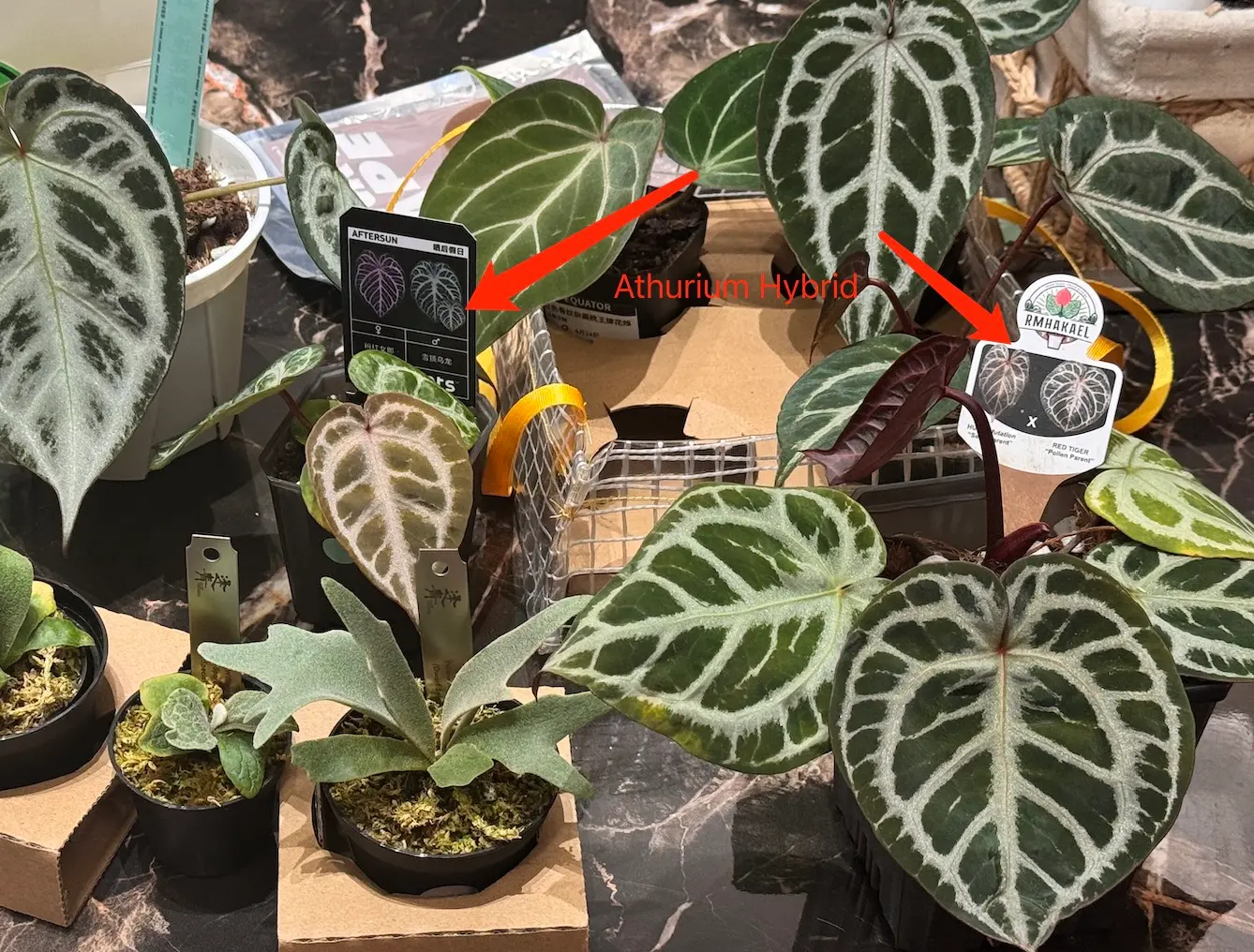
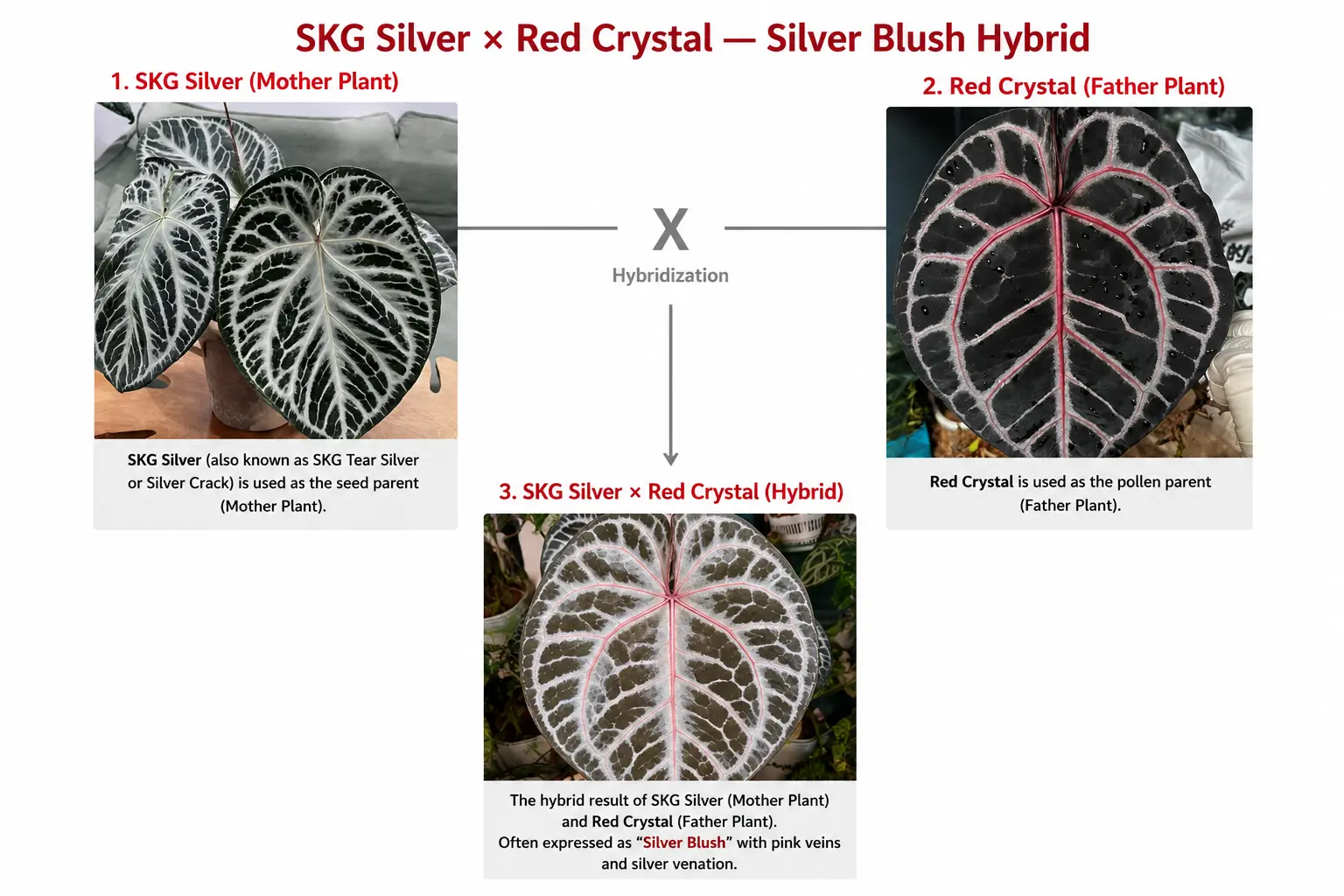
The spots I pointed out with arrows are the plant tags. These tags record the two parent varieties used in the hybridization process, usually including photos of both the pollen parent and the seed parent Anthuriums.
Simply put, they show the “father” and “mother” of a baby hybrid Anthurium.
If you’re curious about how to experiment with different hybridizations at home as a hobbyist, I recommend reading my “100-Day Anthurium Hybridization Process Record” after reading this article.
What Is an Anthurium Hybrid?
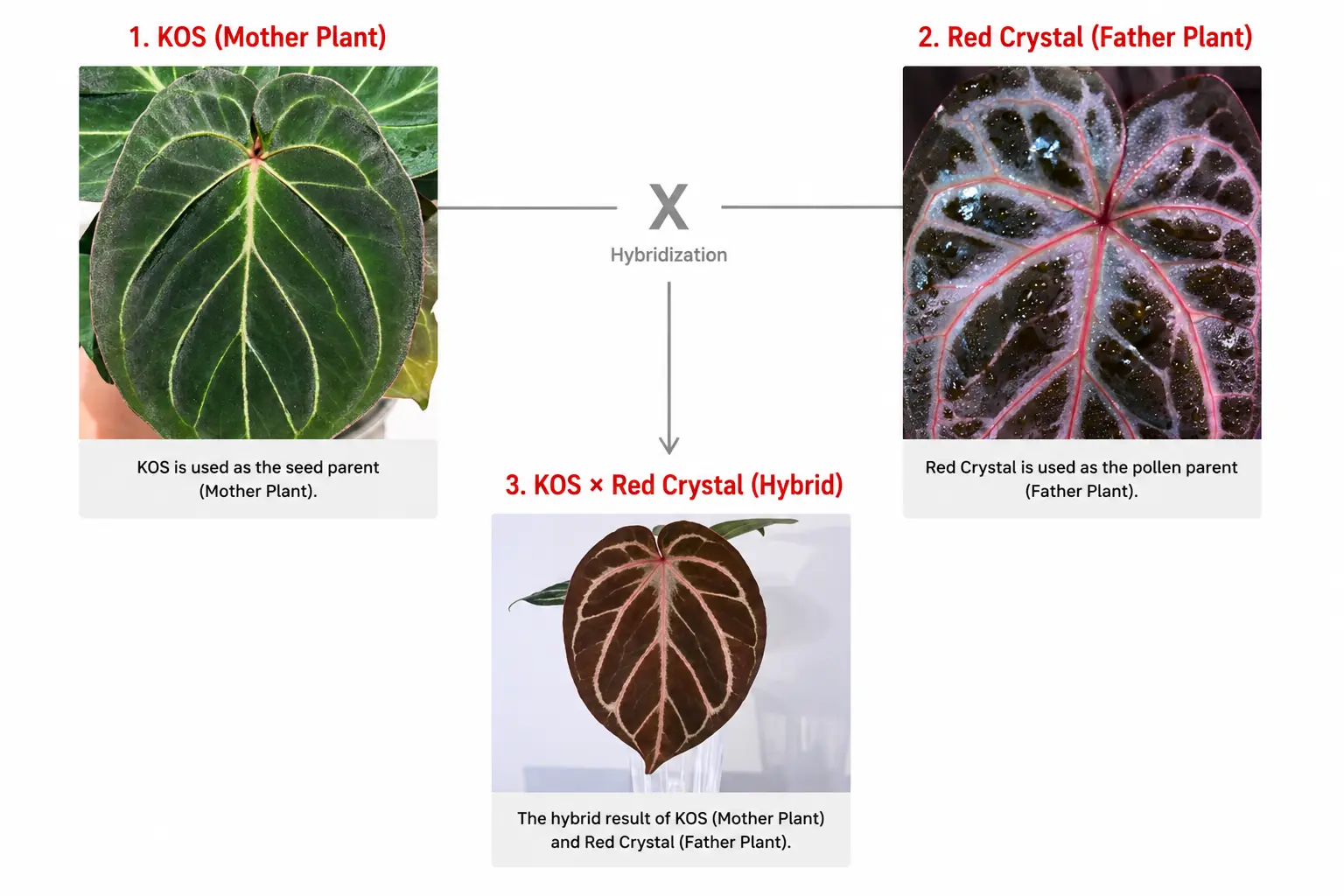
Let’s start simple. A hybrid is a plant produced by crossing two different parent species. Pollen from one plant fertilizes the flower of another, and the resulting seeds carry genetic traits from both parents. The offspring can look like one parent, like the other, or — most excitingly — like something entirely new that neither parent looks like on its own.
In the wild, this occasionally happens by chance when insects carry pollen between nearby flowering plants. But the hybrids you’ll find in today’s collector market are almost always deliberately made by growers and breeders who hand-pollinate specific parent plants to chase a particular combination: bigger leaves, richer velvet texture, bolder veining, unusual color, or more compact growth.
Simple formula: Hybrid = Species A × Species B. The offspring inherits a mix from both. Sometimes it’s predictable. Often it’s a surprise — and that’s half the appeal.
The × symbol (or the word “cross”) is how you recognize a hybrid in a plant name. Anthurium magnificum× regale means the pollen of one species was used to fertilize the other, creating offspring that blend traits from both.
Why Do Collectors Create Hybrids?
There are real reasons why serious breeders invest enormous effort into Anthurium hybridization — it’s not just aesthetics.
Combining the best of two species. One parent might have extraordinary leaf texture; the other might grow faster or handle lower humidity. A successful cross can inherit both strengths. This is the core goal of most serious breeding programs.
Creating something that doesn’t exist in nature. Some of the most celebrated Anthurium hybrids produce characteristics — leaf size, color, vein contrast, bullation — that no wild species produces on its own. That novelty is exactly what drives collector demand and price.
Improving adaptability. Some of the most spectacular wild species are genuinely difficult to keep alive indoors. Crossing them with a more robust species can produce offspring that are easier to grow while still expressing the dramatic looks collectors want.
Named breeding lines and collector clones. Many of the highest-value hybrids come from recognized breeders — Dr. Jeff Block (DocBlock), NSE Tropicals, Carnivero, and others — whose specific pollen parents and clones have a documented track record. A “DocBlock” hybrid or “Tezula clone” designation means something real in the hobby: it signals genetic provenance, not just appearance.
The Two Worlds of Anthurium Hybrids
Before diving into specific examples, it helps to understand that Anthurium hybrids fall into two very different collecting worlds.
Foliage hybrids are grown entirely for their leaves — velvet texture, vein structure, leaf shape, and size. These are what dominate the high-end collector market. Parent species include magnificum, crystallinum, warocqueanum, regale, papillilaminum, luxurians, veitchii, and others.
Flowering hybrids are grown for their long-lasting, colorful spathes (the waxy “flower” that’s really a modified leaf). These descend mainly from Anthurium andraeanum and related species. They’re the Anthuriums you see in supermarkets and garden centers — widely available, very easy to grow, and a perfect first Anthurium for beginners.
We’ll focus mostly on foliage hybrids here, because that’s where the real collector action is.
The Hybrid Species You Actually Need to Know
These are the parent species and hybrid combinations that show up repeatedly in collector markets, specialty nurseries, and high-value trade lists right now. Understanding these gives you a real working vocabulary for the hobby.
1. Anthurium radicans × luxurians — The Texture Hybrid
Type: Foliage
Collector value: ★★★☆☆ (widely available, entry-level collector)
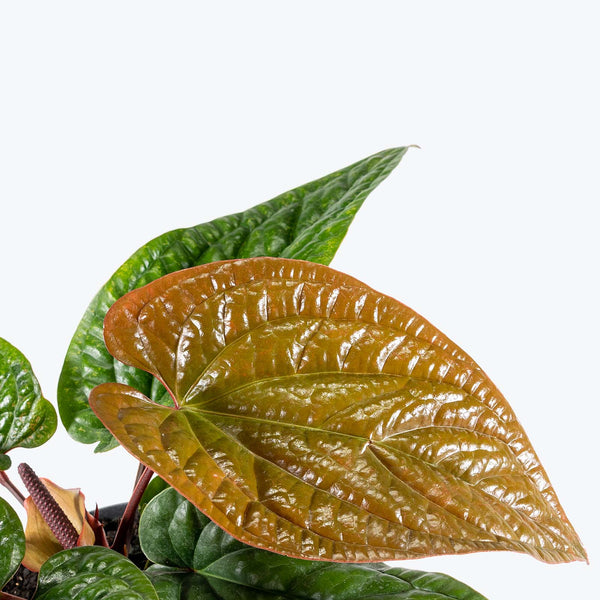
What makes it special: This is one of the most consistently sought-after beginner-to-intermediate collector hybrids in the market. A. radicans contributes compact growth and a climbing habit; A. luxurians brings those dramatic, deeply quilted, almost leathery dark green leaves with a near-metallic sheen. The resulting hybrid has thick, heart-shaped, bullate (blistered/puckered) leaves that feel like textured leather — a tactile experience unlike most houseplants.
New leaves emerge in a striking bronze-copper color before maturing to deep forest green. The plant stays relatively compact, making it manageable even in smaller spaces. It’s widely available from specialty sellers and priced accessibly ($40–$130 depending on size), which makes it an ideal first “collector” Anthurium for beginners who want to step beyond standard species.
Why collectors love it: It delivers genuinely extraordinary texture in a plant that isn’t impossibly difficult to keep. It’s also a popular parent for further hybrids, paired with magnificum, papillilaminum, and Michelle lines.
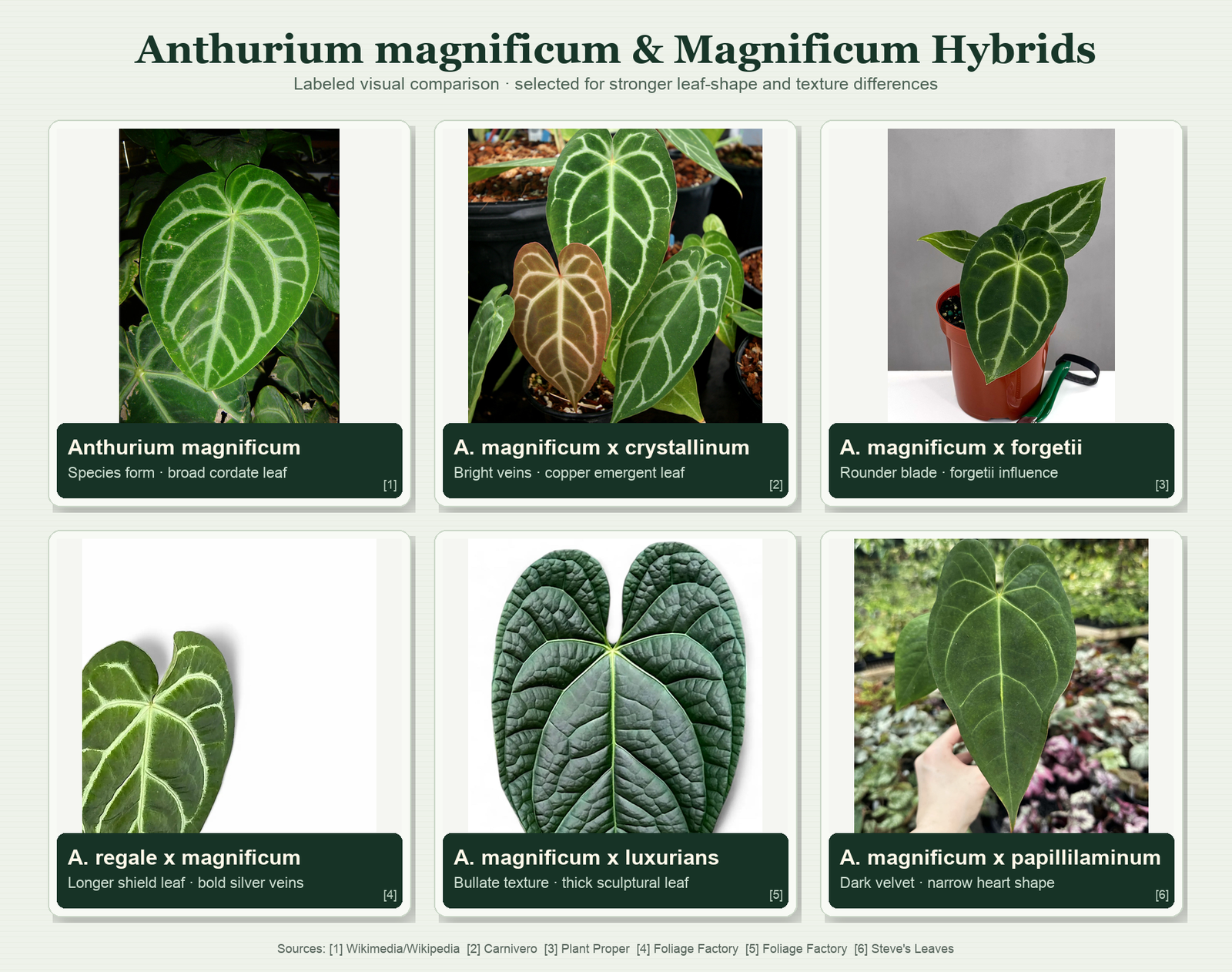
2. Anthurium magnificum (and magnificum hybrids)
Type: Foliage — key hybrid parent
Collector value: ★★★☆☆ (pure species); ★★★★☆ (select hybrids)
What makes it special: A. magnificum is one of the most important species in foliage Anthurium hybridization. On its own, it produces large, velvety, heart-shaped leaves in deep green with prominent white veining — genuinely impressive as a pure species. But its real significance is as a parent.
Magnificum crosses well with a wide range of other species and passes on its bold vein structure, dark leaf color, and strong growth habit reliably. The most prized combinations in today’s market include:
- A. magnificum × regale — combines the velvet texture and compact growth of magnificum with the sheer scale of regale. Produces large, bold leaves with strong venation and impressive presence. Frequently sold out at specialty retailers.
- A. magnificum × luxurians — brings together velvet texture with the bullate quality of luxurians. Leaves are darker and more textured than pure magnificum.
- Crystallinum × magnificum (various forms, including the “Thai Red” line) — highly sought-after for combining the silver vein iridescence of crystallinum with the scale and body of magnificum.
If you see magnificum in a hybrid name, it usually signals a plant with strong velvet texture and good leaf body — a reliable quality indicator.
3. Anthurium crystallinum ‘Red’ (Red Crystallinum)
Type: Foliage — collector clone and hybrid parent
Collector value: ★★★★☆ (high demand, consistently traded)
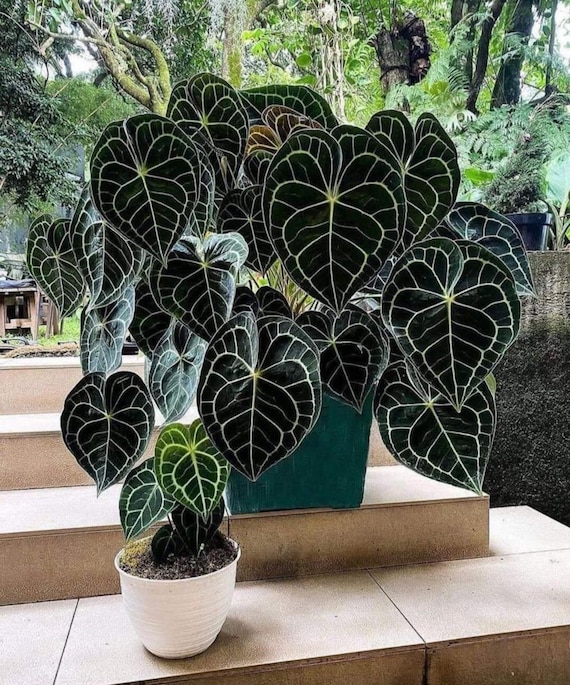
What makes it special: Standard A. crystallinum is already well-known for its large, iridescent, silver-veined leaves. The “Red Crystallinum” (sometimes called “Red Crystal”) is a selected form or line where new leaves emerge in a rich, deep red-pink color before maturing to dark velvety green — an incredibly dramatic flush cycle that’s made it one of the most photographed Anthurium forms in the hobby.
Beyond being stunning on its own, Red Crystallinum is one of the most actively used parents in current breeding:
- Red Crystallinum × magnificum — a staple cross producing large, dark, velvet leaves with a reddish blush on new growth and strong silver veining at maturity.
- Red Crystallinum × papillilaminum — brings iridescence and red new-leaf color together with the rounded, deeply velvety form of papillilaminum.
- The “Tezula clone” of Red Crystallinum × magnificum is a specific, documented selection that has become a reference point in collector circles and is used as a parent in multi-generation crosses (e.g., “Tezula × luxurians“).
If you come across “Red Crystal” or “Red Crystallinum” in a hybrid name, it typically signals dramatic new-leaf coloration and iridescent mature foliage.
4. Anthurium papillilaminum (and ‘Papi’ hybrids)
Type: Foliage — prestige parent species
Collector value: ★★★★☆ to ★★★★★ (select crosses)
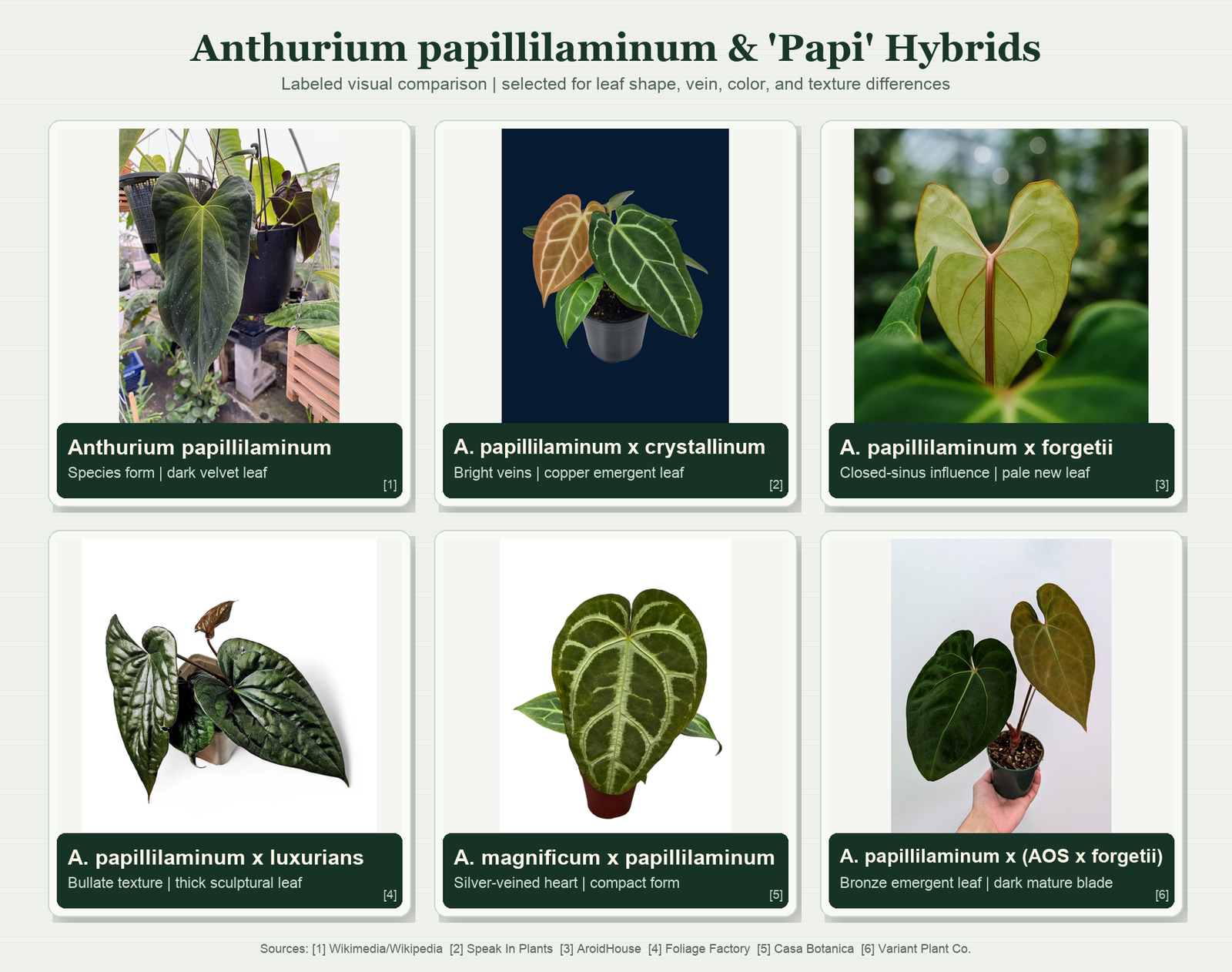
What makes it special: Anthurium papillilaminum — nicknamed “Papi” in collector circles — is a species from Panama with deeply velvety, rounded heart-shaped leaves and an almost suede-like surface quality. It’s one of the most prized parent species in advanced hybridization because it passes on exceptional velvet texture, leaf thickness, and a unique rounded leaf form.
The most celebrated crosses in the current market include:
- Papillilaminum × luxurians — a high-end cross combining suede-velvet texture with the bullate quality of luxurians. Consistently sells for $100–$125+ for small plants.
- Papillilaminum × DocBlock hybrids — Dr. Jeff Block’s breeding lines using papillilaminum as a parent have produced some of the most widely recognized prestige collector plants. The “DocBlock” designation on a papillilaminum cross signals documented pedigree and typically commands premium pricing.
- ‘Dark Mama’ (warocqueanum × papillilaminum) — a named hybrid combining the long, dramatic form of “The Queen” with papillilaminum‘s velvet texture, producing thick heart-shaped leaves with yellow-gold veining. Mature specimens regularly sell for $300–$1,000+.
The ‘Ft. Sherman’ and ‘Ralph Lyman’ clones of papillilaminum are specific documented selections frequently referenced in collector cross names, signaling known, documented parentage.
5. Anthurium magnificum × regale — The Scale Cross
Type: Foliage hybrid
Collector value: ★★★★☆
What makes it special: This cross is exactly what it sounds like: a deliberate attempt to combine the velvet body and strong vein structure of magnificum with the sheer leaf scale of regale (which in the wild can grow leaves over 1.5 meters long). The result is a plant that grows impressively large leaves with bold velvet texture and prominent venation — without the extreme care demands of pure regale.
This hybrid has become a staple at specialty nurseries (GrowTropicals lists it regularly; it consistently sells out) precisely because it delivers the scale drama of regale in a somewhat more adaptable package. It’s a good example of why serious collectors track hybrid parentage — the cross tells you what to expect before you even see the plant.
7. ‘Dark Mama’ — A Named Hybrid Worth Knowing
Type: Named hybrid (A. warocqueanum × A. papillilaminum)
Collector value: ★★★★★ (premium; $300–$1,000+ for mature specimens)
What makes it special: ‘Dark Mama’ is one of the best examples of what a successful named hybrid can be. It combines the long, shield-like form of warocqueanum (the Queen) with the thick, velvety leaf quality of papillilaminum, and adds something neither parent has alone: a golden-yellow vein pattern on dark velvety green leaves that’s genuinely unlike anything else in the genus.
It’s a plant that has developed real name recognition in collector communities globally — people specifically seek it out by name, and mature specimens command prices that reflect genuine rarity and desirability. It also shows that the highest-value collector Anthuriums are often named hybrids with documented parentage, not anonymous “velvet hybrids” of unknown origin.
If you’re new to the hobby, ‘Dark Mama’ is worth knowing simply because it illustrates how far collector Anthurium breeding has come — and where the market puts its highest value.
How to Read a Hybrid Name
Once you understand the notation, hybrid names become much easier to decode.
| What You See | What It Means |
|---|---|
| Anthurium magnificum | A pure species — no hybridization |
| A. magnificum × regale | A deliberate cross; × means “crossed with” |
| A. ‘Dark Mama’ | A named cultivar hybrid with known parentage |
| (Red crystallinum × magnificum) × luxurians | A multi-generation cross — the first cross was used as a parent again |
| “Tezula clone” | A specific documented selection used as a parent |
| “DocBlock,” “NSE,” “Carnivero” | Breeder/nursery designations that signal pedigree |
| A. sp. “King of Spades” | A variety whose exact parentage is unknown or undisclosed |
Tip: In the collector market, documented parentage and known clone designations genuinely add value. A hybrid listed as papillilaminum ‘Ft. Sherman’ × luxurians tells you much more than “velvet hybrid” — and usually commands a higher price accordingly.
A Quick Note on Hybrids That Don’t Work
Not every species combination produces viable hybrids — and this is important to understand, especially if you’re considering breeding yourself.
Some species are simply incompatible at the genetic level: pollen from one won’t successfully fertilize the other, or seeds won’t germinate, or seedlings fail to thrive. A. clarinervium, for instance, is widely noted in experienced grower circles as being very difficult to cross successfully with other velvet-leaf species like crystallinum despite appearing superficially similar. Many attempts — including with different forms and clones — consistently fail to produce viable offspring.
This is part of why knowledgeable collectors pay attention to which species are proven hybrid parents and which crosses have a track record of producing offspring. The combinations featured in this article are all documented, active in the collector trade, and backed by real results.
What to Start With as a Beginner
If you’re new to the hobby, here’s a realistic pathway:
Start here: Anthurium andraeanum hybrid (flowering type). Widely available, under $20, nearly indestructible with basic care. Teaches you how Anthuriums grow, what healthy roots look like, and how they respond to your home environment.
First collector step: Anthurium radicans × luxurians. The most accessible genuine collector hybrid. Extraordinary texture, manageable care requirements, widely available at specialty sellers for $40–$80.
Intermediate: A. magnificum (pure species) or magnificum × regale hybrid. Introduces you to the velvet-leaf world at an impressive scale. Requires higher humidity but is more forgiving than advanced species.
Advanced: Red Crystallinum lines, papillilaminum crosses, and named hybrids like ‘Dark Mama’. By this point you’ll have the experience to understand what these plants need.
For care fundamentals, visit our full Anthurium care guide, and our aroid substrate guide for the right growing mix.
Core Care Basics for Foliage Anthuriums
Most foliage hybrids share the same fundamental needs:
Light: Bright indirect light. No direct sun on leaves — it scorches the velvet. An east-facing window or a few feet from a south/west window is ideal. See our grow light guide for artificial lighting options.
Watering: Water when the top 1–2 inches of substrate feel dry. These plants need moisture but are highly susceptible to root rot in soggy conditions. A chunky, free-draining aroid mix is essential.
Humidity: Most collector foliage hybrids prefer 65–80%+. A humidifier near your collection makes a significant difference, especially for papillilaminum and warocqueanum-based crosses.
Temperature: Keep above 15°C (60°F) at all times. Most hybrids are happiest between 18–27°C. Avoid cold drafts and air conditioning vents.
Fertilizing: Half-strength balanced liquid fertilizer every 4–6 weeks during active growth. Don’t over-feed.
Final Thoughts
An Anthurium hybrid is a plant created — deliberately and often with great care — to combine the best qualities of two parent species into something new. In the collector world, the best hybrids aren’t random crosses: they’re the product of breeders who deeply understand their parent plants, know which combinations are genetically compatible, and track their results across multiple generations.
For beginners, the most important thing is to start building your vocabulary. Learn the key parent species (magnificum, veitchii, papillilaminum, luxurians, crystallinum Red form, warocqueanum), understand what they contribute to a cross, and you’ll be able to read any hybrid name in the market and understand roughly what you’re looking at.
The hybrid Anthurium hobby is one of the most vibrant, fast-moving corners of the plant world right now. There’s no better time to get into it.
References & Further Reading
- Wikipedia: Anthurium — Genus overview, natural distribution, and species diversity
- Wikipedia: Araceae — The aroid plant family that Anthuriums belong to
- Wikipedia: Plant hybridization — The biology and genetics of plant hybrids
- Wikipedia: Heterosis (Hybrid Vigor) — Why hybrids often outperform their parents in growth
- Wikipedia: Epiphyte — How Anthuriums grow in the wild and what it means for care
- Wikipedia: Spathe — What the “flower” of a flowering Anthurium actually is