♡ Orders Over $45 Get free shipping

Monstera Grow Light Guide: Distance, Hours & Best LED Setup

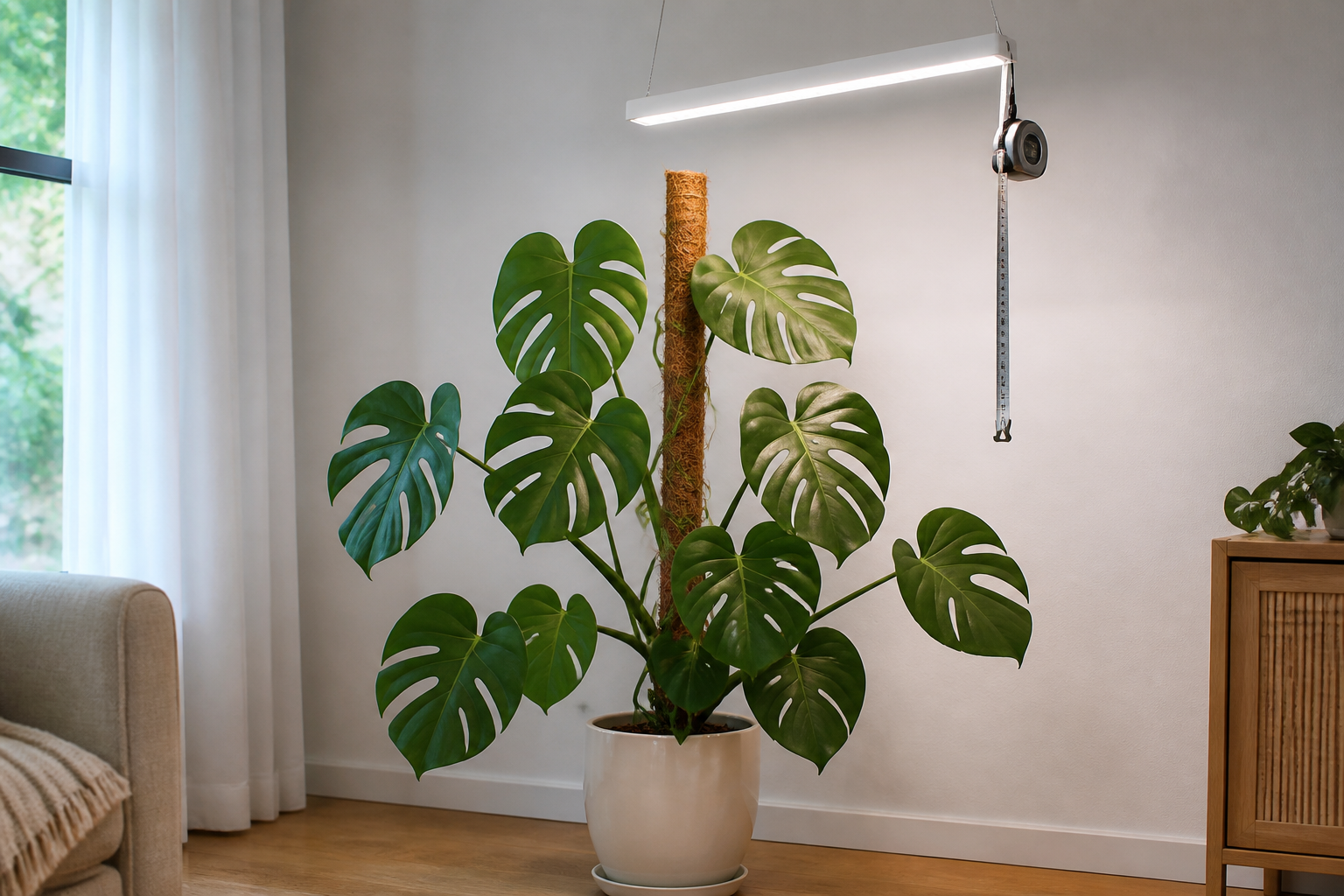
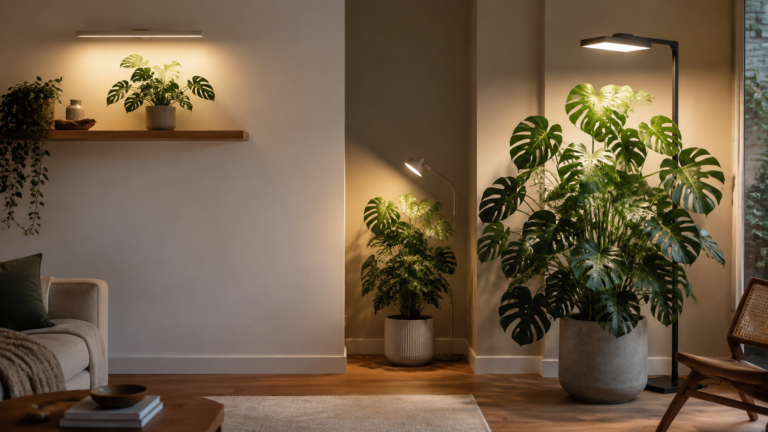
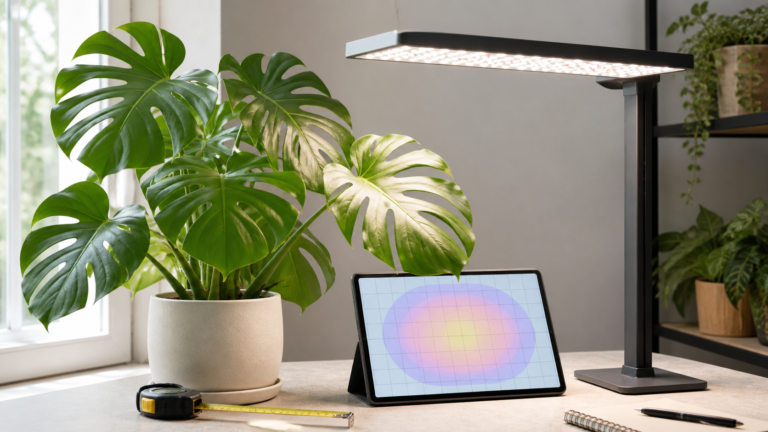
Infographic-style image showing a Monstera under a grow light with labeled wattage, distance, and daily hours as a quick grow light cheat sheet

Ever wonder if your Monstera deliciosa is getting enough light — or if you really need a grow light? We certainly have. At TropicalPlantKit, we’ve spent years caring for tropical houseplants, and one thing we’ve learned is that light can make or break a Monstera’s health.

In this guide, we’ll share how using grow lights can keep your Monstera (and other tropical beauties like staghorn ferns) thriving even in the dimmest corners of your home. We’ll walk through why Monsteras love bright light, how to choose the right grow light, and the exact distance and hours we use — so you can give your indoor jungle the “sunshine” it needs, no matter where you live.

Monstera Grow Light Cheat Sheet

If you just want the quick recipe, here’s the grow light setup we use for our own Monsteras:

  • Light type: Full-spectrum LED grow light (400–700 nm), 4000–6500 K “daylight” colour.
  • Power: Around 20–40 W for a single medium Monstera in a normal room.
  • Distance: Keep the grow light 30–45 cm (12–18 in) above the top leaves.
  • Daily hours: Run it 10–12 hours per day, with at least 6–8 hours of darkness.
  • Good signs: New leaf every 4–6 weeks in the growing season, each one bigger with more fenestrations.
  • Warning signs:
  • Bleached / crispy patches on top leaves → too much light / too close
  • Tiny, leggy growth and very long internodes → not enough light / too far / too few hours

Below, we’ll break down why these numbers work and how to adjust them for your own space.

Do You Really Need a Grow Light for Monstera?

If you’ve owned a Monstera (aka the Swiss cheese plant), you already know its dramatic, holey leaves are its pride and joy — and you may be wondering if a grow light is the missing piece to get more of them.

In their native tropical rainforests, Monsteras climb up trees to reach streaks of sunlight filtering through the canopy. Indoors, though, we often keep them in much darker conditions than nature intended.

We’ve been there: your Monstera might survive in that dim living room corner, but it won’t thrive. The leaves stay small and solid (no splits), growth slows to a crawl, and the plant may even begin to look a bit sad and leggy.

That’s where grow lights come in. We’ve used them to transform pale, sluggish Monsteras into vigorous, happy plants with big fenestrated leaves. By the end of this article, you’ll know exactly why and how to use a grow light for your Monstera (and other tropical houseplants), and what realistic results to expect. If you’re brand new to this plant, you might also like our Monstera care for beginners indoors guide for watering, soil, and general care basics.

Side-by-side indoor scene showing a leggy Monstera in a dark corner and a lush Monstera thriving under a grow light

Monstera Light Requirements Indoors: Why Bright, Indirect Light Wins

When people ask us about Monstera light requirements, this is what we mean by “bright, indirect light” and why it matters so much indoors.

Monsteras are adapted to bright, filtered light in nature. In the wild, a young Monstera starts on the shadowy forest floor but quickly climbs toward brighter light as it matures. More light means more energy for photosynthesis, which means faster growth and bigger leaves. Without sufficient light, Monsteras can survive but will not show their full beauty. You’ll notice:

  • No fenestrations on new leaves – Those iconic holes and splits might not form at all if light is too low. The plant’s upward “goal” in nature is to access light; in low light, it has little incentive to produce those dramatic leaves.
  • Slow or stunted growth – A light-starved Monstera grows very slowly. It might not unfurl new leaves for months, and any new leaves may be smaller than older ones.
  • Leggy, leaning stems – Insufficient light causes the plant to stretch out, with long gaps between leaves (internodes). You may see your Monstera literally reaching toward a window, becoming unstable and thin-stemmed.
  • Poor leaf colour and health – In too little light, leaves often turn a pale green or yellow as chlorophyll production falters. Variegated varieties (like Thai Constellation) may lose contrast or revert to greener leaves. Soil may also stay wet for longer, increasing the risk of root rot and pest issues.

On the flip side, bright light (without harsh direct sun) does wonders for Monsteras. In our experience, a Monstera given ample light will reward you with:

  • More frequent new leaves
  • Larger leaves with more fenestrations
  • Stronger stems and richer green colour

Houseplant experts agree Monsteras prefer bright, indirect light for optimal growth and are medium- to high-light houseplants, not “low-light” decor filler.

It’s also worth noting that Monsteras evolved in an environment with roughly 11–14 hours of daylight year-round. Indoors, especially in winter or in apartments with few windows, it’s hard to give them that many hours of decent illumination. This is where grow lights become a game-changer.hat many hours of good light. This is where grow lights become a game-changer.

Diagram of a Monstera placed in bright, indirect light inside a room, with labels showing the difference between direct sun and bright indirect light

7 Clear Signs Your Monstera Needs a Grow Light

How do you know if your Monstera is light-deprived and could benefit from a grow light? Let’s paint a picture. We had a Monstera in our office that, over time, became a textbook case of “light hunger.”

Here are the classic “help, I need a grow light” symptoms we see in real plants:

  1. No new fenestrations
    New leaves stay completely solid, even though the plant is mature. A happy, well-lit Monstera wants to split its leaves.
  2. Smaller, paler new leaves
    Each new leaf is smaller and lighter green than the last instead of larger and richer in colour.
  3. Long, spindly, leaning stems
    The plant stretches toward the nearest window, with wide gaps between leaves (long internodes) and a lopsided shape.
  4. Lower leaf yellowing and slow overall growth
    Older leaves yellow and drop, but there’s very little new growth to replace them.
  5. Soil that stays wet for too long
    Because the plant isn’t photosynthesising much, it sips water slowly. The potting mix stays damp for many days, which raises the risk of root rot and fungus gnats.
  6. Lost variegation on variegated Monsteras
    Variegated types like Thai Constellation may lose contrast and produce more solid green leaves as the plant desperately tries to make more chlorophyll.
  7. The “sad plant” look you can’t quite explain
    Overall, the plant just looks tired: thin stems, dull colour, and few new leaves despite correct watering and soil. Light is often the missing ingredient.

If any of these symptoms sound familiar, your Monstera is likely craving more light. First, try moving it closer to a window if you can — sometimes a new spot with better natural light will perk it up. But if rearranging isn’t possible (or still doesn’t provide enough rays), it’s a clear hint that a grow light could help mimic the sun for your plant.

We often get questions like, “Is my Monstera getting too little light or too much?” One quick tip:

  • Too much light → browning or scorched patches on leaves (especially in direct sun)
  • Too little light → stretch, pale foliage, small leaves, and perpetually damp soil

Most indoor situations lean toward too little light for Monsteras rather than too much — unless you’ve got it pressed against a hot south window, chances are more light (in the right form) will be beneficial.

Before-and-after comparison of a Monstera’s growth, showing a pale, sparse plant versus a lush, fenestrated plant after using a grow light

How Grow Lights Change Monstera Growth (Our Real Results)

When natural light is limited, grow lights act as a sunlight supplement or stand-in. In practice, adding a grow light tends to do three big things for Monstera:

  • More frequent new leaves, especially in winter or dark rooms
  • Bigger, more fenestrated foliage thanks to higher light energy
  • Thicker stems and better overall health, which also means fewer pest and rot issues

Think of them as artificial suns you can turn on at will. We’ve found grow lights particularly useful in two scenarios:

1. Winter months or cloudy climates

In winter, days are shorter and darker. Even a plant next to a window may only get a few hours of weak daylight. We use grow lights to extend the “day” length for our Monsteras in winter, giving them 4–8 extra hours of light in the morning or evening to top up what the sun provided.

This prevents the plant from going fully dormant and keeps it ticking over until spring. Instead of dropping leaves or attracting pests from stress, our Monsteras maintain steady (if slower) growth through winter thanks to supplemental lighting.

2. Rooms or corners with poor natural light

If you want a Monstera in a spot that looks beautiful decor-wise but is far from a window, a grow light can make that possible. We’ve helped clients green up dim offices and interior rooms by installing discreet grow lights.

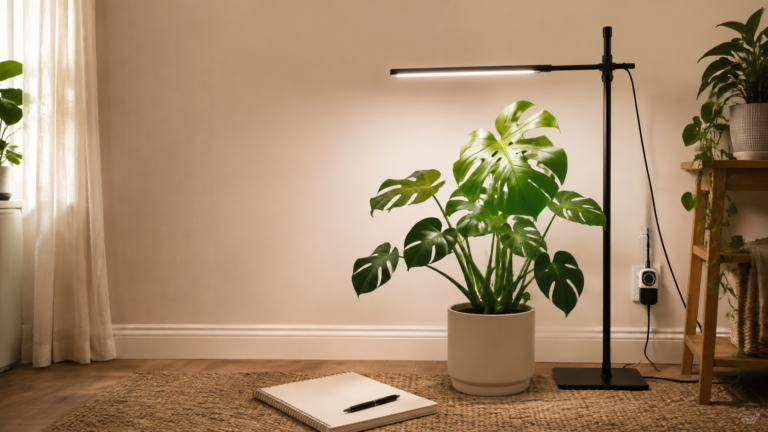
One client had a gorgeous Monstera in a north-facing apartment bedroom — lovely space, but the plant struggled. We set up a floor lamp with a strong full-spectrum grow bulb next to it, on a timer for 8 hours daily.

The result? The Monstera went from surviving to thriving; it pushed out two new leaves in a couple of months, one of which had its first splits.

Before-and-after comparison of a Monstera’s growth, showing a pale, sparse plant versus a lush, fenestrated plant after using a grow light

Beyond just keeping plants alive, grow lights often lead to healthier, sturdier Monsteras. With better lighting, photosynthesis revs up, giving the plant more energy to allocate to growth, root development, and even self-defence.

A well-lit Monstera tends to have thicker, stronger stems and leaves (less flopping or drooping) and is less prone to pests and diseases. Strong light also helps the plant use water efficiently, preventing the constant wet soil that can cause root rot or fungus gnats.

Grow lights aren’t a cure-all, but they contribute to an environment where your Monstera can truly flourish rather than just hang on.

It’s worth mentioning: Monsteras do not require grow lights if you already have ideal natural light. If you’re one of the lucky ones with a big bright window and your plant is doing great, you may not need this extra step. But for many indoor gardeners, especially in apartments or less sunny locales, grow lights are the secret ingredient to replicate that tropical brilliance indoors.

In short, grow lights give you control over a factor (light) that is otherwise hard to adjust, and light is arguably the most important factor for plant growth. We’ve found it immensely satisfying to “take back control” of light — no more feeling helpless during a dreary winter week or watching a beautiful plant slowly decline in a dark room.

Instead, we flip on the lights and watch our Monsteras perk up as if it were a sunny June day.room. Instead, we flip on the lights and watch our Monsteras perk up as if it were a sunny June day!

Best Grow Light Types for Monstera Deliciosa

Okay, so you’ve decided to give your Monstera an artificial sunbath. Now, what kind of grow light should you get? Not all lights are created equal, and the market can be overwhelming (LED panels, fluorescent tubes, bulbs, red/blue “blurple” lights, you name it).

Here’s a quick overview before we dive into the details.

Monstera Grow Light Options at a Glance

TypeBest ForProsConsOur Take
LED grow bulbSingle Monstera in a living roomCheap, fits standard lamps, low heatSmall coverage, needs to be fairly closePerfect entry-level option
LED bar / stripNarrow corners, along walls or shelvesDiscreet, even spread, easy to angleNeeds mounting and cable managementGreat for design-friendly setups
LED panelLarge Monstera or many plants togetherStrong output, wide coverage areaMore expensive, can look “industrial”Best for big plants/collections
Fluorescent tubeExisting grow racks / older setupsDecent output, readily availableBulkier, less efficient than LEDsFine if you already have one

Below, we’ll walk through how to choose between these options and what specs actually matter for Monstera.

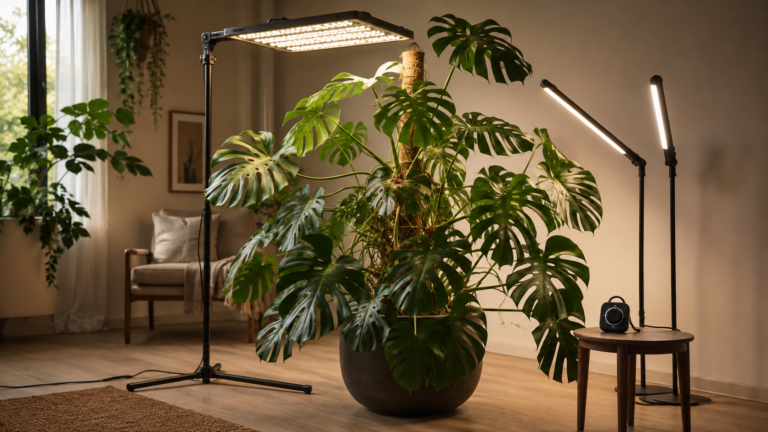
Lineup of different grow light types—LED bulb, LED bar, LED panel, and fluorescent tube—displayed next to a potted Monstera

1. Type of Bulb or Fixture (Why We Prefer LED)

We highly recommend LED grow lights for most home plant parents. LEDs are energy-efficient, long-lasting, and run cool (so they won’t scorch your Monstera’s leaves as long as you keep a reasonable distance).

They come in many form factors: LED grow bulbs that screw into a regular lamp, slim LED strip lights, or larger LED panels to hang above plants. Fluorescent tubes can also work (and were the old standard), but they use more energy and need replacing more often. Incandescent or halogen bulbs are not ideal — they waste most energy as heat and can burn plants easily.

2. Light Spectrum (Colour Temperature & “Blurple” vs White)

You’ll see some grow lights that glow purplish — these use a combination of red and blue LEDs, since those are the main wavelengths plants use for photosynthesis. While those “blurple” lights do work for plants, we prefer full-spectrum (white) grow lights.

Full-spectrum LEDs emit a balance of wavelengths (mimicking daylight) so they appear white or slightly warm to the human eye. In our experience, white full-spectrum lights grow Monsteras just as well and make your space look normal. Aim for a colour temperature in the “daylight” range (around 5000–6500 K) if listed — it’s a crisp, plant- and human-friendly white.

3. Light Intensity (Lumens, PAR, PPFD – in Plain Language)

This is arguably the most critical factor. A weak light kept too far away won’t do much good, whereas a sufficiently strong light will.

  • Lumens / lux measure brightness as perceived by human eyes. They give a rough idea but don’t tell you exactly how much plant-usable light is emitted.
  • PAR / PPFD tell you how much photosynthetically active light actually hits the leaves. Think of PPFD as “light intensity at the plant”. Higher PPFD = more usable light.
  • Watts are just power draw, not brightness. For the same technology, higher wattage usually means more light, but efficiency varies by brand.

For Monsteras, growers often suggest a moderate to high light level. If those numbers mean nothing to you, don’t worry — you don’t need a PAR meter to succeed.

In practical terms, we’ve gotten excellent results when a Monstera’s leaves are lit to roughly the brightness of bright outdoor shade or a very sunny indoor room:

  • One of our larger Monsteras sits under an LED panel delivering roughly the equivalent of a bright window (it produces massive, deeply split leaves consistently).
  • A smaller Monstera grows well with a simpler clamp light for about 8 hours daily plus some ambient daylight — slower, but still healthy and fenestrating.

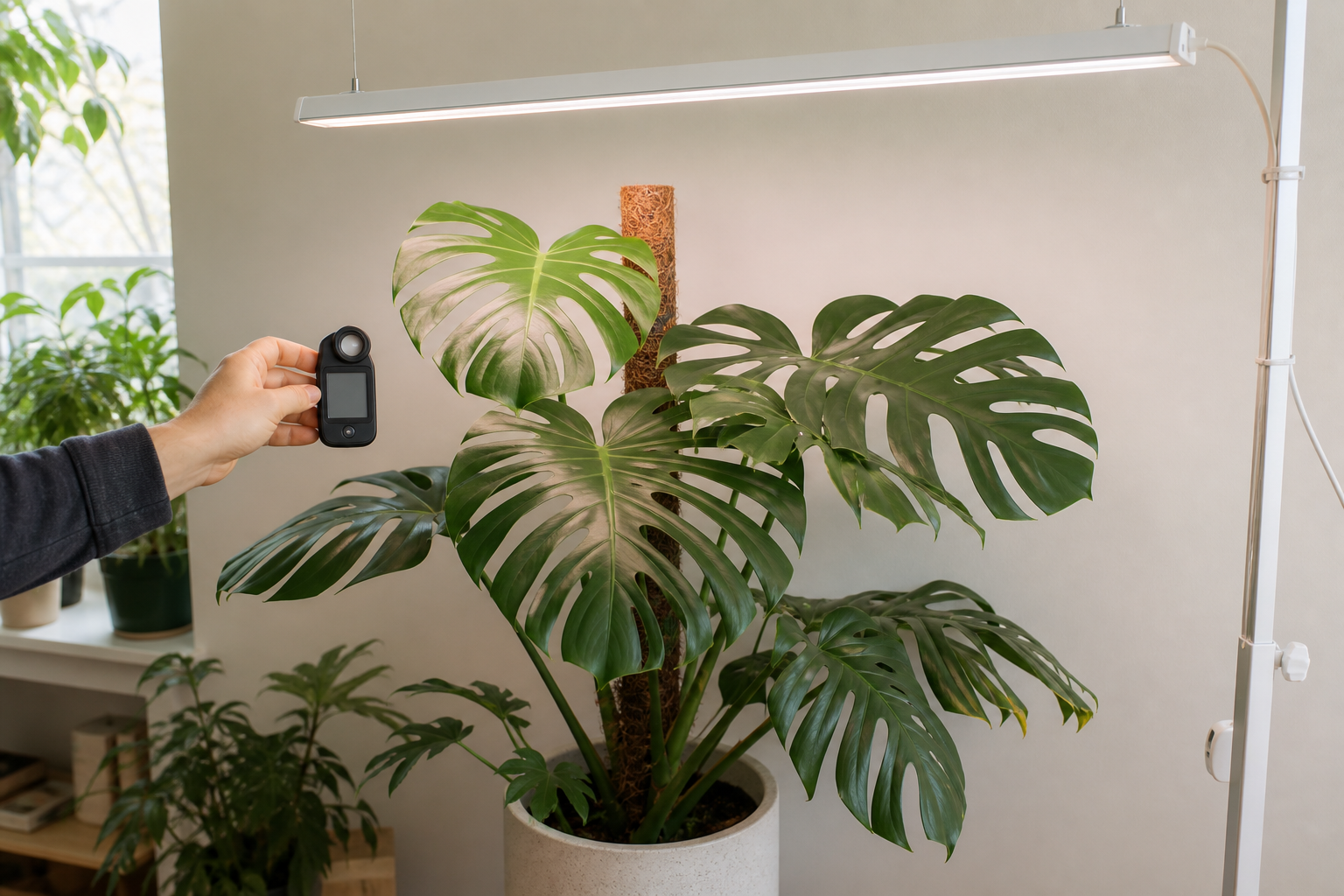
If you don’t have a light meter, trust your eyes and the plant’s reaction: the light should cast a clear but soft-edged shadow. If shadows are very faint or absent, the light might be too weak or too far.

4. Coverage Area (Matching the Light to Your Plant Size)

Consider how many plants or how large your Monstera is. A small LED bulb might be enough for a single young plant on a table, but a big Monstera with wide leaves might need a broader light source or multiple bulbs.

We learned this the hard way: one year we used just a single desk-lamp-style grow light on a mature Monstera. The leaves closest to the lamp grew well, but those on the backside stayed in relative darkness and didn’t improve much.

Now, we use either overhead panel lights or two opposing lamps for large plants to bathe the whole plant in light. If you have a collection, a powerful hanging grow light can illuminate a whole area. For one corner with a Monstera and maybe a fern, a simple gooseneck lamp with LED grow bulbs can do the trick on a budget.

Rule of thumb: stronger light from farther away can light multiple plants; weaker lights need to be closer and usually cover only a small zone.

5. Quality and Budget (How Much You Actually Need to Spend)

Price ranges for grow lights are huge. You can get a basic clamp light for $20 or splurge $300+ on a high-end panel. In our experience:

  • You don’t have to break the bank, but very cheap lights might not deliver enough intensity.
  • A mid-range LED panel around $70–$100 is often a sweet spot for a serious plant corner.
  • Even a $20 LED grow bulb can provide a helpful boost if used appropriately (close to the plant for supplemental light).

A higher upfront cost on a quality LED often pays off in longevity and energy efficiency. When in doubt, stick with known brands or products with proven results in the plant community.

In summary, the ideal grow light for a Monstera is a full-spectrum LED that provides bright, diffuse light over the plant’s foliage. Aim for one you can position about 30–45 cm (12–18 in) above the leaves and run for several hours a day.

Lineup of different grow light types—LED bulb, LED bar, LED panel, and fluorescent tube

Monstera Grow Light Setup: Distance, Hours and Positioning

Getting a grow light is half the battle — now you have to use it effectively. How you position the light and how long you run it each day will determine the results.

1. How Far Should a Grow Light Be from a Monstera?

We recommend placing the grow light above and slightly to the side of your Monstera, about 12–24 inches (30–60 cm) from the foliage. Overhead placement simulates natural sunlight and encourages upright growth.

The exact distance depends on the light’s intensity:

  • High-powered light (e.g. a strong LED panel) → hang it 60–90 cm (2–3 ft) above the plant or dim it to avoid leaf burn.
  • Small bulb or strip → keep it closer, roughly 15–30 cm (6–12 in) from the nearest leaves.

A good rule of thumb: start around 30–45 cm (12–18 in) and observe your plant for a week:

  • If new growth appears healthy and leaves show no stress → you’re at a good distance.
  • If the top leaves get pale spots or crispy patches → move the light higher or reduce intensity.
  • If growth is still sluggish, with long internodes → bring the light slightly closer or extend the lighting hours.

Also make sure the light covers as much of the plant as possible. If only one side is lit, rotate the plant weekly or use a reflective wall or panel opposite the light to bounce light around.

2. How Many Hours of Grow Light Does a Monstera Need?

We’ve experimented and found a sweet spot around 8–12 hours per day of grow-light exposure for Monsteras in low-light situations:

  • No natural light (basement, windowless room) → aim for 10–12+ hours daily.
  • Some daylight from windows8–10 hours of supplemental light is often enough.

Monsteras can handle long days, but we don’t run grow lights 24/7. Plants need a dark period to rest. Give your Monstera at least 6–8 hours of darkness each day.

In our own routine, we like to split the lighting period:

  • On: 6–10 a.m. (morning boost)
  • On again: 5–9 p.m. (evening boost)

This “sandwiches” the natural daylight window and creates a long, steady day for the plant while keeping the light off at times when we’re using the room.

If you’re using a weaker light, you might need up to 16 hours to deliver enough total light per day. Your two levers are intensity and time.

Don’t forget a timer:
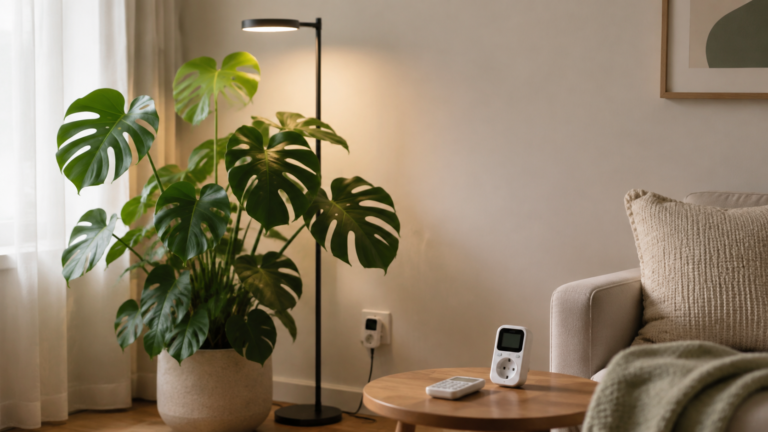
Use a simple outlet timer or smart plug. Consistency is key, and timers protect you from accidentally leaving the light on all night.

3. Monitor, Adjust, and Feed for the Extra Growth

After setting up, keep an eye on your Monstera over the next few weeks.

  • Positive signs: Within a few weeks to a month, you should see a new leaf or an overall perkier appearance. Leaves may get larger, and fenestrations may start appearing where they didn’t before.
  • Negative signs: Yellowing or browning on top leaves, crispy edges, or leaves curling upward indicate too much light or heat. Back the light off (higher or fewer hours).

If after 4–6 weeks you see no improvement, you may need to either increase the light’s intensity or duration. Each environment is different; don’t be afraid to experiment. Monsteras are fairly forgiving, and small tweaks can yield big results.

With increased light, your Monstera may also:

  • Drink more water (soil dries faster).
  • Benefit from occasional feeding (we like half-strength liquid fertilizer about once a month in the growing season).

If you were intentionally letting the plant rest, keep in mind a grow light might nudge it to keep growing year-round, so adjust watering and feeding accordingly.

Case Study: How a $30 Grow Light Saved “Molly” the Monstera

To illustrate everything we’ve discussed, here’s a quick story from our tropical plant team.

We had a beautiful Monstera named “Molly” in our co-founder’s apartment. Molly sat about 8 feet away from a north-east window — a spot that looked great in the room but didn’t get much sun. Over a year, her growth stalled. No new leaves emerged for 9 months, and two of her older leaves yellowed and fell off. She was down to four leaves and looking sparse. We knew light was the issue.

So, we set up a simple solution: a full-spectrum LED clamp grow light (about $30) attached to a shelf, shining down on Molly from ~30 cm (1 ft) away. We put it on a timer for 10 hours a day. The lamp emitted a pleasant white light, so the room still felt natural.

Within a few weeks, the soil started drying out quicker — a good sign that Molly was using more water. Then, about 6 weeks in, a new leaf bud swelled at the tip of her stem. It opened into a medium-sized leaf with two small fenestration holes — Molly’s first new leaf in almost a year, and her first ever with natural holes.

Three months later, another new leaf emerged, larger than the last and with even more splits. Molly had effectively doubled her leaf count and regained a lush appearance. The new leaves were a rich, vibrant green, and she started pushing out more aerial roots, trying to climb.

Now, Molly is a centerpiece in that apartment. Visitors can’t believe it’s the same plant that once looked like a few sad leaves in a pot. The key to her turnaround was consistent supplemental light.

Stories like Molly’s are why we’re so passionate about grow lights. They’re not about “cheating nature” — they’re about giving these tropical plants a fair chance indoors.

Tips for Using Grow Lights Safely and Aesthetically

Before we wrap up, we want to address two common concerns: safety and looks.

Safety First: Heat, Cables and Eyes

Quality grow lights (especially LEDs) are very safe to use, but a few basics matter:

  • Secure installation – Make sure the fixture is stable. If it’s hanging, use proper hooks and chains/ropes. If it’s a clamp or gooseneck, check that it’s firmly attached and won’t slip.
  • Heat and ventilation – LEDs run cool, but high-powered ones do generate some heat. Ensure there’s airflow around the light and avoid draping fabric over it.
  • Electrical safety – Use surge protectors if you can, and keep cords tidy and away from water or drainage trays.
  • Eye protection – Don’t stare directly into LEDs. Think of them like mini suns. If the light is very bright, turn it off while working close to the plant or position it so it doesn’t shine in your eyes.

Making Grow Lights Look Good in Your Home

Not everyone loves the look of grow lights in their decor. The good news is there are many stylish or subtle options now:

  • Grow light bulbs that look like normal bulbs – Screw them into a nice floor or pendant lamp above your plant.
  • LED strip lights – Mount them under shelves or furniture edges so they’re almost invisible while casting a pleasant glow.
  • Designer grow lights – Sleek bar lights or pendant fixtures that look like modern lamps but are tuned for plants.
  • Hide the source – Position a clamp light behind the Monstera so the plant hides the bulb. You see a beautifully lit plant, not the hardware.

Energy Use: How Much a Grow Light Really Costs

Modern LED grow lights are very efficient. For example:

  • A 40 W LED running 10 hours a day uses 0.4 kWh daily.

In many areas that’s only a few cents per day. Our plant corner with two LED lamps adds a minor bump to the monthly bill, and the joy of a thriving indoor jungle more than compensates.

Using Grow Lights for Staghorn Ferns and Other Tropical Plants

While we’ve focused on Monstera deliciosa, the same principles apply to many tropical houseplants that prefer bright conditions.

At TropicalPlantKit, we also care for staghorn ferns (Platycerium), another epiphytic tropical plant that benefits from good light. Staghorn ferns naturally grow on trees under filtered sun, so they like bright, indirect light much like Monsteras. In insufficient light, staghorns become slow-growing and prone to issues like fungus on their fronds.

By adding a grow light above a mounted staghorn fern in a dim room, we were able to improve its vigor and keep it healthy indoors. One caution: ferns, including staghorns, can be more sensitive to direct intensity than thick-leaved Monsteras. We keep fern lights at the higher end of the distance range (60+ cm / 2+ ft away) or diffused to avoid frond scorching.

Other tropical plants that often enjoy a boost from grow lights include:

  • Philodendrons
  • Anthuriums
  • Calatheas
  • Bird of paradise
  • Fiddle-leaf figs

If a plant is labeled “bright indirect light” in its care instructions, it likely stands to gain from supplemental lighting in a dim home.

One of our team members uses a single large LED panel hung in a spare room to overwinter a collection of tropicals (palms, rubber plants, Monsteras, ferns) all together. It’s like a mini indoor greenhouse. By clustering plants, one light serves all. Just be mindful of spacing for airflow and place the most light-hungry plants (Monstera, bird of paradise) directly under the lamp, with medium-light plants a bit off to the side.

In short, once you’re comfortable using a grow light for Monstera, it’s easy to extend the same approach to the rest of your tropical plant family.

Conclusion: Give Your Monstera Its Own Patch of Sun

If there’s one thing we’ve learned from years of growing Monsteras indoors, it’s this: light is the lever that changes everything. A good full-spectrum LED grow light, placed at the right distance and run for the right number of hours, can turn a leggy, sleepy plant into a strong, fenestrated showpiece.

Start simple: pick a 20–40 W LED grow light, hang it about 30–45 cm (12–18 in) above your Monstera, and let it run 10–12 hours a day on a timer. Then watch the plant and tweak from there. If you see larger, greener leaves and more splits, you’re on the right track.

And if you’re not sure whether your plant’s problem is light or something else, you can always come back to this guide, compare the signs, and adjust. We’re cheering for you — and for your Monstera’s next big, beautiful leaf.

Monstera Grow Light FAQ

1. Do Monsteras actually need a grow light?

Not always. If your Monstera gets strong, bright, indirect natural light for most of the day (for example, near a large east or south-facing window with sheer curtains), it can thrive without artificial light. We recommend a grow light when:

  • Your windows are shaded or north-facing
  • You live in a high-rise with deep balconies
  • Winter daylight hours are short
  • New leaves stay small, solid, or far apart on the stem

In those cases, a grow light bridges the gap between “surviving” and “actively growing”.

2. What type of grow light is best for Monstera?

For most home setups, we suggest:

  • Full-spectrum LED (around 400–700 nm) that mimics daylight
  • Dimmable output so you can fine-tune intensity
  • A fixture that lists PPFD or has data for 30–60 cm (12–24 in) hanging height

Red–blue LED panels also work, but full-spectrum white is easier on human eyes and better for mixed displays in living spaces.

3. How many hours per day should I run a grow light for my Monstera?

A good starting point is:

  • 10–12 hours per day of bright, indirect-equivalent light

If your Monstera has been in low light for a long time, increase gradually over 1–2 weeks to avoid stress. We like to run lights on a timer, e.g.:

  • ON: 8–9 a.m.
  • OFF: 6–8 p.m.

This keeps its “day length” fairly close to a tropical photoperiod.

4. How far should the grow light be from my Monstera?

Typical starting distances (for an average 20–40 W LED panel or bar):

  • 30–45 cm (12–18 in) above the top leaves for a medium plant
  • 45–60 cm (18–24 in) if you’re using a stronger/high-output fixture

Then fine-tune by watching the plant:

  • If leaves pale, curl, or get dry patches → increase the distance or dim the light
  • If leaves are dark but very small, internodes long, and fenestrations poor → move the light slightly closer or extend the photoperiod

5. How do I know if my grow light is strong enough for Monstera?

If you use a PAR or lux meter:

  • Aim for roughly 50–150 μmol/m²/s PPFD at the leaf surface for foliage plants like Monstera, which aligns with many indoor-plant guidelines.

If you don’t have a meter, let the plant “tell” you:

  • Good sign: new leaves every 4–6 weeks in the growing season, steadily larger, with more fenestrations
  • Poor sign: long, bare internodes, floppy stems, or tiny solid leaves, even after 2–3 months of added light

6. Can I grow Monstera with only artificial light and no windows?

Yes, as long as:

  • The grow light provides enough intensity (again, ~50–150 μmol/m²/s at leaf level)
  • You maintain 10–12 hours of light daily
  • You still respect normal care: well-draining soil, correct watering, and decent humidity

In a completely windowless room, we also suggest:

  • A small supplemental lamp in a warm color temperature for human comfort
  • Occasional rotation of the plant so growth stays even

7. What are the signs my Monstera is getting too much light from a grow light?

Watch for:

  • Bleached or very pale patches between veins
  • Crispy brown spots on the highest or closest leaves
  • Leaf edges curling upward or inward
  • Soil drying out in 1–2 days when it used to take 5–7

If you see this, back the light away 10–15 cm (4–6 in), dim it, or cut the daily hours by 1–2.

8. What are the signs my Monstera isn’t getting enough light, even with a grow light?

Common clues:

  • New leaves are smaller than older ones
  • Fenestrations stop appearing on mature leaves
  • Stems stretch toward the light; internodes get very long
  • The plant leans heavily toward the lamp or window
  • Potting mix stays wet for a long time because transpiration is low

In that case, we either increase intensity slightly, extend the photoperiod, or move the plant/light so the foliage is more directly under the beam.

9. Which color temperature (Kelvin) should I choose for a Monstera grow light?

For living spaces, we usually recommend:

  • 4000–5000 K “neutral–cool white”

This sits in a sweet spot:

  • Plants get a balanced spectrum suitable for photosynthesis
  • The light looks like natural daylight in the room, not purple or harsh blue

10. Can one grow light cover multiple Monsteras and other tropical plants?

Yes, as long as:

  • The footprint of the light (e.g., 60 × 60 cm or 2 × 2 ft) matches how you group the plants
  • Taller plants aren’t shading shorter ones completely
  • All leaves sit in roughly the same intensity zone under the beam

We often create “light tiers”: Monstera and Philodendron closest to the light, shade-tolerant ferns and pothos a bit off to the sides.

References

Díaz-Valverde, V., Avalos, G., & Quesada-Fonseca, J. (2025). Phenotypic differences in sun and shade leaves of Monstera deliciosa (Araceae). Revista de Biología Tropical, 73(1), e56794.

Jacobi, A. (2024). Effects of sun vs shade and leaf age on leaf morphology, herbivory, and physical defenses in the Swiss cheese plant (Monstera adansonii). University of Colorado Honors Journal.

Khan, I., Sohail, S., Zaman, S., Li, G., & Fu, M. (2025). Adaptive responses of plants to light stress: Mechanisms of photoprotection and acclimation. Frontiers in Plant Science, 16, 1550125.

Lubenow, C. J. (2011). The adaptive function of leaf fenestrations in Monstera spp (Araceae). Monteverde Institute Tropical Ecology Collection.

Ma, Y., Xu, A., & Cheng, Z.-M. (2021). Effects of light emitting diode lights on plant growth, development and traits: A meta-analysis. Horticultural Plant Journal, 7(6), 552–564.

Wu, B.-S., Mansoori, M., Trumpler, K., Addo, P. W., MacPherson, S., & Lefsrud, M. (2023). Effect of amber (595 nm) light supplemented with narrow blue (430 nm) light on tomato biomass. Plants, 12(13), 2457.

Chazdon, R. L., & Fetcher, N. (1984). Photosynthetic light environments in a lowland tropical rain forest in Costa Rica. Journal of Ecology, 72(2), 553–564.

Demmig-Adams, B., & Adams, W. W. (1992). Photoprotection and other responses of plants to high light stress. Annual Review of Plant Physiology and Plant Molecular Biology, 43, 599–626.

Lichtenthaler, H. K., Buschmann, C., Döll, M., Fietz, H.-J., Bach, T., Kozel, U., … Rahmsdorf, U. (1981). Photosynthetic activity, chloroplast ultrastructure, and leaf characteristics of high-light and low-light plants and of sun and shade leaves. Photosynthesis Research, 2, 115–141.

Share This :

Facebook
Twitter
Threads
WhatsApp
Best Soil for Monstera
Best Soil for Monstera: Airy Aroid Mix (40/30/20/10)
Toronto Best Houseplant shop list
15 Best Houseplant Shops in Toronto (and the GTA): Where to Buy Healthy Plants, Rare Aroids, and Budget Gems
Best Water for Monstera
Best Water for Monstera: Tap vs Filtered vs RO (Fix Brown Tips)
Review of Indoor Hanging Planter for Staghorn Ferns to to Hang Your Moss Ball by Sarah M.
How Do You Choose the Right Mount Board or Planter for a Staghorn Fern—So It Grows Bigger and Stays Rot-Free?
Tropical Plant International Expo 2026 - TPIE 2026
Tropical Plant International Expo (TPIE) 2026: Is it worth attending?

Hot Selling

Plant Care Guide