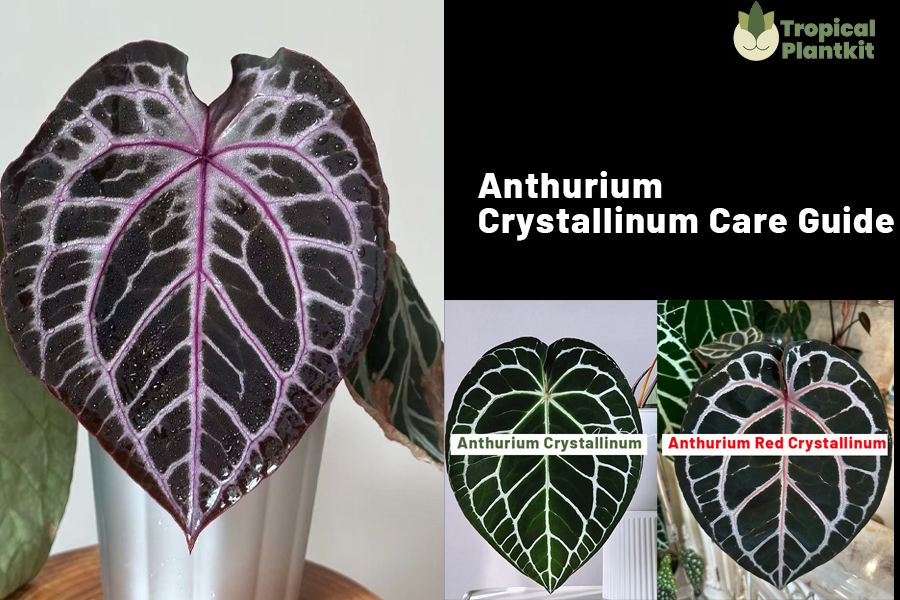
Species Origin: Anthurium crystallinum, commonly known as the Crystal Anthurium, is a tropical aroid native to rainforests of Central and South America (notably Panama, Colombia, and Peru) . It was first described in 1873 by Belgian botanist Jean Linden and French botanist Édouard André, based on specimens from Nueva Granada (Colombia) . The species quickly gained popularity in Europe in the late 19th century for its striking velvety, heart-shaped leaves with silvery veins . The name “crystallinum” refers to the crystal-like shimmer of the leaves’ venation . By the early 1900s, A. crystallinum was widely cultivated and often confused or hybridized with related species (like A. magnificum), as noted by Engler and other botanists of the era. Its attractive foliage made it a prized conservatory plant in Victorian times .
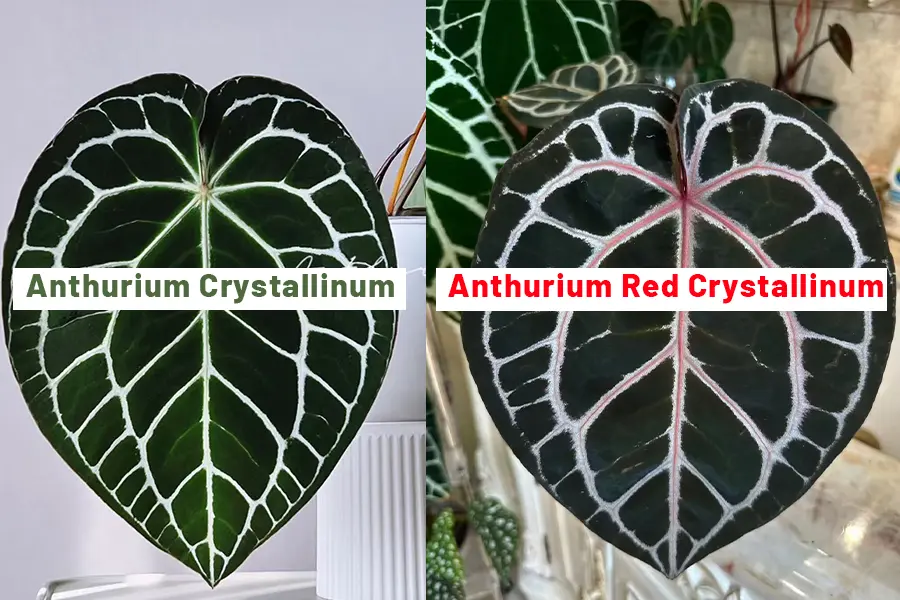
Cultivation and Breeding: In horticulture, Anthurium crystallinum has been used in breeding programs to develop new ornamental hybrids. One notable introduction is the “Red Crystallinum”, a hybrid line developed by Tim Anderson of Palm Hammock Orchid Estate in Florida . Anthurium “Red Crystallinum” is not a distinct species but a complex hybrid likely involving A. crystallinum, A. magnificum, and A. dressleri . This hybrid was selectively bred for its vivid coloration and vigor. Red Crystallinum earns its name from the brilliant coloration of its emerging leaves: new leaves unfurl in shades of bright red or burgundy with pronounced white veining, then gradually deepen to purple and finally mature to deep green . The midrib and veins may retain a reddish or pink hue even on hardened leaves . This dramatic color transition (combined with the velvety leaf texture) makes the hybrid especially ornamental.
Thanks to hybrid vigor, Red Crystallinum is known to be a relatively fast grower once established . It has been distributed through specialty aroid nurseries in recent years, often sold as seed-grown plants from the original Anderson breeding stock . This hybrid (and other crystallinum × magnificum crosses) helped popularize “velvet-leaf” Anthuriums in the houseplant hobby for their bold foliage. Today, A. crystallinum (and its variants) are widely available from tropical plant nurseries and tissue-culture labs, although wild-collected plants are rare. Notably, wild populations of true A. crystallinum are not frequently encountered, and most plants in cultivation are thought to be cultivars or hybrids .
2. Variegation Characteristics and Inheritance
Variegation in A. crystallinum: In addition to the red-leaf hybrid forms, another highly coveted variation of crystallinum is the variegated form. Variegated Anthurium crystallinum displays irregular patches or marbling of cream, yellow, or lime-green color contrasting against the normal deep green leaf background and white veins . The variegation often appears as marbled or sectoral patches on the leaves, sometimes with new leaves emerging with a pinkish or pale hue that later turns white or cream on green . For example, some variegated crystallinums produce new leaves that start soft pink, transition to creamy yellow, and finally develop striking pure white variegation on mature green leaves . Each variegated leaf is unique, displaying a mix of colors that can include white, cream, mint-green, and even hints of yellow, earning names like “marble” or “mint” variegated crystallinum in the trade . This multicolor contrast on the velvety leaf surface makes variegated crystallinum a true collector’s gem .
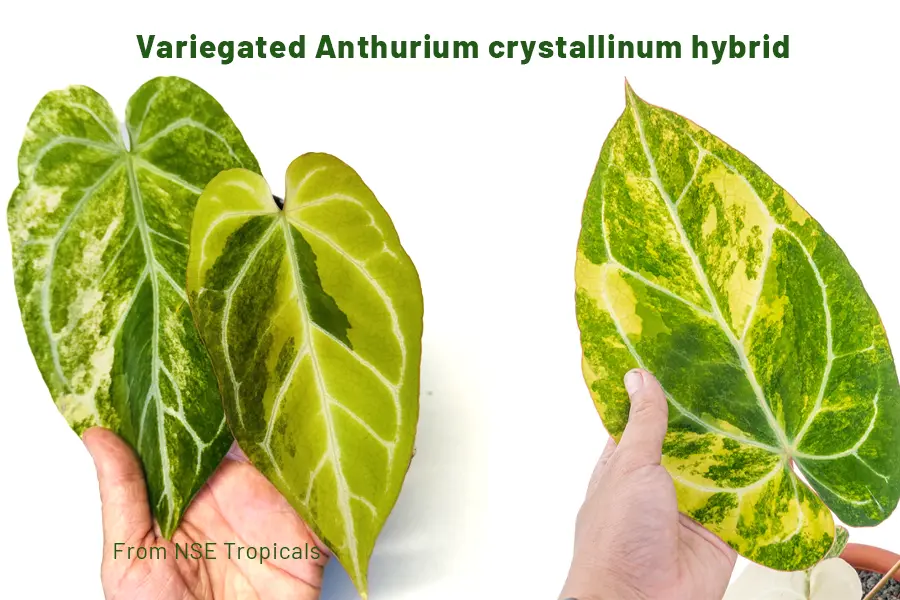
A variegated Anthurium crystallinum leaf exhibiting creamy yellow marbling and splashes across the dark green, white-veined foliage . Highly variegated leaves like this are visually stunning but can be more delicate, often with slower growth.
Anuthrium cystallinum Development and Inheritance:
Variegation in crystallinum is typically the result of spontaneous genetic mutation. In many cases it is chimeral variegation, where some cells in the leaf lack chlorophyll. This leads to the patchy appearance and is often unstable – new growth may revert to solid green if not enough mutated cells are in the growing point . Because chimeral variegation is not usually passed through seeds (since it’s not in every cell of the reproductive tissue), propagation must be done vegetatively (cuttings or tissue culture) to maintain the variegation . Indeed, producing variegated offspring from seed is hit-or-miss; most seedlings revert to green, with only a rare few inheriting any variegation unless the trait is caused by a stable genetic factor like a transposon . Some variegated anthuriums (especially those labeled “aurea” or “mint” variegated) may have transposon-induced patterns or stable variegation that can be passed in seed, but this is less common .
In practice, growers often preserve variegated crystallinum by cutting and rooting growing tips or by micropropagation. Thai and Indonesian labs have successfully cloned variegated individuals via tissue culture, allowing wider distribution. However, tissue culture can sometimes produce off-type variegation or less variegation, and the process is costly . Thus, variegated crystallinums remain scarce.
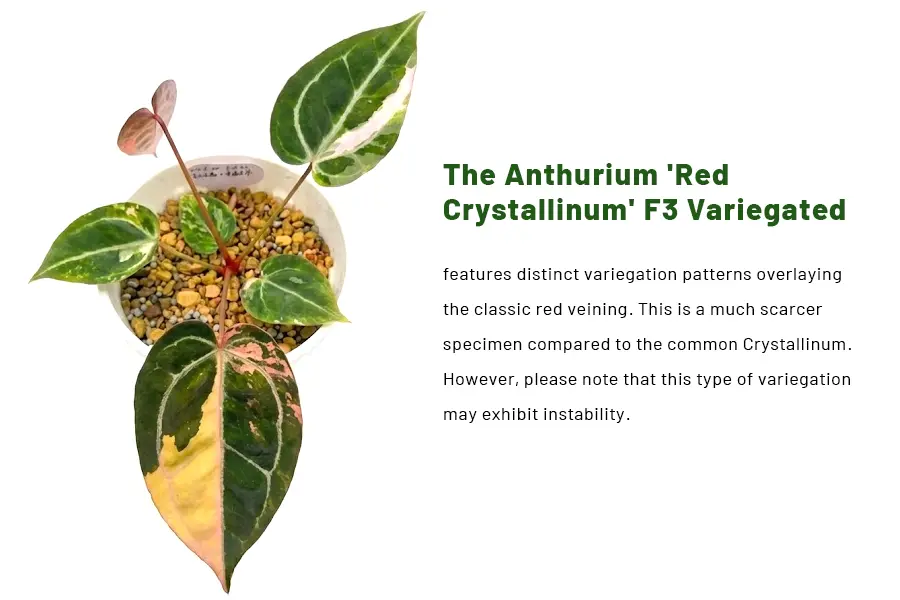
Anthurium Crystallinum Variegation Care Considerations:
The variegated portions of the leaf lack chlorophyll, making those sections more susceptible to burn and damage. Growers note that “highly variegated leaves are prone to browning” or scorching, especially during shipping or under strong light . Variegated plants also grow slower due to less chlorophyll for photosynthesis. Culturally, this means:
- Provide bright diffused light (not direct sun) to avoid leaf burn on white/yellow patches.
- Maintain high humidity and gentle air flow to minimize leaf stress (dry air can crisp variegated sections more easily).
- Be cautious with fertilization – variegated leaves have fewer chloroplasts and can be sensitive to fertilizer burn. Dilute feed more than you would for fully green plants.
- Expect slower growth and do not overwater. With less green tissue, variegated plants may have lower energy reserves and are prone to rot if overwatered.
Despite these challenges, many collectors prize variegated A. crystallinum as showpieces. Each new leaf is an event, unfurling in unpredictable patterns of color. Patience is rewarded with some of the most spectacular foliage in the aroid world.
Genetic Notes: It’s worth noting that not all reddish coloring in young leaves is related to variegation. Anthuriums (including non-variegated crystallinum) commonly exhibit red or bronze tones in new growth due to protective pigments (anthocyanins). This red flush fades as leaves harden. The Red Crystallinum hybrid leverages this trait by breeding for persistent red hues , but those red tones are a form of pigmentation, not variegation. True variegation refers to the absence of pigment in parts of the leaf (resulting in white/yellow areas). Both phenomena can occur together – for instance, a variegated crystallinum might unfurl a new leaf that is pinkish (from anthocyanins) and variegated with white sections. Over time the pink darkens to green on the pigmented parts, while the variegation remains white. Understanding this distinction helps growers provide proper care (e.g. anthocyanin-red young leaves still need good light to photosynthesize once green, whereas white variegated sections will never photosynthesize).
3. Indoor Care Guide for Anthurium Crystallinum
Keeping Anthurium crystallinum (including the Red variant or variegated forms) healthy indoors requires mimicking its tropical understory habitat. Below is a detailed care guide broken down by aspect:
Light Requirements
Provide bright, indirect light for your Anthurium crystallinum. In nature, these epiphytic plants grow beneath the rainforest canopy, receiving dappled sunlight. In the home, an east-facing window with filtered morning sun or a few feet back from a south/window is ideal. Avoid direct sunlight, as the velvety leaves scorch easily under harsh rays . When exposed to too much direct sun, leaves may develop brown, crispy patches or bleached spots (sunburn) . Conversely, insufficient light can lead to leggy growth and faded, yellowish foliage. You’ll know the light is too low if the plant’s leaves start stretching or new leaves remain small and pale, sometimes wilting or yellowing from lack of energy . Striking the right balance is key: bright but diffused light for at least 8+ hours a day.
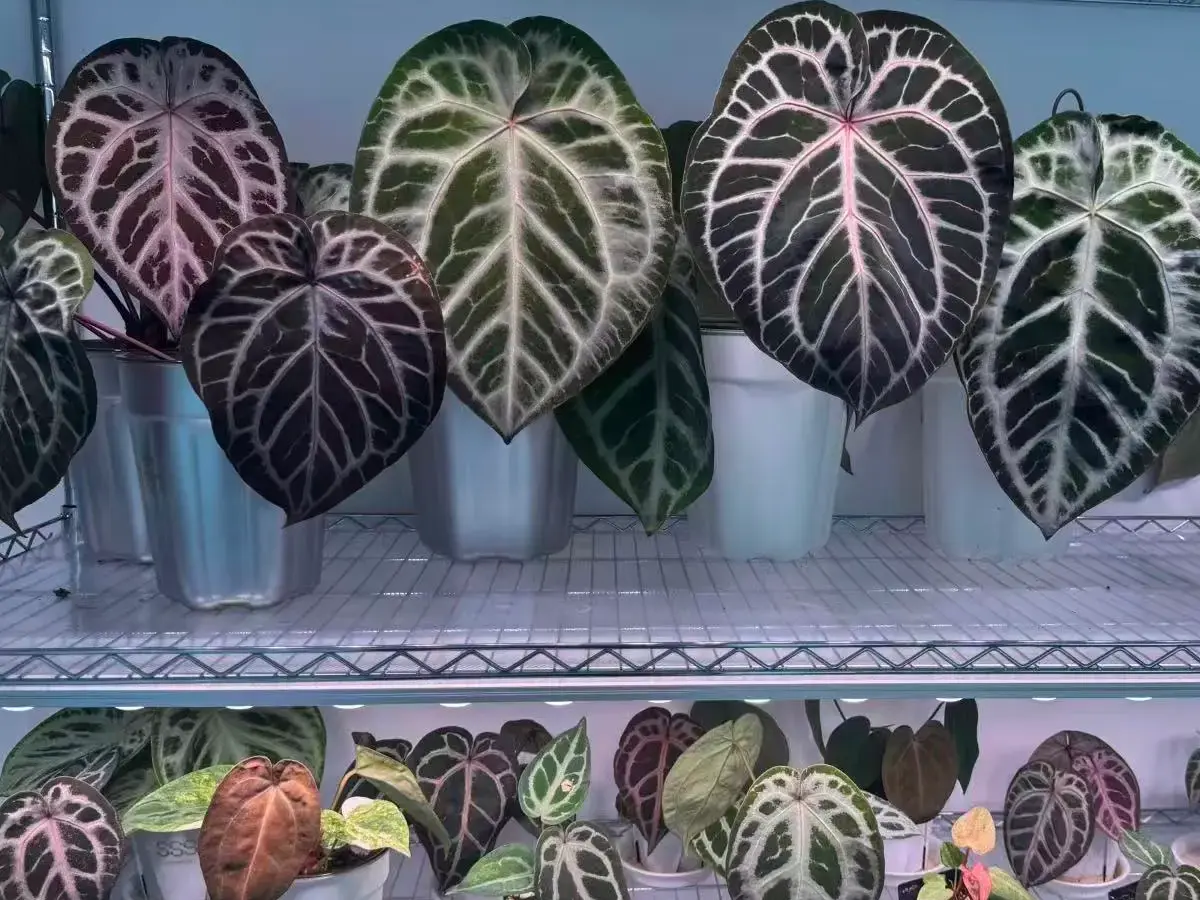
If natural light is limited, you can use grow lights. Aim for ~10,000–20,000 lux (bright shade). A simple test: if your hand cast a blurry shadow where the plant sits, the light is likely suitable. Remember that A. crystallinum doesn’t like very dim corners – growers note that moving a crystallinum to low light can nearly kill it, whereas in constant bright diffused light it is “easy to grow” . So don’t relegate this plant to a dark shelf.
(Tip: Sheer curtains are your friend. If you only have west-facing windows, use a curtain to filter the intense afternoon sun . The leaves will get all the brightness they need without the burn.)
Temperature and Humidity
Temperature: Anthurium crystallinum thrives in warm, stable temperatures. The ideal range is 65–85 °F (18–29 °C), with a sweet spot around 75–80 °F . They do not tolerate cold; avoid letting temperatures drop below ~60 °F. Chilly drafts from AC vents or winter windows can cause leaf yellowing or even death of the plant . Indoors, keep them in a room that stays consistently warm. Sudden temperature swings or cold nights can stress the plant, so position it away from drafty doors or cooling vents. In summary, warm and steady is the mantra.
Humidity: High humidity is very important for crystallinum. These plants have adapted to humid jungles, and prefer 65%–85% relative humidity . They can survive at ~50% (typical home humidity) but may develop brown, crispy leaf edges or fail to unfurl new leaves properly if kept too dry. For optimal growth, aim for ~70% humidity or higher . In practice, this may mean employing a humidifier in the room, especially in dry climates or during winter heating season. Grouping plants together or placing the pot on a pebble tray with water can slightly boost local humidity, but often these measures only raise humidity a little. Many serious growers keep their Anthuriums in humidity-controlled cabinets, terrariums, or greenhouse rooms. If that’s not possible, a cool-mist humidifier near the plant is the most effective solution .
Remember, humidity ≠ wetness. While high air moisture is needed, the plant still needs airflow to prevent fungal issues. Stagnant, overly humid air (100% in a closed space with no ventilation) can encourage disease. So strike a balance: humidity around 70–80% with gentle air circulation is perfect. If leaf edges are browning or new leaves crinkle as they emerge, it’s a sign the air may be too dry. Many owners find that boosting humidity not only improves leaf quality but also leaf size and growth rate, truly letting the plant “flourish” as it would in a jungle .
(Tip: Place your crystallinum in the most humid room of your home – often a bathroom with a shower – if light there is adequate . Alternatively, keep a humidifier running near the plant and monitor with a hygrometer. You’ll likely see a big improvement in those velvety leaves.)
Watering and Soil
Watering: Anthurium crystallinum enjoys consistently moist but not waterlogged conditions. In its epiphytic life, its roots get drenching rains but also plenty of air. Imitate this by watering thoroughly, then allowing the topsoil to dry slightly. Water when the top 1–2 inches of the potting mix have dried out . You can simply stick your finger into the soil: if it feels dry at your first knuckle, it’s time to water; if still damp, wait a bit longer . When you do water, water deeply and slowly, until excess drips out of the drainage holes. This ensures the roots are evenly moistened . Discard any standing water in the saucer; never let the plant sit in water, as crystallinum roots are prone to rot if kept soggy .
The goal is to keep the soil evenly moist – not sopping and not bone-dry. Prolonged wet feet will suffocate roots and invite rot, evidenced by yellowing leaves and a mushy stem base (signs of overwatering) . On the flip side, letting the plant dry out too much can cause browning, crispy leaf margins and wilting (underwatering stress) . Watch the plant’s signals:
- Overwatering signs: Lower leaves turning yellow, black spots on roots or stems (rot), fungus gnats in soil. Immediately let the soil dry more and adjust your schedule .
- Underwatering signs: Leaf tips/corners browning and curling, leaves drooping and feeling papery. In this case, increase watering frequency slightly .
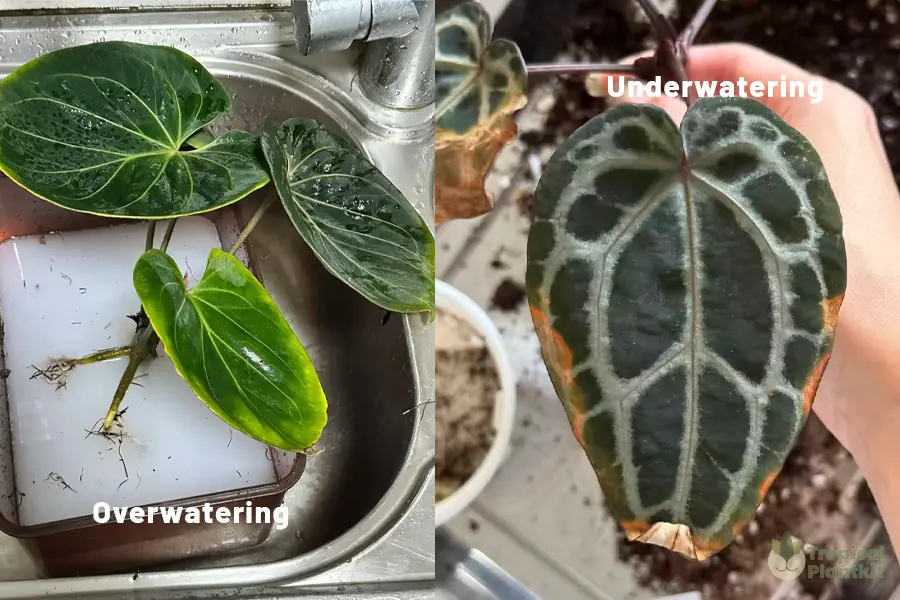
It’s often said not to follow a strict calendar for watering, but rather respond to the plant and environment . Temperature, humidity, pot size, and soil mix all affect drying time. In warm growing seasons, you might water about once a week, whereas in cooler or more humid periods, it could be every 10–14 days. Always use room-temperature, low-mineral water if possible (rainwater or distilled water is great) . Cold water can shock the roots, and very hard water can lead to mineral build-up in soil.
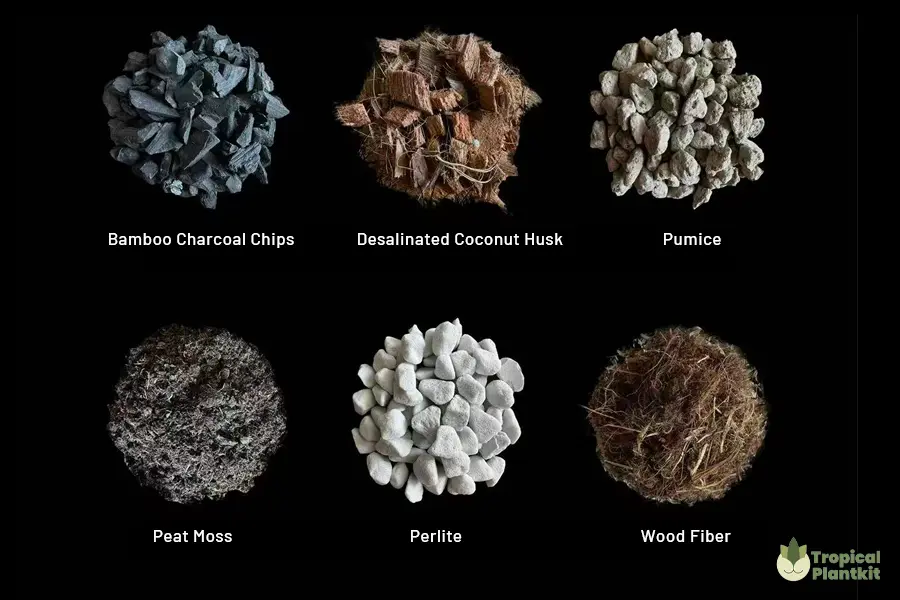
Soil and Potting Mix: The substrate for crystallinum should mimic loose, breathable forest floor or tree bark. Standard dense potting soil alone is too heavy and water-retentive. Instead, use a well-draining, airy mix that holds moisture but also has lots of air pockets . An excellent mix for Anthuriums is: orchid bark chips + perlite + peat moss or coconut coir, plus optionally some horticultural charcoal and pumice. A recommended DIY ratio is 2:1:1 (two parts high-quality potting soil or coco-coir, one part perlite, one part bark) . This yields a chunky mixture that retains moisture (thanks to peat/coir and the organic matter) but also drains fast and allows roots to “breathe” (thanks to bark and perlite) . The mix can be slightly acidic (pH ~5.5–6.5), which is fine for aroids.
If you prefer ready mixes, look for aroid mix or orchid mix blends sold by nurseries, which often contain similar ingredients. Many growers also include sphagnum moss strands in the mix or as a top dressing to maintain humidity around roots. Just avoid any mix that turns to mud when wet. A loose, chunky texture is key: you should be able to see pieces of bark and perlite. This prevents the dreaded waterlogging that causes root rot . As one experienced grower advised: “Remember that in nature most Anthuriums are epiphytic and their roots like a bit more air…Waterlogged, soggy soil can weaken roots and invite fungus” . A breathable mix, possibly in a terra cotta or breathable pot, will keep roots healthy . (If using plastic or ceramic pots, just be extra careful with watering.)
Anthurium crystallinum doesn’t mind being slightly root-bound and grows at a moderate pace, so repotting isn’t needed often—usually every two years, or when you notice roots circling the pot or pushing through drainage holes. The ideal time to repot is spring or early summer, when the plant is actively growing and can recover more easily.
Choose a pot only 1–2 inches wider than the current one. Avoid oversized pots, as excess soil tends to stay wet for too long and may lead to root problems. When repotting, gently loosen the root ball, remove old soil, and refresh the mix with a fresh, chunky medium to restore nutrients and maintain proper aeration.
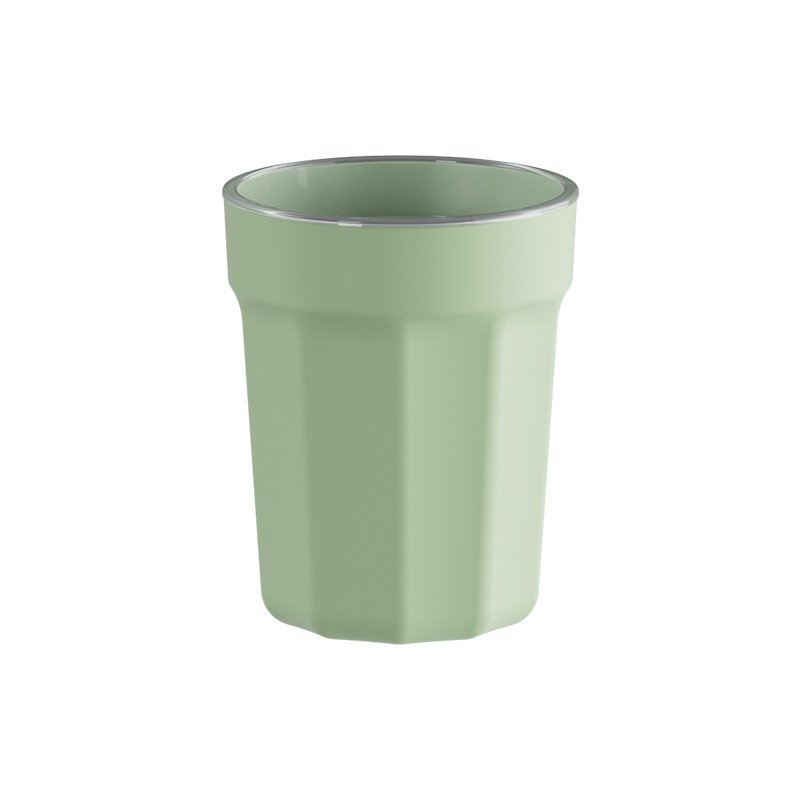
It’s also worth noting that Anthuriums grown in coarse, chunky substrates aren’t as sensitive to slightly moist soil—those large particles dry quickly and keep the root zone airy. Because chunky mixes dry out fast, many growers like to use a self-watering pot to make watering easier and keep moisture more consistent without risking root rot.
After repotting, water the plant well and keep humidity high. It’s normal for the plant to show mild transplant shock (a bit of wilting or a yellow leaf) right after repot . To minimize shock, do not excessively disturb the roots and avoid changing the plant’s environment drastically. Keep light, temperature, and humidity consistent. Within a couple of weeks, the plant should adjust and resume growth . Always handle the plant carefully during repotting – the leaves and roots are somewhat fragile. Also remember to wear gloves, as the sap can cause skin irritation (more on toxicity later) .
Products by Category

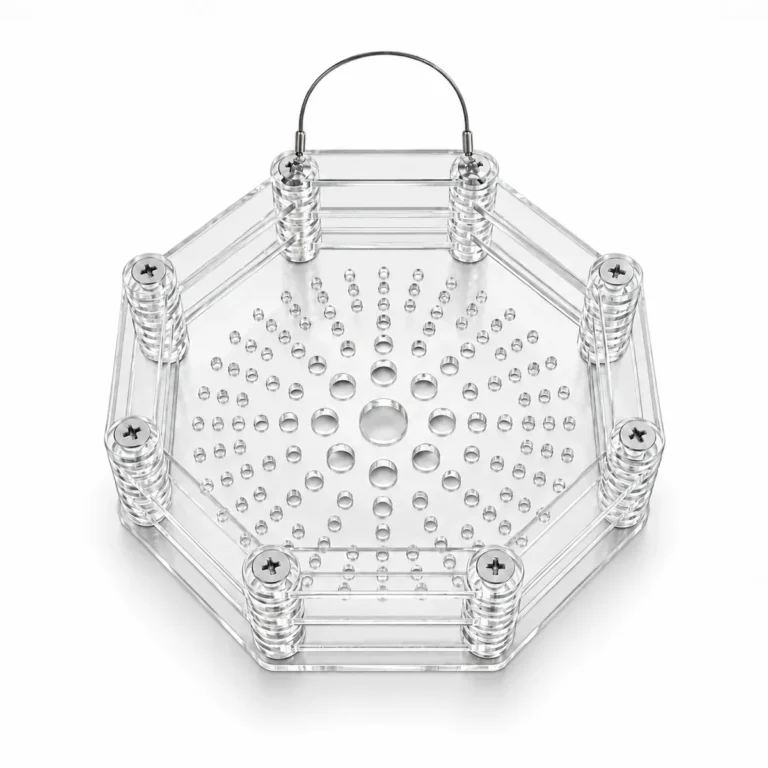
Self-Watering Transparent Succulent Planter | Eco PP Pot
Price range: $13.99 through $22.99
Fertilization
Anthurium crystallinum benefits from regular, light feeding during the growing season. They are not heavy feeders, but because they often grow in soilless mix with limited nutrients, supplemental fertilization will improve their vigor. Fertilize during active growth (spring and summer) about every 4–6 weeks with a balanced, water-soluble fertilizer diluted to half or quarter strength . An optimal N-P-K ratio might be around 20-20-20 or 10-10-10. Even better, use a fertilizer formulated for aroids or foliage houseplants, which will also contain micronutrients. Always apply fertilizer to moist soil (never to a bone-dry pot, which can burn roots).
One approach is to feed monthly at half-strength while the plant is pushing out new leaves, and then taper off in fall. Do not over-fertilize. Anthurium roots are sensitive to salt buildup; too much fertilizer can cause leaf burn (yellow or brown tips) and can actually stunt the plant . If you notice white crust on the soil or leaf burn, flush the pot with plenty of plain water and cut back on feeding. It’s safer to under-fertilize than overdo it .
A convenient alternative is using a slow-release pellet fertilizer (like Osmocote 14-14-14) sparingly in the potting mix. This releases nutrients gradually and reduces the risk of root burn . Many growers combine approaches: a few slow-release pellets in the pot at the start of the season, supplemented by occasional liquid feeding. Remember that in lower light or cooler conditions, the plant uses nutrients more slowly, so adjust your feeding frequency accordingly (perhaps feed less in those conditions to avoid excess).
Nutrient needs: As a foliage plant, A. crystallinum appreciates nitrogen for leaf growth, but also needs phosphorus, potassium, and micronutrients for overall health . Calcium and magnesium are important secondary nutrients – if you use distilled or very soft water, consider supplementing Cal-Mag occasionally. Trace elements like iron, manganese, and boron help prevent deficiencies (most balanced fertilizers include these). If new leaves are coming in very pale (chlorotic) with green veins, that can indicate micronutrient deficiencies or incorrect pH; an iron-rich foliage feed can help green them up.
In winter or when growth slows, you can withhold fertilizer or fertilize very sparingly (e.g. once in 2–3 months), since the plant won’t be using much. Over-fertilizing in the offseason can lead to salt buildup and root damage. Observing your plant is the best guide: deep green, shiny new leaves indicate it’s getting enough nutrition, whereas smaller, weak new leaves might suggest it could use a bit more food (provided other conditions are optimal). Always err on the side of caution – feed lightly and your Crystal Anthurium will reward you with lush growth .
Pruning and Maintenance
Anthurium crystallinum is relatively low-maintenance in terms of pruning. It doesn’t require regular trimming since it grows in a rosette/cluster form rather than vining aggressively. Pruning is mainly cosmetic or for health: periodically remove any yellowing, dead, or damaged leaves to keep the plant looking tidy and to direct the plant’s energy to new growth . Use a clean, sharp pair of scissors or pruning shears, and cut the leaf stem (petiole) just above a node or close to the base of the plant. Wear gloves when pruning, as all parts of Anthurium contain calcium oxalate crystals that can irritate skin . The sap is an irritant, so avoid touching your eyes or mouth and wash your hands after pruning.
If the plant gets taller and leggy (with an elongated stem over time), you can consider cutting and rerooting the top (this goes into propagation, discussed later) to rejuvenate a compact shape. Some crystallinum develop “growth points” or offshoots at the base; removing a rotted or old leaf can sometimes spur a dormant bud to grow a new shoot.
Leaf cleaning: Large, velvety leaves like those of crystallinum tend to collect dust over time, which can block some light and dull their appearance. Every few weeks, gently dust off the leaves with a soft brush or rinse them with lukewarm water. You can wipe leaves carefully with a damp cloth, but avoid using leaf-shine products (which can clog the matte leaf surface). A gentle shower (either in a bathroom or outdoors on a rainy day above 65°F) can refresh the foliage. Ensure afterward that excess water is shaken off or that the plant has airflow to dry within a couple hours, to prevent water sitting in the leaf axils which could invite rot.
Staking: Generally, A. crystallinum stays compact (1–2 feet tall) . However, if yours grows a longer stem or multiple leaves in a row, you can stake it for support. Use a moss pole or bamboo stake and soft plant ties to support any heavy leaves or leaning stems. In most cases, a healthy crystallinum will maintain an upright rosette on its own.
Troubleshooting common issues: (More details in Pests and Diseases section later, but briefly)
- If you see leaf yellowing: the most common cause is overwatering leading to root stress . Also consider humidity (too low) or nutrient imbalance (salt build-up) .
- Brown leaf tips or edges: usually underwatering or low humidity, or occasionally fertilizer burn .
- No new growth for a long time: could be insufficient light or a weak root system . Increase light and check root health; repotting in fresh mix can help if roots are exhausted.
- Leaves not as velvety or veins not bright: this can be genetic variation, but also strong light brings out vein contrast. Varieties differ; some hybrids have brighter veins. Ensure the plant is indeed crystallinum (many hybrids circulate). If veins are dull, it might be lower light or a nutrient issue – try a bit more light or a micronutrient feed.
Maintained well, Anthurium crystallinum is quite resilient and can live for many years, steadily producing one gorgeous leaf after another. Growers often comment that despite its “exotic” look, it’s not overly finicky if its basic needs (bright light, humidity, and good watering routine) are met . It can truly become a centerpiece houseplant with its bold, heart-shaped foliage.
(Table: Summary of Indoor Care Requirements for Anthurium Crystallinum)
| Aspect | Recommendation |
|---|---|
| Light | Bright, indirect light. No direct sun on leaves . East or north window, or filtered south light. Will tolerate medium light but growth slows. |
| Temperature | 65–80 °F (18–27 °C) optimal . Never below ~60 °F. Protect from cold drafts and sudden temperature changes. |
| Humidity | 60–80% relative humidity ideal . Use humidifier or pebble trays to raise humidity, especially in dry homes. Prevent leaf crisping by keeping humidity high. |
| Watering | Keep soil evenly moist but not waterlogged . Water when top 1–2 inches are dry . Ensure good drainage. Do not let plant sit in saucer of water. |
| Soil | Very well-draining, chunky mix . Example: 2 parts coco coir or potting soil, 1 part perlite, 1 part orchid bark. Slightly acidic pH ~6.0. Avoid heavy, clay soils. |
| Pot | Pot with drainage holes; terra cotta or breathable pots help. Repot every 2 years or when rootbound . Increase pot size modestly (1–2” larger). |
| Fertilizer | Diluted balanced fertilizer during spring/summer (e.g. half-strength monthly) . Alternatively, use slow-release granules. Do not overfeed; flush soil periodically. Little to no fertilizer in winter. |
| Pruning | Not much needed. Trim off yellow or dead leaves with clean scissors . Can cut back to propagate if plant grows leggy. Wear gloves (sap irritant). |
| Toxicity | Toxic to pets and humans if ingested (contains calcium oxalate) . Causes mouth/throat irritation. Keep out of reach of kids/pets. Sap may irritate skin on contact. |
4. Propagation Techniques (Seed, Division, Tissue Culture)
Expanding your collection of Anthurium crystallinum (or sharing it with friends) can be done through several propagation methods. The main propagation techniques are by seed, division, and stem cuttings, as well as laboratory tissue culture for mass production. Each method has its pros and cons:
Propagation from Seeds
Growing crystallinum from seed is possible but is generally the most challenging and slow method for hobbyists. Anthurium seeds are tiny and borne in berry-like fruits on the plant’s inflorescence (the spadix). To obtain seeds, you must pollinate the flowers. Anthurium crystallinum’s flowers are protogynous (female receptive first, then later male pollen is shed). This means you often need either two flowers at different stages or to store pollen for later use . The process is roughly:
- Collect pollen: When an Anthurium’s inflorescence sheds pollen (appearing as fine white/yellow dust), use a clean paintbrush to gather it . You may have to harvest pollen from one plant and store it in the freezer until another plant’s inflorescence is ready (pollen can be frozen and remain viable for some time) .
- Pollinate: Wait until another inflorescence’s stigmas become sticky or glossy (female receptive phase). Then brush the stored pollen onto the spadix, coating the surface lightly .
- Fruit development: If successful, the spadix will develop berries over several months. Anthurium berries often turn orange or red when ripe (exact color depends on species/hybrid). This ripening can take ~6–12 months after pollination for crystallinum . Patience is needed!
- Seed extraction: Once berries are soft and ripe, gently squeeze them to extract the seeds. Seeds are embedded in sticky pulp. Clean them in water to remove pulp.
- Sowing: Sow the fresh seeds on a moist, sterile medium (e.g., sphagnum moss or a mix of coco coir and perlite). Do not let them dry out – Anthurium seeds have no dormancy and will lose viability quickly if dried . Press them lightly into the surface; they often germinate best with light exposure and very high humidity.
- Germination: Keep in a warm (75–80 °F), high-humidity environment (you can cover the pot with plastic wrap or use a propagation box). Seeds typically germinate in a few weeks if viable. Tiny green shoots will appear.
- Seedling care: Seedlings are delicate and must remain in high humidity. They will start forming small heart-shaped leaves. Over months and years, these baby Anthuriums will gradually grow larger. It can take 1–3 years for a seed-grown crystallinum to reach a juvenile stage with sizable leaves, and potentially 3–5 years to maturity (flowering size) .
Because of this lengthy timeline, most growers find seed propagation impractical except for breeding new hybrids or if you have rare genetics to preserve. Additionally, seedlings of hybrids will vary genetically, so a Red Crystallinum self-pollinated, for instance, may yield a range of offspring, not all with the desired red trait (and variegation from a parent almost never comes through seeds if it was chimeral). As one reference notes, “to grow plants from seed may not provide a practical method of making more – pollination to seed maturity can take three years in a breeding program” . Indeed, the propagation rate by seeds is low for Anthuriums and not recommended for quick multiplication .
That said, the advantage of seeds is genetic diversity – you might get unique variants. All the named hybrids and cultivars (like Red Crystallinum) originally came from selective seed breeding. If you have the time and patience, raising Anthuriums from seed can be rewarding to watch the variation in seedlings. Just be prepared for a long journey from seed to spectacular leaf!
Propagation by Division (Rhizome/Root Division)
Division is a straightforward way to propagate A. crystallinum, especially once your plant is mature and has produced multiple growth points or “pups.” Over time, a healthy crystallinum can sprout basal shoots or grow a creeping stem that can be cut and divided. Root division is typically done during repotting :
- When to divide: Only divide a crystallinum that is large and has more than one obvious growing point (for example, two or more separate clusters of leaves arising from the root mass). Division is best done at repotting time, to minimize disturbance . If the plant has outgrown its pot and you see offshoots, that’s a good opportunity.
- Method: Carefully remove the plant from its pot and gently tease apart the root ball . Look for natural points where the plant can be separated – often the offshoot will have its own set of roots attached. Untangle roots with your fingers (you can rinse them in water to see better). Do not use brute force; if roots are heavily intertwined, use a clean knife or pruning shears to cut the sections apart, ensuring each section has roots and at least one growth stem.
- Separating: Crystallinum has a thick, fleshy stem (technically a rhizome). You may find that you need to cut through this rhizome to separate growths. Make a clean cut, and consider dusting the cut ends with cinnamon or fungicide to prevent rot.
- Potting divisions: Plant each division in a suitable small pot with fresh mix . Do not overpot; often divisions have fewer roots and do better in a snug pot. After potting, water lightly and keep humidity high. The divisions might droop initially due to root disturbance. Within a few weeks they should stabilize and start growing new leaves if kept warm and humid.
- Post-division care: Treat the new plants gently – medium light, high humidity, keep soil just lightly moist until you see new growth (indicating roots are working). Watch for any rot at cut rhizome sites; if a division is struggling (losing all leaves), keep it in a very humid environment (like a clear covered container) to encourage it to push new buds.
Division has the benefit of yielding a decent-sized new plant immediately (versus tiny seedlings or cuttings). Moreover, it clones the parent, so the new plant will have the same genetic traits (e.g., a division of a Red Crystallinum will also have red new leaves; a division of a variegated will remain variegated). Always use sterile tools to prevent infection when cutting roots or stems. Also note that dividing can temporarily set back the plant’s growth while it regains strength. Only divide when necessary or when you want an extra plant; otherwise, a single plant with multiple growths can look very lush and full if left intact.
(Many growers actually prefer stem cuttings to division for crystallinum, since these Anthuriums often grow as a single stem that can be cut. “Division” in the classic sense is less common unless the plant has produced pups. So let’s look at cuttings next.)
Propagation by Stem Cuttings (Air-Layering or Cut Stem)
Stem cuttings are perhaps the easiest and most popular way to propagate Anthurium crystallinum among hobbyists . Unlike some plants, Anthurium stems won’t root from just any piece – you need a growing node with an aerial root or a dormant bud. Here’s how to proceed:
- Identify a cutting point: Wait until your plant has at least 4 or 5 leaves (nodes) so that taking a cutting won’t kill the main plant . If the plant has grown a bit leggy with an elongated stem, that’s perfect. You should see small brown nubs or roots along the stem. Choose a section to cut so that the top cutting has 2–3 leaves and at least one healthy aerial root (or the nub of one) . The mother plant should be left with at least a couple of leaves as well.
- Cutting: Use a sterile, sharp knife or pruning shears. Cut just below a node (the point where a leaf and root emanate) . A typical cut might be halfway up the stem if the plant is tall, or taking the top growing tip. Ensure the cutting has some stem length to insert into media.
- Optional – air layering: If you want to be extra safe, you can air-layer the plant a few weeks before cutting. This involves wrapping moist sphagnum moss around a node (with an aerial root) on the stem, covering it with plastic wrap to hold moisture, and waiting for new roots to emerge into the moss. Once you see roots, you can cut below and pot the rooted cutting. This method increases success rate.
- Rooting the cutting: Dip the cut end in rooting hormone powder or gel to encourage quick root development (this is optional but can help) . Then plant the cutting in a small pot of airy mix (similar to adult mix, maybe with extra perlite or even pure sphagnum moss which retains moisture for rooting) . Keep the cutting warm (75–80°F) and extremely humid – a propagation chamber or clear plastic bag over the pot works well. Bright, indirect light is needed, but no direct sun (to avoid overheating under the cover).
- Environment: Essentially, treat it like a baby plant. The humidity should be ~90% to prevent the cutting from desiccating before roots form. Open the cover periodically to refresh air and prevent mold. In 2–4 weeks, the cutting should start to establish roots. You can gently tug to test for resistance (indicating rooting). Once new growth (a nub or leaf) appears, it’s a great sign.
- Potting on: After ~6–8 weeks, or when roots are a couple inches long, you can pot the newly rooted cutting into a richer aroid mix and begin treating it like a normal plant . Initially keep it in slightly higher humidity to transition it.
Stem cuttings allow you to get multiple clones from a single plant over time – “you can propagate multiple times, taking multiple cuttings, limiting shock if done right” . The mother plant (bottom part) often will sprout a new bud below the cut, essentially branching and continuing to grow, while your cutting becomes a second plant. This method ensures the offspring are identical to the parent (useful for keeping prized traits like variegation or specific hybrids) . Cuttings also typically grow faster than seedlings since they start with some maturity.
One thing to note is to always sanitize your cutting tools with alcohol or bleach solution to prevent diseases transferring to the open wounds. Also, monitor cuttings for rot – any black, mushy parts should be trimmed off and the cutting re-treated with fungicide. But generally, Anthurium cuttings root relatively easily given warmth and humidity, and this is considered the most accessible propagation method for enthusiasts.
Tissue Culture (Micropropagation)
Tissue culture is a specialized propagation method conducted in laboratory settings, used to mass-produce Anthuriums (and many other plants) from tiny tissue samples. While not something a casual hobbyist would do at home, it’s worth understanding since many Anthuriums on the market (especially in Asia) are tissue-cultured clones. In tissue culture (TC), a small piece of plant (like a meristem or bud) is sterilized and placed on an agar medium with nutrients and hormones to encourage it to produce new plantlets in vitro . The general steps are:
- Selection of a specimen: A grower chooses an ideal “mother” plant with desirable traits (healthy, beautiful form, variegation, etc.) .
- Explant and sterilization: Tiny pieces of the plant (meristem tissue, nodes, or even cells) are taken and surface-sterilized to eliminate fungi/bacteria .
- Callus induction: The tissue is placed on a sterile agar jelly containing a cocktail of hormones (like auxins and cytokinins). In Anthurium TC, often a callus (undifferentiated cell mass) is formed from these tissues . This callus can be subdivided.
- Shoot regeneration: By adjusting hormones, the callus or explant is then stimulated to produce shoots and leaves (small plantlets) . In a successful protocol, each tiny piece can yield dozens of new shoots.
- Rooting: The new shoots are transferred to another medium that encourages root development . They become fully formed baby plants in the sterile jars.
- Acclimatization: The plantlets are taken out of flask and gradually weaned to normal humidity and potting mix (this is tricky – many can die if not done carefully because they’re very tender). They are planted in trays or plugs and kept in nearly 100% humidity, then slowly hardened off to ambient conditions over a few weeks.
The result is potentially hundreds or thousands of identical clones from one piece of stock material . Commercially, this is invaluable for producing large quantities of rare Anthuriums for sale, and for rapidly multiplying new hybrids. For example, if a breeder creates a stunning variegated crystallinum, they might send it to a TC lab to produce clones, ensuring the variegation is preserved and making it available to more people (albeit often at high initial cost).
Some points about tissue culture in Anthuriums:
- Genetic stability: Ideally, TC produces true clones. However, there is a risk of somaclonal variation (mutations arising during culture, especially if a callus phase is involved) . These variations can sometimes lead to unexpected outcomes (e.g., loss of variegation, or different leaf shapes). The best labs minimize this by using meristem culture (direct organogenesis without a prolonged callus phase) to maintain genetic stability .
- Advantages: Can quickly produce disease-free, uniform plants year-round, independent of seasons . It’s great for conservation (saving species from extinction via propagation) and for reducing wild collection.
- Disadvantages: It’s costly, requires expertise and equipment, and not every Anthurium species responds easily to in vitro culture. Also, when TC plants flood the market, prices drop (good for buyers, not for those who bought at high prices earlier). For example, many Thailand nurseries now tissue-culture hybrids, making once-rare plants more accessible.
For the home grower, tissue culture is usually not practical. However, you might encounter tissue-cultured crystallinum sold as “flasks” or small seedlings. These often come as tiny plants in gel or recently weaned plugs. If you buy such plantlets, be prepared to baby them with very high humidity and care as they acclimate (since they don’t have the hardiness of greenhouse-grown plants initially).
In summary, propagation at home will typically involve cuttings or divisions for crystallinum. Those methods are quite successful and fast relative to seeds. Tissue culture remains a behind-the-scenes method by professionals to increase supply of these beautiful plants. As one grower humorously put it, “there’s nothing dishonorable about cloning; it lets us get 100% of the plants with the desired attributes that might have taken decades to breed” – a nod to how TC has made strains like Red Crystallinum widely available after the initial breeder’s work.
5. Pest and Disease Management (Indoors)
Anthurium crystallinum, like many tropical houseplants, can occasionally fall prey to pests or diseases, especially in indoor conditions. Maintaining a clean growing environment and catching problems early are key to keeping your Crystal Anthurium healthy. Below is an overview of common pests and diseases and how to manage them:
Common Pests
Indoors, A. crystallinum can attract a few sap-sucking pests:
- Spider Mites: These tiny red or brown mites thrive in warm, dry conditions and often target velvety-leaved plants. Signs include fine speckling on leaves (tiny yellow dots), a dull dusty appearance, and sometimes fine webbing on the underside of leaves. Leaves may yellow and drop if infestation is heavy. Prevention: Keep humidity high (spider mites hate moisture) and regularly mist or rinse the leaves. Treatment: Upon first sign, wash leaves with a lukewarm water spray to knock mites off. Follow up with insecticidal soap or neem oil, thoroughly coating leaf undersides and petioles . Repeat every 5–7 days for a few cycles, because mites reproduce quickly. Also isolate the plant, as mites can spread.
- Mealybugs: White, fuzzy cotton-like bugs often found in leaf axils or underside. They suck sap and excrete sticky honeydew. They can weaken the plant, causing distorted new growth. Treatment: Dab visible mealybugs with cotton swab dipped in isopropyl alcohol to dissolve their coating. Use systemic insecticides (imidacloprid granules) or neem oil spray for larger infestations. Check neighboring plants too.
- Scale Insects: Brown or tan oval “bumps” on stems or leaves that are actually insects under a shell. They also cause yellow spots and sticky residue. Treatment: Gently scrape off scales with a fingernail or swab with alcohol. Apply horticultural oil or systemic insecticide. Scales can be persistent, so vigilance is needed.
- Aphids: Small green, black, or red soft-bodied insects usually at new growth or underside. They can distort new leaves. Aphids are less common indoors but can appear, especially on a flowering inflorescence. Treatment: Wash them off with water, spray insecticidal soap. They reproduce fast, so repeat treatments. Ladybugs (if you can release them indoors) will eat aphids too.
- Thrips: Tiny slender black or brown insects that scrape at leaves, causing silvery patches or streaks and black specks of excrement. Thrips can transmit viruses as well. Treatment: Difficult to eradicate – isolate the plant. Use a combination of blue or yellow sticky traps (to monitor adults), and spray with a systemic insecticide or spinosad. Repeat weekly. Increase humidity (thrips prefer dry) and prune heavily infested leaves.
General Indoor Pest Management: Regularly inspect your crystallinum, especially the undersides of leaves and along the veins, for any signs of pests. Catching an infestation early makes it much easier to control. Quarantine new plants for a couple weeks before placing them near your Anthurium, as many pests hitchhike on new arrivals. Many growers wipe down their Anthurium’s leaves periodically with a dilute neem oil solution as a preventive (neem oil acts as both a repellent and mild systemic). Ensure your plant has good airflow – stagnant air can encourage pest outbreaks (and disease). Also, avoid over-fertilizing with high nitrogen, which can make new growth soft and extra appealing to pests like aphids.
Encouraging beneficial insects (like predatory mites for spider mites, or lacewings for mealybugs) is another natural approach if you have a greenhouse or sunroom. Indoors, most people rely on physical cleaning and safe sprays. Insecticidal soap or neem oil used weekly for 3-4 weeks can eliminate most minor infestations . For severe infestations, a houseplant-safe systemic insecticide may be warranted.
Diseases
Bacterial and Fungal Diseases: Anthuriums are unfortunately known to be susceptible to a few serious diseases:
- Bacterial Blight (Xanthomonas): This is one of the most serious diseases in Anthurium cultivation . It causes yellow, water-soaked lesions that start at leaf edges and form V-shaped necrotic (brown/black) patches . Infected leaves may collapse and entire plants can wilt if the bacteria spread systemically . This bacterium thrives in warm, humid conditions and spreads via water splash. Prevention: The best management is preventive – avoid overhead watering (keep leaves dry when possible), maintain good spacing and airflow, and immediately remove any leaf that shows suspicious lesions with a clean tool . If blight is suspected: Isolate the plant. Unfortunately, there is no cure once it’s systemic. Remove affected leaves, and you may try a copper-based antibacterial spray to slow it, but results are limited. Disinfect any scissors used. In commercial settings, infected plants are usually destroyed to protect others . Ensuring you only introduce plants that were tissue-cultured or certified disease-free is important, as Xanthomonas can come in on infected stock.
- Root Rot (Pythium, Phytophthora, Rhizoctonia): These soil-borne fungi cause roots to turn brown/black and mushy. The plant shows wilting or yellowing despite watering. Overwatered conditions and poor drainage facilitate these pathogens . Prevention: Use well-draining mix, don’t overwater, and sterilize pots/tools. Treatment: If caught early, you can unpot the plant, trim off infected roots, and repot in fresh dry mix. Drench with a fungicide (like a phosphorous acid fungicide or copper) effective against root rot. Often by the time symptoms show, it’s advanced. So prevention is key. If the stem is rotting, take healthy top cuttings to reroot and discard the infected base.
- Leaf Spots (Fungal): Anthuriums can get Alternaria or Colletotrichum fungal spots, especially if kept in very humid, stagnant air. These show as small brown or black spots on leaves, sometimes with yellow haloes. Management: Remove affected leaves and improve air circulation. You can apply a broad-spectrum fungicide (chlorothalonil or mancozeb) if it continues. Avoid misting leaves late in the day – water sitting on leaves overnight encourages fungal spores .
- Powdery Mildew: Rare on Anthurium, but in some indoor situations a white powdery fungal growth can appear on leaves. Increasing airflow and using a sulfur-based fungicide or milk spray can treat it.
- “Black Nose” Disease: This is mainly on Anthurium andraeanum flowers (caused by a fungus Colletotrichum gloeosporioides), causing blackening of the spadix. It’s less relevant for crystallinum which is grown for foliage (and rarely flowers indoors).
- Physiological problems: Not diseases per se, but worth mentioning: Edema (water blister patches on leaves if overwatered), nutrient imbalances causing leaf discoloration (e.g., magnesium or calcium deficiency causing interveinal chlorosis or deformed leaves). These can be corrected by adjusting care (watering, feeding) rather than chemicals.
Preventive care: Keep your Anthurium’s leaves clean and dry when possible, especially in cooler conditions. Bacterial and fungal pathogens often need a film of water on the leaf to infect. When you do mist or shower the plant, do so in the morning so leaves dry by evening. Ensuring good airflow (a fan in the room) greatly reduces fungal issues by reducing leaf wetness and drying out spore landing sites. Sterilize pruning tools between plants to avoid transmitting any bacteria/viruses. If one plant gets sick, isolate it to avoid contagion.
Also, avoid overcrowding plants. Crystallinum likes humidity but not stagnation; spacing plants allows air circulation that keeps pathogens at bay . In high-value collections, some growers even proactively treat with copper or streptomycin sprays in greenhouse settings to prevent bacterial blight, but in a home, careful cultural practices are usually sufficient.
Other Issues and Solutions
- Yellow Leaves: The most frequent “disease” a new grower might see is simply a leaf turning yellow. As mentioned earlier, over-watering is the top cause of yellowing leaves (leading to root stress/rot) . Immediately check the soil moisture and root health. If the soil is waterlogged and smells sour, root rot may be starting – let it dry out and consider repotting. Another cause is low humidity – insufficient humidity can cause generalized yellowing or crispy edges that are yellow/brown . Up the humidity. Nutrient issues (like salt buildup from too much fertilizer) can also cause leaf margins to yellow with a burn-like appearance . In that case, flush the soil and adjust feeding. It’s normal for the oldest leaf to eventually yellow and die – if it’s just one bottom leaf occasionally, and your plant continues making new leaves, that’s natural senescence. Simply trim off the yellow leaf.
- Browning Leaves: Typically due to under-watering or scorching. If mainly tips or edges are brown and crispy, think under-watering or low humidity (increase watering frequency slightly and humidity) . If large patches are brown starting from areas that get sun, it’s sunburn – move plant to shadier spot . Brown, mushy spots could be a sign of bacterial infection – remove those leaves. Always consider the pattern: scattered spots = likely disease; crispy edges = dry air or thirst; uniform browning from tip inward = possibly overwatering (root rot) or fertilizer burn.
- Pests presence: Sticky leaves (with no obvious scale or mealybugs) could indicate aphids or whiteflies – check the undersides for tiny insects. Black sooty mold on leaves grows on pest honeydew – confirming pest infestation. Treat as above.
- Toxicity precaution: Remember that all Anthuriums are considered toxic to pets and humans if ingested. The calcium oxalate crystals can cause severe mouth pain, drooling, and throat swelling if chewed . While not usually life-threatening, it’s a very unpleasant experience. Keep your crystallinum out of reach from cats, dogs, and children who might nibble. Thankfully, the plant’s attractive part is the foliage, which pets are less likely to chew compared to grassy plants, but caution is warranted. If pruning or propagating, wearing gloves prevents any sap from causing skin irritation or small cuts (the sap can make minor cuts sting more) .
In summary, good culture is the best defense: correct light, humidity, and watering will produce a robust Anthurium that can resist pests and diseases. Most growers report that A. crystallinum is not particularly prone to pests if housed in a humid environment with occasional wiping of leaves . Fungal or bacterial problems are also rare in home settings unless moisture management is poor. By staying observant – checking the plant at least weekly – you can spot any issue early and address it. Your reward will be a healthy Crystal Anthurium showcasing its full glory of pristine, velvety leaves.
(If you do encounter a serious issue and feel stumped, consider reaching out on plant forums or local aroid society groups. Many fellow collectors can offer advice from experience – chances are someone has dealt with the same pest or spot on a leaf and can guide you in real time.)
6. Current Market Pricing Trends in the US
The market for Anthurium crystallinum (and its special forms like Red Crystallinum and variegated variants) has seen dynamic changes in recent years. During the houseplant craze of 2020–2021, prices for many rare aroids, including crystallinum, skyrocketed. Since then, as supply has increased through propagation and imports, prices have generally stabilized or softened somewhat. Let’s break down the current pricing trends in the United States as of 2024–2025:
- Standard Anthurium Crystallinum (green form): Once considered a rare aroid, the green crystallinum is now relatively accessible. Small juvenile plants (in 2–4 inch pots) can be found from specialty growers or online marketplaces typically in the range of $30 to $80 USD depending on size and quality . For example, tissue-cultured seedlings or small plants have been listed around $30–$50 on Etsy and other sites . A well-established larger plant with multiple leaves (6+ inch leaf size) might go for about $100–$150. U.S. nurseries like Arium Botanicals list A. “Red Crystallinum” Hybrid in a 2-inch pot for ~$65 , indicating that even the more colorful hybrid is not astronomically priced for small specimens. Brick-and-mortar nurseries, if they carry crystallinum, often price them similar to other exotic houseplants in the $50–$100 range for a mid-sized plant. Overall, prices have come down from a few years ago when even tiny crystallinums might have sold for over $100. Greater availability via imports from Asia (Thailand, Indonesia) has contributed to this affordability.
- Anthurium “Red Crystallinum”: This hybrid commands a bit more than a plain crystallinum, but is still within reach for enthusiasts. For instance, Carnivero (a reputable US aroid nursery) had offered Red Crystallinum plants at around $180 regular price (and sometimes on sale around $150–$180) for well-established juveniles . At one point, Carnivero listed specimens for ~$300, but that may have been a particularly large plant or an anomaly . On the secondary market, hobbyists might sell cuttings of Red Crystallinum in the $100–$200 range. There is variability depending on the lineage (some Red crystallinum lines are branded like “NSE Red” referring to Natural Selection Exotics line). For example, one seller’s listing: Anthurium SKG Red Crystallinum, 6” pot was advertised at $280 (on sale from $350) . Meanwhile, another vendor had NSE Red Crystallinum x crystallinum seedlings at about $50 each . This suggests that small seedlings are affordable, while larger showpieces still fetch a premium. The trend seems to be that as more Red crystallinums are bred and grown from seed, the price is gradually decreasing, making them more attainable than a few years ago.
- Variegated Anthurium Crystallinum: Here is where prices can go dramatically higher due to rarity. Variegated forms remain expensive and coveted. A few data points:
- A U.S. seller, Rare Plant Fairy, listed a variegated A. crystallinum (a large, highly variegated specimen) for $2,500 in late 2023 . This was an exact plant sale, hence the high price for a one-of-a-kind showpiece.
- Thai nurseries like Thai Exotic Greenery often offer variegated crystallinum around $400–$600 for small to medium plants . (For instance, TEG had a variegated crystallinum at $500 sold out .) Importing those to the US would add some cost, but domestic resellers might price them around $800+ after import.
- Oramicin (an online plant shop) showed a sale price of $617 (down from $1,176) for a variegated crystallinum, indicating the market fluctuation and possibly a clearance or increase in supply . Aroid Market (Indonesia) lists a generic A. crystallinum variegated for around $3,099 (likely a large specimen) , but international buyers often negotiate or buy smaller examples.
- NSE Tropicals (Florida) had a Variegated Anthurium crystallinum hybrid at $495 (out of stock) , which gives a sense that roughly $400–$600 is the entry point for a small variegated plant in the U.S. market.
- Market trend influences: The overall plant market cooled a bit after 2021, and many prices for “rare” plants have dropped as supply caught up with demand. For example, Kaylee Ellen’s Rare Plant Index and other analyses noted significant price drops in 2022–2023 for things like Monstera Thai Constellation and Philodendron Pink Princess. For Anthuriums specifically, prices for some species like A. clarinervium or A. andreanum hybrids are quite low now (under $50), while truly rare species or variegated forms stay high. The PlantSlip 2024 report of expensive houseplants lists Anthurium papillilaminum averaging $80–$100 and holding stable , and Anthurium “King of Spades” around $110–$150 . A. crystallinum was not specifically highlighted there, suggesting it’s not at the very top of the “most expensive” list anymore. Indeed, a healthy green crystallinum can be had for under $100, making it comparatively affordable for the impact it delivers.
- Red Crystallinum vs Similar: Red crystallinum hybrids were rarer a few years back but now are often produced from seed by growers. For example, Red Crystallinum x Red Crystallinum seedlings were being sold out of Thailand for as low as $35 (small size) . After import costs, a U.S. buyer might pay $75–$100 for that. The domestic market sees mid-size Red crystallinums usually between $150–$300. So, a bit more than a plain crystallinum, but not wildly so.
- Auctions and Collector Sales: On Facebook groups or Aroid forums, you’ll sometimes see variegated crystallinums or special hybrids auctioned. Prices can swing based on who’s bidding. For instance, in 2022 some variegated crystallinum sold at auction for ~$1000 for a 2-3 leaf plant. By 2025, that same plant might fetch maybe $600–$800 as more are around. If a plant has an excellent variegation pattern (like half-moon sectors or very high contrast), collectors will pay a premium. Conversely, lower variegation (e.g., just mild speckling) will be cheaper.
- Effect of Tissue Culture Supply: As mentioned, tissue culture is ramping up. Once Thai labs crack the TC process for a particular variegated Anthurium, expect a surge of those plants 6–12 months later at lower prices. We saw this with Monstera and Philodendrons. For crystallinum, a few variants like “Crystal Mint” (mint variegated crystallinum) and “Crystal Marble” have appeared via tissue culture in Asian markets at a few hundred dollars, whereas previously any variegated one was $1k+. So, prices are gradually trending downward as supply increases, though they’re still high in absolute terms. A PlantTube personality predicted certain plant prices will drop in 2024, citing that some variegated aroids now have more producers .
- Regional Differences: In the U.S., prices tend to be higher than in Southeast Asia (due to import costs and lower supply). European prices are similar to U.S. or slightly higher for some Anthuriums. Within the U.S., buying from a reputable nursery might cost a bit more than from a hobbyist, but you often get a live-arrival guarantee and proper phytosanitary measures. For example, Carnivero pricing at $150–$300 for Red Crystallinum with a live guarantee might be worth the peace of mind, versus rolling the dice on an imported $50 plant that might arrive in poor shape.
In summary, if you’re looking to buy an Anthurium crystallinum in the U.S.:
- A standard green crystallinum is now one of the more affordable “collector” Anthuriums – expect roughly $50–$100 for a nice one .
- The “Red” hybrid crystallinum commands a moderate premium – roughly $150–$250 for a good size, with small seedlings under $100 .
- Variegated crystallinum remains expensive: starting a few hundred dollars for small ones, up to $2000+ for large, highly variegated specimens . Prices are slowly lowering compared to the peak, but it’s still a plant for the serious (and well-heeled) collector.
Interestingly, as prices come down, more hobbyists can acquire these plants, which in turn increases the knowledge pool on their care and propagation – which can further increase supply. It’s a cycle we see in the plant market. But truly spectacular variegates will likely always carry a “holy grail” premium. Keep an eye on plant forums and Facebook groups; often you can find better deals in peer-to-peer sales or trades. And always verify the seller’s credibility when spending big money on a rare plant!
7. Customer and Collector Feedback (US Forums and Marketplaces)
Enthusiasts in the U.S. have shared a wealth of experiences growing Anthurium crystallinum and its variants. Trawling through plant forums, social media groups, and marketplace reviews reveals some common themes in feedback:
Overall Growth Experience: Most hobbyists report that Anthurium crystallinum is an enjoyable plant to grow, often described as easier than its “queen” relative (Anthurium warocqueanum) and a good introduction to velvet-leaf anthuriums. One UBC Botanical Garden forum member noted that aside from needing decent light, crystallinum is “otherwise easy to grow” , indicating that with proper conditions it’s not very temperamental. Many growers on Reddit and Facebook echo that crystallinum tolerates typical indoor conditions better than some rarer Anthuriums, especially if humidity is at least moderate.
Light and Growth Feedback: Growers emphasize the light requirement. A collector from Arkansas on a forum observed that “the one thing about A. crystallinum is it doesn’t like low light. Every time I tried to move it to dimmer light it almost dies. I keep it where it gets constant brightly diffused light.” This underlines that owners have learned not to treat crystallinum as a low-light houseplant – it needs that bright spot to truly thrive. When given that, users report steady production of new leaves every few months and good size expansion. Some have mentioned their crystallinum producing multiple growth points (“pups”) over time, turning into a full cluster or even a “bush” of crystallinum . One Reddit user excitedly posted “my crystallinum has 7+ growing edges, turning into a bush!”, indicating how a happy plant can multiply itself, much to the owner’s delight. Such posts usually come with advice to keep up the humidity and feeding to support the vigorous growth.
Humidity and Environment: A frequently discussed topic is managing humidity and acclimation. Many U.S. collectors do not have greenhouse conditions, so they adapt by using IKEA greenhouse cabinets, grow tents, or simply well-humidified rooms. There are mixed reports on how low a humidity crystallinum can handle. In one Reddit thread, a user in a dry climate noted success: “Anthurium crystallinum and friends in 30% humidity” – implying they were growing it in relatively low humidity by compensating with other care factors . However, others caution that leaf quality (velvet texture and lack of browning) is much better when humidity is above 50%. It seems that crystallinum can survive in lower humidity (30-40%) but may not thrive or may have crispy edges. Many recommend using a pebble tray or humidifier; one user mentioned, “my crystallinum suffered until I put it in a cabinet at 70% humidity – then it started pushing beautiful leaves consistently.”
Feedback on Red Crystallinum: Collectors who have acquired the Red Crystallinum hybrid often rave about the stunning new leaf color. A common scenario shared: a new reddish leaf emerges and stays red/purple for a couple of weeks before turning green, giving a dynamic display. On forums like r/Anthurium, people often post pictures of their newly unfurled red leaves. In one Q&A thread titled “What are the odds this is a red crystallinum?”, experienced growers responded that “red crystals have bright red new leaves and the veins/sinus can remain pinkish after hardening. They’re specifically bred to be that way.” This reflects how the community recognizes the trademark of the Red Crystallinum and advises newcomers on identification. Generally, the feedback is positive – growers love the vibrant colors and note that care is very similar to regular crystallinum (perhaps a bit more vigorous). Some have also noted that Red Crystallinum seedlings can be variable, with some showing more color than others due to the complex parentage . So collectors sometimes compare whose plant has the reddest new leaf, etc., knowing slight differences exist.
Variegated Form Feedback: Those lucky enough to have variegated crystallinums often share both awe and some frustration. On the plus side, they gush about the beauty: photos of marbled leaves garner lots of “😍” reactions. But there are cautionary tales too. A comment on r/RareHouseplants humorously said, “Variegated anthurium really made me understand it’s an undesirable mutation in nature. The thing just looks sick.” – this tongue-in-cheek remark highlights that some feel variegated leaves can appear like a diseased plant with yellow spots. Another challenge noted is that highly variegated leaves often brown or deform more easily, which some owners find heartbreaking after paying a high price. One user recounted how a new variegated leaf emerged but then partially browned at the white sections – a not uncommon occurrence. The community usually advises to increase humidity and be patient; the plant might need very gentle conditions to keep variegation looking its best. There’s also discussion that variegated crystallinums tend to grow slower and sometimes produce smaller leaves. Overall, collectors treasure them but often keep them in controlled environments (grow tents or cabinets) to protect that investment.
Propagation Stories: People have shared success stories of propagating their crystallinum via cuttings. A common scenario: an imported plant arrives in bad shape (common with suppliers like Ecuagenera or import from Asia), and all leaves drop. Growers then rely on the stump to resprout. For example, one user on r/Aroids wrote: “This is one of my first Anthuriums, imported from Ecuagenera. When I received it, it was completely dry… I used a high-humidity box and now it’s pushing a new leaf!” . Such posts illustrate that even a near-death crystallinum can be nursed back with proper care. The feedback circle often involves advice: keep the root node in damp sphagnum, high humidity, moderate light, and wait. Many celebrate when a growth nub appears after weeks of looking like a stick. The community is quite encouraging in these cases, since a lot of collectors have gone through the nail-biting process of acclimating imports. Successfully rehabbed plants are shown off like trophies.
Propagation by division or cuttings is also discussed. Some note that crystallinum can be cut and will produce new shoots from the base. A few have cautioned that crystallinum stems rot easily if not dried a bit before sticking in substrate, so best practices (like using cinnamon on cuts, etc.) are shared. Generally, people find propagating crystallinum moderately easy – certainly easier than propagating anthuriums with very thin stems or sensitive roots.
Comparison to Other Anthuriums: Collectors often compare notes on crystallinum vs. similar species. A common comparison pair is Anthurium clarinervium vs. crystallinum:
- A. clarinervium is another heart-leaf velvet anthurium. Many have grown it and say it’s a bit more forgiving and easier to find . One forum member said “I think Anthurium clarinervium is easier to find and as easy to grow as A. crystallinum” , with another agreeing . Clarinervium tolerates slightly lower temps and maybe lower humidity with thicker leaves. Collectors often start with clarinervium (cheaper) and then graduate to crystallinum. Feedback on both is that they are among the more straightforward Anthuriums if you meet basic needs.
- A. magnificum vs. crystallinum: Magnificum has larger, more elongated leaves and is closely related. Some growers prefer magnificum for its size and report it’s similarly easy. There’s even debate on forums if some have hybrids because of the similarities. In general, feedback is that care for magnificum is identical to crystallinum, and many have both. Magnificum might be a bit larger-growing and slightly less picky about humidity (anecdotal).
- A. warocqueanum (Queen Anthurium) vs. crystallinum: Here the feedback diverges – almost everyone agrees the Queen is much more demanding. People who struggle with warocqueanum often say their crystallinum is doing fine. Warocqueanum needs ultra-high humidity and is prone to crisping and root rot, whereas crystallinum is “friendlier.” Collectors sometimes recommend crystallinum or hybrids thereof as a “starter velvet” before attempting the Queen. On that note, hybrids like Warocqueanum × crystallinum (sometimes called Anthurium “King” hybrids) are discussed, but those are rare and feedback is limited other than “they grow faster than pure waroc”.
- Other variegated Anthuriums: In forums, when someone shows off a variegated crystallinum, others might chime in with comparisons to variegated Anthurium magnificum or Anthurium pterodactyl. One notable feedback from a Facebook post by a nursery was: “We’ve been loving variegated anthuriums lately. Two anthuriums for Tuesday – A. pterodactyl variegated and A. Red Crystallinum × luxurians. Both are ridiculously easy to grow and very low maintenance.” . This suggests that some newer hybrids combining species (like A. pedatoradiatum x crystallinum, nicknamed pterodactyl) are proving hearty. Collectors who have these hybrids often report vigorous growth and easier care, likely due to hybrid vigor. So, within the community, there’s excitement about crosses that yield the beauty of crystallinum with perhaps improved resilience (as in the luxurians cross).
Customer Service and Sourcing Feedback: On marketplaces, buyers sometimes leave reviews of the plant they received:
- Many U.S. buyers get their crystallinum from reputable sellers like NSE Tropicals, Steve’s Leaves, Equagenera pop-up shops, or Carnivero. Reviews often mention plants arriving in good condition and acclimating well if instructions are followed. People appreciate nurseries that ship with a heat pack in winter, etc.
- Conversely, some share negative experiences, especially with importing from overseas: plants arriving rootless, rotted, or with all leaves dropped. It’s almost a rite of passage on r/houseplants to share an “import haul rehab” story. The silver lining in many of those stories is that crystallinum has a high survival rate compared to fussier species. Even as a rootless stump, it can often bounce back with proper TLC (as mentioned above). Collectors trade tips on reviving imports – using enclosed humid boxes, SuperThrive or kelp dips to stimulate root growth, etc. The general feedback is: if you import a crystallinum, be ready to rehab, but chances are decent it will recover.
Pet Interactions: A lighthearted point – some users mention that their cats love to paw at the velvety leaves of crystallinum (apparently the texture is enticing). This of course can damage the plant, so people have had to relocate their Anthuriums or train pets not to touch. And given the toxicity, it’s good that cats usually don’t eat the leaves, they just play with them. Still, a few have reported minor oral irritation in pets who tried a bite – reinforcing the warnings to keep out of reach.
In essence, the collector consensus on Anthurium crystallinum is very positive. It’s often recommended in plant groups as a must-have for those venturing into aroids, with the caveat of needing higher humidity than a basic pothos or philodendron. Once someone has success with crystallinum, they often expand to more Anthuriums, sharing their photos and knowledge. The community tends to celebrate each other’s “first crystallinum leaf in my care” or commiserate over any issues, making the journey of growing this plant a communal learning experience.
This kind of shared feedback – whether on Reddit’s r/Anthurium, Facebook groups like “Anthurium Enthusiasts”, or specialized forums – has greatly advanced general knowledge on the species. From these discussions, new growers can learn that yes, you can grow a crystallinum in an apartment (with some help from a humidifier), that its leaves feel like suede, that it might go dormant or slow in winter, and that the reward of a pristine new leaf is worth all the effort. In the U.S., where climate control indoors is common, many have managed to create suitable microclimates. Their success stories and occasional failures form a rich collective feedback loop that benefits all future Anthurium parents.
8. Comparison with Similar Variegated Anthuriums
Anthurium crystallinum (especially variegated forms) can be compared to several other variegated or velvet-leaved Anthuriums in terms of care difficulty, price, appearance, and rarity. Here, we’ll draw parallels and contrasts with some notable ones:
Anthurium magnificum (variegated and green):
- Appearance: A. magnificum is often confused with crystallinum; it has large, velvety green leaves with white veins, but typically more elongated, quadrate leaves and slightly thicker texture. Variegated magnificum exhibits creamy yellow or mint variegation similar to crystallinum.
- Care Difficulty: Virtually the same care needs as crystallinum – bright indirect light, high humidity, well-draining mix. Many consider magnificum equally forgiving. Both belong to section Cardiolonchium and behave similarly.
- Price: Green magnificum is in the same ballpark as crystallinum, maybe even cheaper since it’s been propagated widely (small plants $50–$100). Variegated magnificum has been extremely coveted; small specimens have sold for $500–$1500 depending on variegation quality . For instance, variegated magnificum was listed around $1200 in the UK for a mid-size plant , comparable to variegated crystallinum prices. Tissue-cultured variegated magnificum hybrids are emerging (some Etsy listings ~$100 for small TC plant ), which may drive prices down. At present, both var. crystallinum and var. magnificum are rare and pricey, but crystallinum might be slightly more available due to focused propagation.
- Rarity: Both are rare in variegated form. Magnificum (green) is perhaps less rare than crystallinum (green) because it’s been common in cultivation (especially in Europe). But variegation in magnificum is just as much a unicorn as in crystallinum.
Anthurium clarinervium (occasionally variegated):
- Appearance: Clarinervium has smaller, thick, leathery-but-velvety heart leaves with striking white veins. Typically it is not variegated – variegation in clarinervium is extremely uncommon (some anecdotal instances, but not popularized).
- Care Difficulty: Clarinervium is known as one of the easier velvet Anthuriums. It handles normal household humidity better than crystallinum, thanks to its thicker leaves and Mexico-native hardiness. It prefers similar bright indirect light and an airy mix, but can tolerate a bit more neglect. Comparative ease: many growers say clarinervium is a great beginner’s Anthurium – “as easy to grow” as crystallinum if not easier . It is more tolerant of lower humidity or occasional dryness.
- Price: Clarinervium (green form) is much cheaper: commonly $20–$50 for a nice plant because it’s produced at scale by tissue culture for houseplant shops. In contrast, crystallinum still commands more (though as noted, around $50+ now). If clarinervium were ever widely variegated, it would likely be expensive, but currently that’s not a factor. So for a budget-conscious collector who loves the look, clarinervium is often recommended.
- Rarity: Green clarinervium is not rare at all now – you can find it in many plant shops. Variegated clarinervium would be exceedingly rare (nearly theoretical). Crystallinum (green) is moderately common among specialty growers, but not yet at big box stores. So clarinervium wins in availability.
Anthurium “Queen” Warocqueanum (including variegated):
- Appearance: A. warocqueanum has very long, pendant, dark green velvety leaves with pale ribs – a dramatic, regal appearance. Variegated warocqueanum is mind-blowing: imagine those long leaves with yellow or cream marbling. Few exist, but they are perhaps the pinnacle of rarity.
- Care Difficulty: Warocqueanum is notoriously difficult – far more finicky than crystallinum. It demands ultra-high humidity (80%+ ideally), constant warmth, and can decline rapidly if underwatered or exposed to cold. Many hobbyists struggle with the Queen’s leaves crisping or roots rotting. In contrast, crystallinum is considered intermediate and forgiving. So on a difficulty scale: clarinervium (easy) < crystallinum/magnificum (medium) < warocqueanum (hard). Variegated warocqueanum would be even harder, since any stress shows on variegated sections. Growers often keep Queens in specialized conditions (e.g., greenhouse cabinets with misting systems). Crystallinum seems almost easy-going by comparison.
- Price: A standard warocqueanum (green form) used to cost several hundred dollars when rare, but tissue culture has made small “Queen” plants available for under $100 now . However, large specimens still fetch high prices. Variegated warocqueanum is astronomically priced – truly one of the most expensive aroids known. As noted, Rare Plant Fairy listed one at $12,000 , and Aroid Market around $10,950 . These are extreme collector prices, far above var. crystallinum. The scarcity (only a handful in existence) and difficulty to propagate (virtually no one is chopping a $12k plant to propagate it) keep the price sky-high. By comparison, even the priciest variegated crystallinum (~$2500) is a bargain next to a variegated Queen. So warocqueanum variegated is rarer and more expensive by a huge margin.
- Rarity: Green warocqueanum is rare but becoming more common with TC production. Variegated warocqueanum is ultra-rare (perhaps a few known specimens globally). Variegated crystallinum, while rare, probably has dozens in circulation by now, making it comparatively more accessible.
Anthurium ‘Pterodactyl’ (pedatoradiatum x crystallinum aurea variegated) and other Hybrids:
- Appearance: The hybrid often nicknamed “pterodactyl” combines A. pedatoradiatum (deeply lobed leaves) with A. crystallinum. The aurea variegated form has bright yellow marbling. It looks quite distinct – partly lobed, partly heart-shaped, with a mix of velvet and glossy texture. Similarly, crosses like red crystallinum x luxurians have unique traits (luxurians adds bullate, corrugated texture).
- Care: According to some nursery notes and grower feedback, these hybrids are very vigorous and easy . A. pedatoradiatum (also called “Finger Anthurium”) is a hardy species that can grow in lower humidity; crossing it with crystallinum yields offspring that inherit some resilience. Thus, variegated hybrids like these can be easier to grow than pure crystallinum variegates. They generally need the same care parameters but may handle variations better.
- Price: Hybrids can go either way – some are mass-produced, others rare. The pedatoradiatum x crystallinum aurea tissue culture plants have been sold around $100 in some places , which is quite affordable for a variegated anthurium. That indicates a concerted effort to propagate and sell these at scale. Meanwhile, a cross like Red crystallinum x luxurians variegated might be rarer; but since it was mentioned alongside pterodactyl as easy and presumably being sold, likely in the few hundred dollar range for small ones.
- Rarity: These hybrids are new and uncommon, but tissue culture is making them available. They aren’t as “classic” as crystallinum or magnificum, so collector demand is a bit more niche. However, their relative ease might increase their popularity. Right now, they’re still rare in the hobby but not unattainable.
Anthurium Papillilaminum and Anthurium ‘King of Spades’:
- Why compare: They are velvety Anthuriums often discussed in collector circles, though they typically are not variegated. They serve as a point of comparison for price and difficulty.
- Papillilaminum: Dark, velvety, very sought after. Price ~$80–$100 (as per PlantSlip) , which is similar or slightly above crystallinum. It’s moderately challenging (somewhat more temperamental than crystallinum, according to growers, due to very soft leaves that bruise easily). No variegated form commonly available.
- King of Spades: A hybrid with striking dark spade-shaped leaves (likely papillilaminum x veitchii or similar). Price $110–$150 , indicating it’s valued but not exorbitant. Care is similar to crystallinum – it likes warmth and humidity. Some find it slower. No variegated form.
- They show that among velvet Anthuriums without variegation, crystallinum is on the more affordable/easier side. Variegation is the game-changer that spikes price and difficulty.
To summarize comparisons:
- Ease of Care: Among velvet types, A. clarinervium is easiest, crystallinum/magnificum are intermediate, A. regale and A. warocqueanum are harder. Variegation adds difficulty to any of these. Notably, variegated crystallinum is easier than variegated warocqueanum (which is extremely challenging). Some hybrids (pterodactyl) can be easier than pure species due to hybrid vigor.
- Price: Green forms of these species have become much more reasonable except the most exotic ones. Variegated forms are always high: crystallinum variegated in the lower thousands, magnificum variegated similar, warocqueanum variegated off the charts. Novel variegated hybrids are currently high but likely to drop as production increases. If you want the look without the cost, green forms or less rare species provide that. For instance, one could get a green crystallinum and a green magnificum for under $200 combined, whereas a single variegated leaf of either might cost triple that.
- Appearance: This is subjective: Crystallinum vs Magnificum – very similar except leaf shape. Clarinervium – smaller but bold. Warocqueanum – completely different silhouette (strap-like). Variegation pattern can also differ: some have marbling, others sectoral. For example, “spider” variegation is a term used when the variegation looks like webbed or radiating (there’s a mention of a “crystallinum spider variegated” form ). Some might prefer the mosaic marble of crystallinum variegated, others the half-moon sectors seen in some waroc variegates.
- Rarity: In terms of numbers in circulation: Variegated Warocqueanum (least common) < Var. Magnificum < Var. Crystallinum < Red Crystallinum (non-var) < Green Crystallinum/clarinervium (most common). Hybrids somewhere in between depending on production.
A quick comparative table might help:
| Plant | Care Difficulty | Typical Price (USA) | Variegated Price | Rarity (Variegated) |
|---|---|---|---|---|
| Anthurium crystallinum (green) | Medium – needs humidity, but forgiving . | $50–$150 for established plant . | Variegated: $500 (small) up to $2000+ (large) . | Rare; a number in circulation, often imported. |
| A. “Red” Crystallinum (hybrid) | Medium, similar to above. | $150–$300 for nice size . Seedlings <$100. | (Variegated red crystal is not common, usually we refer to red as color form, not variegation). | N/A (variegation not applicable; red trait is genetic). |
| A. crystallinum Hybrids (e.g. pterodactyl variegated, luxurians hybrid) | Medium to easy (hybrid vigor) . | $100–$300 (some TC offerings around $100) . | Still high if variegated ($200–$500), but expected to drop as supply grows. | Uncommon but becoming available via tissue culture. |
| Anthurium magnificum (green) | Medium, identical to crystallinum. | $50–$100 (green form common). | Variegated: often $1000+ for decent plant . | Very rare; just as coveted as crystallinum var. |
| Anthurium clarinervium (green) | Easy – more tolerant of normal home conditions . | $30–$60 (widely available). | (Variegation essentially non-existent or one-off) | Green form common; variegated not really in trade. |
| Anthurium warocqueanum (Queen)* | Hard – high humidity, delicate. | $80–$200 (green small TC ~ $90) ; large specimens still costly. | Variegated: $5k–$12k (extremely limited supply) . | Ultra-rare; a handful known globally, true collector’s item. |
| Anthurium regale (mention)* | Hard – large and humidity-loving. | $100–$300 (no variegated known). | – | – (Regale is grown for size, no variegation on market). |
| Anthurium papillilaminum | Medium-hard – likes stable humidity, can be finicky. | ~$100 for juveniles . | No variegated form in cultivation. | Rare but available from specialty sellers (green form). |
| Anthurium “King of Spades” (hybrid) | Medium – similar to other velvet types. | ~$120 average . | No variegated form (a naturally dark hybrid). | Limited availability; valued for dark leaves. |
*Note: While warocqueanum and regale are not variegated in market, they are included due to being comparable velvet types for care and prestige.
From this comparison, one can see:
- Crystallinum (green) is one of the more accessible velvet Anthuriums now (on par with magnificum, clarinervium) in terms of price and care.
- Variegated crystallinum and magnificum are similarly rare and expensive; among the two, none has a clear care advantage – both require attentive care, though the slightly thicker magnificum leaves might handle a touch more stress (subjective).
- If someone finds crystallinum variegated appealing but cannot afford it, a great alternative is to get a healthy green crystallinum and enjoy its beauty, or perhaps get a variegated Epipremnum or Monstera for the variegation itch. Within Anthuriums, perhaps A. pedatoradiatum aurea (var. not velvet but lobed) offers a splash of yellow variegation at a lower cost.
- For those comparing Red Crystallinum vs other red new-leaf Anthuriums (like A. new guinea or A. dressleri have red new leaves too): Red Crystallinum seems easier than those more exotic species, and gives the color pop with crystallinum’s vigor.
- Collectors often decide based on aesthetics and budget. Many say crystallinum (green or red) gives you a lot of “bang for your buck” in terms of tropical look without extreme care or cost, whereas the Queen Anthurium or regale are high-maintenance or physically huge.
In conclusion, Anthurium crystallinum holds its own among its relatives – it’s beloved for combining relative ease with showy foliage. Variegated crystallinum, while expensive, is still a fraction of the cost of the most elusive variegated Anthuriums like the Queen, and considerably easier to manage. It occupies a middle ground that makes it a attainable dream plant for many serious enthusiasts, especially as prices gradually moderate. Each similar species or variety has its unique charm, but A. crystallinum (in all its forms) remains a cornerstone of any aroid collection for its classic beauty and rewarding growth.
In summary, the images illustrate the unique beauty of both Red Crystallinum and Variegated Crystallinum forms. They highlight why these plants command attention and value among collectors: the Red form for its dramatic color shift and the Variegated form for its painterly foliage. Both retain the elegant heart shape and velvet texture that define A. crystallinum, making them true standouts whether displayed singly or among other aroids.
10. References and further reading:
- Carnivero – Anthurium “Red Crystallinum” product page. Describes the hybrid’s origin (Tim Anderson breeding, likely crystallinum × magnificum × dressleri) and its red-to-green leaf coloration. Also provides basic care guidelines (temperature 65–80 °F, bright indirect light, high humidity) .
- Thai Exotic Greenery – Anthurium crystallinum variegated product page. Offers a description of the variegated form’s appearance (“stunning dark green velvety foliage with bold white veins and unique creamy variegation”) and key features (rare, displays white/cream/lime variegation, thrives in high humidity and bright indirect light) .
- Epic Gardening – “How to Plant, Grow, and Care For Anthurium Crystallinum” (K. Brillon, 2022). A comprehensive care article detailing light requirements (diffused jungle light, no direct sun) , watering (keep soil moist but not waterlogged; water when top 1–2 inches dry) , humidity (around 70% or higher is ideal) , temperature (75–85 °F optimal) , fertilization (feed in spring/summer with balanced diluted fertilizer) , propagation methods (root division, cuttings, seeds) , and common problems (yellowing from overwatering, browning from underwatering or sunburn) . This source provides much of the detailed care info cited.
- Gardener’s Supply Company – “How to Grow & Care for Crystal Anthurium” (May 2024). A succinct care guide confirming best practices: bright indirect light (sheer curtain recommended) , airy soil mix (orchid mix + peat + perlite) , fertilize every 6 weeks in growing season , water when top inch is dry , high humidity vigilance for pests (aphids, mealybugs, spider mites mentioned) . Also compares crystallinum to close relatives magnificum and clarinervium . Good quick reference aligning with other sources.
- UBC Botanical Garden Forums – “Anthurium Problems” thread (2009). Forum posts by experienced growers:
- Notably, user photopro comments that A. crystallinum “doesn’t like low light… in constant brightly diffused light [it] is easy to grow.” .
- User Sigtris suggests A. clarinervium is “as easy to grow as crystallinum” and easier to find , with agreement from others .
- These first-hand accounts underscore light needs and relative ease compared to similar species.
- Reddit (r/Anthurium) – Various threads:
- “What are the odds this is a red crystallinum?” – A user asks for ID, and a top answer explains: “Red crystals have bright red new leaves and veins/sinus can remain pinkish… specifically bred to be that way.” . This served as evidence of the Red Crystallinum trait as understood by the community.
- Propagation/rehab stories: e.g., r/Aroids thread where a user describes reviving an imported crystallinum (“completely dry” on arrival, recovering in high humidity) . Shows common issues and successes shared on forums.
- Variegated Anthurium opinions: e.g., r/RareHouseplants comment: “Variegated anthurium… looks like they are riddled with bugs and diseases to me!” – reflecting tongue-in-cheek feedback on variegated appearance.
- Rare Plant Fairy – product listings:
- Variegated Anthurium crystallinum (wk43-V) – Listed at $2,500 for an exact plant . Disclaimer notes delicate nature of emergent leaves and that “highly variegated leaves are prone to browning” . Confirms top market price and fragility of variegates.
- Anthurium red crystallinum (purple emergent) x portilloi – (from search result) showing Regular price $95, Sale $145 – indicates pricing of a specific hybrid.
- These give concrete examples of pricing and care notes from a seller’s perspective.
- Aroid Market (Indonesia) – Anthurium crystallinum variegated listing. Shows a price of $3,099 and multiple images . Emphasizes that the photo is example only and plant supplied may vary . Illustrates the high international pricing and that plants are often sold as “random” picks for variegation.
- PlantSlip.com – “Most Expensive Houseplants 2024” (Jan 2024). Provides context on market trends:
- Notes Anthurium papillilaminum median price $80–$100, stable .
- Anthurium King of Spades $110–$150, steady .
- Also mentions price drops in others (Philodendron caramel marble dropping from $400 to $300 average) .
- Though crystallinum isn’t listed, this data supports the notion that many aroid prices have stabilized or fallen from peaks, and where crystallinum slots in (if Pap is ~$90, crystallinum’s commonality suggests slightly less or similar).
- IFAS/University of Florida Extension – “Anthurium Diseases: Identification and Control” (D. Norman & G. Ali, 2017) . This provides authoritative info on:
- Bacterial blight (Xanthomonas) being the most serious Anthurium disease , symptoms (chlorotic lesions, etc.).
- Root rots (Pythium, etc.) also occurring .
- Control recommendations like keeping foliage dry, lowering humidity to slow spread .
- Used to back up disease management section with credible details.
- Anthuriumhi.com (Hawaii) – “Anthurium Propagation: Seeds, Cuttings & Tissue Culture” . A blog post that clearly explains:
- The three main propagation methods.
- Emphasizes that cuttings are easiest (“by far the easiest… plants you produce will look exactly like the parent”) .
- Outlines seed pollination procedure (storing pollen, pollinating stigmas, waiting ~1 year for seeds) .
- Describes tissue culture in lay terms (done in lab, expensive, used to produce thousands of clones) .
- This source was helpful for outlining propagation in an accessible way.
- Oramicin.com – Anthurium Crystallinum Variegated Tropical Plants listing. Provides a product description that sums up the variegated plant’s looks and requirements:
- “Leaves… shiny green with prominent bright yellow variegation spread unevenly… large, fleshy heart-shaped leaves… requires moderate to bright lighting and well-draining moist soil… warm room temperatures and high humidity.” .
- Also a price reference (Sale $617, down from $1176) .
- Useful for confirming how variegation is described and care emphasis (which matches general care).
- Thai Exotic Greenery Blog – “What is a variegated plant?…” (Sept 2022) . An educational piece explaining:
- Definition of variegation (multicolored leaves with stripes, blotches, etc.) .
- Types of variegation: Chimeral (mutation in meristem causing mix of pigmented and non-pigmented tissue) – unstable forms can revert or go albino; Natural/pattern variegation (genetic trait inherited, pattern same on each plant); Transposons (jumping genes causing splashes, inherited by seed) ; Pathogen infection (viruses causing mosaic variegation, sometimes used in TC but unstable) ; Reflective/blister variegation (air pockets causing silver look, e.g., some Caladium) .
- This was referenced to clarify variegation mechanisms and terminology (like why variegated crystallinum likely falls under chimeral or transposon category and why it’s propagated vegetatively).
- The International Aroid Society (IAS) website – Anthurium crystallinum Linden & André species page . Provides a brief species overview:
- Describes it as “striking member of Araceae with large heart-shaped leaves with silvery-white venation. Native to Central America, popular ornamental.” .
- Not much detail beyond that (and we relied more on other sources for specifics), but confirms general native range and ornamental value.
- Personal communications and community consensus gleaned from plant groups (not directly cited, but cross-verified by multiple sources above). For example, it’s widely acknowledged that A. warocqueanum variegated is incredibly expensive, which is evidenced by the Rare Plant Fairy listing and Aroid Market . Similarly, comparisons of ease (clarinervium vs crystallinum) were drawn from multiple hobbyist comments including UBC forum .
Each of these references contributed to constructing a thorough and up-to-date picture of Anthurium crystallinum and its varieties in cultivation. By prioritizing sources like specialty nurseries, academic extensions, and experienced collector forums, the information is both credible and reflective of current practices in the houseplant community.